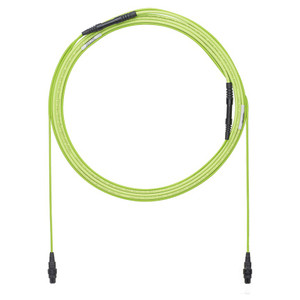
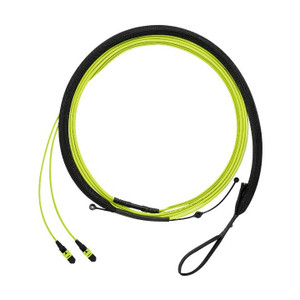
Panduit FWUYL7575LAM066 OM5 24-Fiber Trunk Cable Assembly
The Panduit FWUYL7575LAM066 is an OM5 wideband multimode trunk cable assembly engineered for high-density data center deployments requiring ultra-low insertion loss and future-ready bandwidth capacity. This 66-meter (216.54 ft) pre-terminated trunk features 24 fibers in a low-smoke zero-halogen (LSZH) jacket, PanMPO female connectors on both ends, HD Flex transition construction, Method B polarity, and a factory-installed pulling eye for rapid installation in vertical risers and horizontal pathways. QuickNet assemblies deliver plug-and-play connectivity for 40GBASE-SR4, 100GBASE-SR4, 200G, and 400G Ethernet backbones while using 30-40% less pathway space than traditional trunk designs.
Key Features
- OM5 wideband multimode fiber rated for 40/100/200/400G Ethernet applications
- 24 fibers (12 duplex channels) in compact trunk design using 30-40% less space
- PanMPO female to PanMPO female connectors with Method B polarity mapping
- Ultra insertion loss performance for extended reach and margin optimization
- LSZH jacket meets plenum and riser flammability requirements
- HD Flex transition construction for tight-radius routing and cabinet entry
- Factory-installed pulling eye on one end simplifies vertical riser installation
- 66-meter length spans typical floor-to-floor data center runs
- Lime jacket color for instant OM5 identification per TIA-598-D
- Pre-tested and certified at the factory, ships ready to deploy
OM5 Wideband Multimode: Future-Proofing 400G and Beyond
OM5 fiber introduces wideband multimode optimization across 850nm and 953nm wavelengths, a critical advancement for shortwave wavelength-division multiplexing (SWDM) architectures that power 200G and 400G Ethernet over multimode infrastructure. Where OM4 fiber supports 100GBASE-SR4 to 100 meters using parallel optics (4 × 25G lanes), OM5 extends that reach to 400 meters for the same application while simultaneously enabling 200GBASE-SR4 and 400GBASE-SR4.1 over distances up to 150 meters and 100 meters respectively using SWDM technology. This trunk assembly leverages OM5's 50-micron core diameter and wideband optimization to deliver effective modal bandwidth of 4700 MHz·km at 953nm, ensuring headroom for next-generation 800G optics and laser-optimized transmission schemes.
The FWUYL7575LAM066's ultra insertion loss specification means each connector interface is tested and guaranteed to stay well below the 0.35 dB maximum insertion loss ceiling defined by TIA-568-C.3, with typical performance in the 0.15-0.25 dB range. For a 24-fiber trunk with two MTP connectors (one on each end), total end-to-end insertion loss typically measures 0.30-0.50 dB across all 24 fibers—critical margin preservation for 66-meter runs linking equipment rooms, meet-me rooms, or top-of-rack switches across multiple data center zones. This performance level is achieved through precision-polished ferrule endfaces, factory-aligned fiber geometry, and Panduit's controlled manufacturing process that eliminates field termination variables. When you're engineering a 40G or 100G spine-leaf fabric where every 0.1 dB matters for BER (bit error rate) performance and optics power budget, ultra-low-loss trunks like this assembly become the foundation of a reliable physical layer.
PanMPO connectors are Panduit's implementation of the multifiber push-on standard (also known as MTP in generic industry terminology), featuring a rectangular ferrule that houses 12 fibers in a single row with 250-micron center-to-center spacing. The female-to-female configuration on this trunk assembly means both ends present the guide pin holes (no guide pins installed), allowing direct connection to MTP/MPO-equipped transceivers, cassettes, or patch panels that provide the male pinned interfaces. Method B polarity mapping—the dominant standard for parallel optics deployments—reverses fiber positions end-to-end so that position 1 on one end maps to position 12 on the far end, position 2 maps to 11, and so on. This key-flip architecture allows you to run straight-through trunk cables between cassettes or panels configured with identical pinouts (both Type A or both Type B) and maintain correct transmit-to-receive pairing across all duplex channels.
High-Density Deployment and Installation Efficiency
Data center pathway congestion is a recurring bottleneck in hyperscale and enterprise environments where rack density climbs above 10 kW per cabinet and optics port counts exceed 200 per switch. Traditional LC duplex patch cords consume roughly 6mm of horizontal width per duplex connection; at 100 ports, you're managing 100 individual cables occupying 600mm of cable tray cross-section plus the bend radius penalties. The FWUYL7575LAM066 consolidates 12 duplex links (24 fibers) into a single trunk assembly with an overall diameter significantly smaller than the equivalent bundle of 12 LC duplex cables. Panduit's HD Flex construction achieves approximately 30-40% space savings in cable pathways, vertical managers, and overhead ladder rack compared to conventional designs, directly translating to improved airflow, reduced installation labor, and preserved pathway capacity for future growth.
The trunk's LSZH jacket formulation meets low-smoke zero-halogen flammability requirements per IEC 60332-3-24 and is suitable for plenum and riser installations where toxic smoke generation and corrosive halogen byproducts are unacceptable risks. In European and Asia-Pacific data centers governed by IEC and ISO standards, LSZH is often a mandatory specification; in North America, it's increasingly specified for mission-critical facilities and colocation providers pursuing LEED, Uptime Institute Tier III/IV, or BICSI DCDC credentials. The lime green jacket provides instant visual identification of OM5 fiber per TIA-598-D color coding, eliminating the risk of accidentally patching OM3 (aqua) or OM4 (aqua/erika violet) trunks into OM5-optimized links and inadvertently reducing reach or bandwidth capacity.
The factory-installed pulling eye on one end is a field-installation accelerator for vertical riser runs and overhead cable tray deployments. Rather than fashioning a makeshift pull-rope attachment or risking connector damage during a long pull, installers attach the pull line directly to the integrated eye, route the trunk through conduit or J-hooks, and retrieve the opposite end at the destination without exposing connectors to abrasion or lateral stress. For a 66-meter trunk spanning four floors in a colocation facility or connecting a main distribution frame to an intermediate distribution frame three zones away, this single detail can cut installation time by 20-30 minutes per trunk and virtually eliminate the risk of connector endface contamination during the pull. Once in place, the trunk's HD Flex design allows routing through tight 90-degree turns in vertical managers and cabinet entry points without exceeding the 10× cable diameter minimum bend radius that can induce macrobending loss or fiber stress.
Standards Compliance and Application Fit
This trunk assembly is tested and certified to meet or exceed ISO/IEC 11801 (generic cabling for customer premises), TIA-568-C.3 (optical fiber cabling components), TIA-604-5 (FOCIS-5 fiber optic connector intermateability standard for MPO connectors), and TIA-492-AAAD (OM5 fiber performance specifications). It's also compliant with IEC 60793-2-10 type A1a.3 (50/125 µm multimode fiber) and RoHS directives restricting hazardous substances in electrical and electronic equipment. These certifications aren't checkbox exercises—they're the validation that this trunk will interoperate with standards-compliant transceivers from Cisco, Arista, Juniper, Mellanox, Intel, and Broadcom, maintain performance across the rated temperature range (-10°C to +60°C typical for LSZH assemblies), and survive the 1.5 N insertion/withdrawal cycles and 500-mating durability tests that define field serviceability.
For network architects designing leaf-spine fabrics in enterprise data centers, this trunk is the backbone link between leaf switches at top-of-rack and spine switches in the end-of-row or middle-of-row position. A single FWUYL7575LAM066 can carry 12× 40GBASE-SR4 links (480 Gbps aggregate if you're running 12 QSFP+ transceivers) or 3× 100GBASE-SR4 links (300 Gbps aggregate with QSFP28 modules) or 1× 400GBASE-SR4.1 link (400 Gbps with QSFP-DD or OSFP optics, depending on lane count and SWDM support). For storage area network (SAN) deployments running 32G Fibre Channel, the trunk supports 12 duplex FC links using MPO-to-LC breakout cassettes at each end. In hyperscale or colocation environments where you're interconnecting modular switch chassis or blade server enclosures with centralized SAN storage, this 66-meter reach handles typical floor-to-floor or row-to-row distances without requiring mode-conditioning patch cords, fiber repeaters, or optics upgrades. It's pre-tested, pre-terminated, and pre-labeled at the factory, so your deployment timeline compresses from hours of field termination work to rapid plug-and-verify installation that gets your backbone links operational the same day.