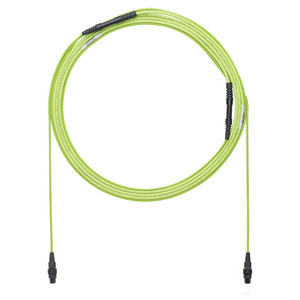
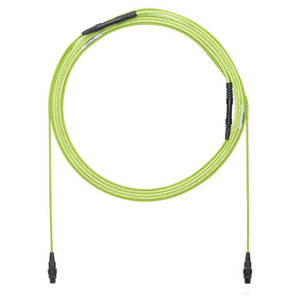
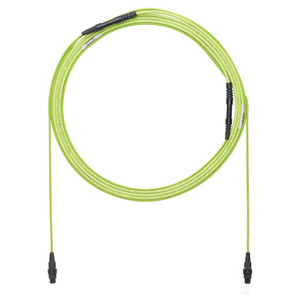
Panduit FWTYL7575LAM037 OM5 12-Fiber PanMPO Trunk Cable Assembly
The Panduit FWTYL7575LAM037 is a 37-meter OM5 trunk cable assembly engineered for high-density data center deployments requiring extended reach and rapid infrastructure scalability. Built on OM5 wideband multimode fiber (50µm core), this 12-fiber trunk supports short-wave wavelength-division multiplexing (SWDM) up to 400 Gbps over extended distances—critical for leaf-spine architectures and storage-area-network consolidation where traditional OM3 and OM4 reach limits become deployment bottlenecks. The assembly features PanMPO female connectors on both ends with HD Flex transition bodies, Method B polarity (direct key-up to key-up connectivity), and Ultra Insertion Loss grades to minimize signal degradation across multi-tier switch fabrics. Low Smoke Zero Halogen (LSZH) jacketing meets plenum and international fire-safety standards for enclosed spaces. Factory-terminated with integrated pulling eye on one end, this trunk eliminates field-termination variability and accelerates deployment in congested pathways where every dB of headroom and every cubic inch of conduit capacity matters.
Key Features
- OM5 Wideband Multimode Fiber: 50µm core optimized for 850nm–950nm SWDM transmission, enabling 400GBASE-SR4.2 up to 400m and future 800G applications over installed infrastructure
- Ultra Insertion Loss Grade: Factory-polished endfaces and precision-aligned ferrules deliver ≤0.15 dB per mated pair, preserving link budget for multi-hop topologies and 40G/100G/400G optics with tight loss allocations
- HD Flex Transition: High-density MPO boot geometry reduces bend radius and cable pathway congestion by 30–40% versus standard MPO assemblies, critical for 1U switch breakout panels and zero-U vertical cable managers
- Method B Polarity: Key-up to key-up (Type B) configuration supports direct trunk-to-trunk connections in base-8 structured cabling without crossover adapters or polarity-flipping cassettes—simplifies design and reduces failure points
- LSZH Jacket: Low Smoke Zero Halogen outer jacket meets IEC 60332-1, IEC 60754-1/2, and IEC 61034 for reduced toxicity and smoke generation during fire events—required for European data centers and enclosed equipment rooms
- Integrated Pulling Eye: Factory-installed pulling eye on one end (37m length) enables safe installation through conduit, ladder rack, and overhead cable tray without stressing MPO connectors or fiber cores during pull operations
- Lime Green Identification: OM5-standard lime jacket color provides instant visual differentiation from OM3 (aqua) and OM4 (eero/violet) infrastructure, reducing cross-connection errors during MACs and emergency troubleshooting
- QuickNet™ System Integration: Part of Panduit's QuickNet pre-terminated ecosystem—pairs with PanMPO-to-LC breakout cassettes, HD switch modules, and Zone 4 enclosures for end-to-end polarity-tested assemblies
OM5 fiber represents the evolutionary step beyond OM4 for data centers planning 400 Gigabit Ethernet and 800GbE migrations without forklift upgrades to single-mode infrastructure. While OM4 supports 400GBASE-SR8 to 100 meters (adequate for row-to-row connectivity), OM5's wideband performance extends 400G reach to 400 meters using short-wave wavelength-division multiplexing across four wavelengths (850nm, 880nm, 910nm, 950nm). This reach advantage eliminates the need for costly middle-mile single-mode links in many spine-to-spine and storage-cluster topologies. The 50-micron core diameter maintains backward compatibility with existing OM3/OM4 transmission equipment while future-proofing the physical layer for next-generation 800G and 1.6T BiDi optics expected to leverage SWDM modulation. For hyperscale operators and enterprise IT teams managing 5–10 year cable plant lifecycles, OM5 provides measurable insurance against stranded multimode investments as optics roadmaps shift toward higher lane counts and spectral efficiency.
The HD Flex transition design solves a persistent problem in high-density leaf-spine fabrics: congestion at the patch panel and switch faceplate. Standard MPO boots often measure 15–18mm width, consuming excessive horizontal space when 24 or 48 trunk ports populate a single 1U panel. Panduit's HD Flex geometry reduces boot width to approximately 11mm, enabling tighter port pitch and reducing the likelihood of accidental cable snags during adjacent MACs. This dimensional advantage compounds in zero-U vertical managers and overhead runway installations where cable-bend radius and pathway fill ratio directly determine whether a new switch tier can be added without re-cabling. The 37-meter length of this assembly is specifically chosen for intra-row and cross-aisle runs in ANSI/TIA-942-compliant data centers with central meet-me-room architectures—long enough to reach distribution areas two rows away, short enough to avoid excessive slack loops and loss accumulation. The Ultra Insertion Loss grade (typically ≤0.12 dB measured, ≤0.15 dB max) is factory-verified via automated interferometric inspection, ensuring every fiber pair meets the tightest allocations in 400GBASE-SR8 and 400GBASE-SR4.2 link budgets where total channel loss cannot exceed 1.5–1.9 dB depending on optics vendor.
Method B polarity (straight-through key-up to key-up) is the industry-standard configuration for base-8 and base-12 duplex LC breakout systems. In a typical deployment, this trunk connects a switch-side PanMPO port directly to a Zone 4 enclosure or wall-mount cassette without intermediate polarity adapters. Inside the cassette, a Method B or universal-polarity module converts the 12-fiber MPO into six duplex LC ports (transmit on fibers 1-6, receive on fibers 7-12), which then connect to server NICs or storage controllers via standard duplex LC patch cords. This architecture eliminates the A-to-B or B-to-A crossover dongles that plagued early MPO deployments, reducing per-link component count and troubleshooting complexity. For installations that must support legacy Method A (key-up to key-down) equipment, Panduit offers Type AF adapter modules, but modern 40G/100G/400G switches from Arista, Cisco, Juniper, and Mellanox have standardized on Method B, making this the correct default choice for new builds and refresh projects.
LSZH jacketing is mandated in many international markets (EU, APAC) and increasingly specified in North American colocation and enterprise facilities where enclosed equipment rooms lack independent ventilation. During a fire event, PVC-jacketed cables release hydrochloric acid gas and dense black smoke that obscures egress paths and corrodes electronics. LSZH compounds eliminate halogenated polymers, reducing toxicity and smoke opacity per IEC 61034 (≥60% light transmittance). While LSZH jackets have slightly lower abrasion resistance than PVC, the QuickNet trunk's factory-terminated design and pulling-eye installation method protect the jacket from the scraping and compression forces that typically cause field damage. The LSZH rating does not compromise fiber performance—internal tight-buffered 900µm subunits and aramid strength members maintain the same 1.6mm bend radius and 220N tensile load rating as plenum-rated versions. For U.S. deployments, verify local AHJ interpretation: some jurisdictions accept LSZH as a plenum substitute under NFPA 70 Article 770, while others require explicit UL 910 (OFNP) listing for air-handling spaces.
This 37-meter trunk is designed for Panduit QuickNet cassette-based architectures in TIA-942 Rated-3 and Rated-4 data centers, connecting spine switches in main distribution areas to leaf switches in end-of-row or middle-of-row configurations. It pairs with Panduit FQTAP or FQSPP cassettes (8-fiber or 12-fiber breakout modules), PanMPO adapter panels, and Zone 4 pre-connectorized enclosures. The assembly ships with factory test reports documenting per-fiber insertion loss, return loss, and endface geometry per IEC 61300-3-35, providing serialized traceability for change-management databases and as-built documentation. Pulling eye orientation is marked on the cable jacket; always pull from the eye end to avoid connector damage during installation. Meets or exceeds TIA-568-C.3, ISO/IEC 11801, TIA-492-AAAD (OM5 fiber specs), and TIA-604-5 (FOCIS-5 MPO connector interface). RoHS compliant. Backed by Panduit's Manufacturer Warranty covering materials and factory workmanship.