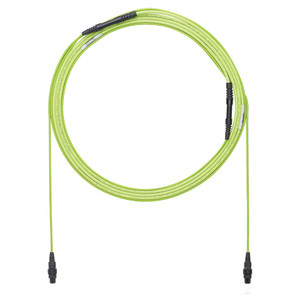
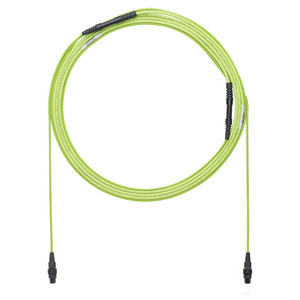
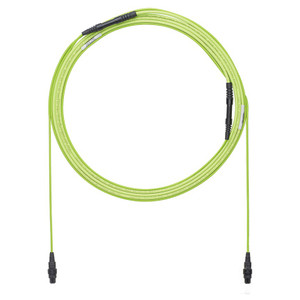
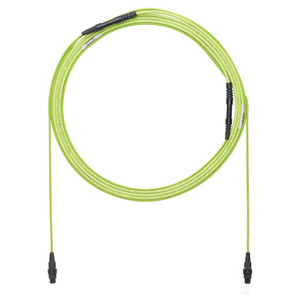
Panduit FWTYL7575KAM048 OM5 QuickNet 12-Fiber Trunk Cable Assembly
Panduit's FWTYL7575KAM048 delivers a factory-terminated 12-fiber OM5 trunk cable engineered for high-density data center backbone deployments where 40/100 Gigabit Ethernet links require extended reach and installation speed is critical. This 48-meter (157.5 ft) assembly terminates in PanMPO female connectors on both ends with Method A polarity, HD Flex low-profile cable construction, and LSZH jacketing for fire-code compliance in enclosed pathways. The integrated pulling eye simplifies long-distance conduit runs, while the ultra insertion loss rating ensures margin for multi-span links in structured cabling infrastructures.
Key Features
- OM5 wideband multimode fiber (50 µm core, 4700 MHz·km effective modal bandwidth) supports 40GBASE-SR4, 100GBASE-SR4, and future 200G/400G short-wavelength division multiplexing (SWDM) applications
- Factory-terminated PanMPO female-to-female connectors with Method A polarity eliminate field termination labor and ensure tested, guaranteed performance out of the box
- HD Flex cable design uses 30-40% less pathway space than traditional trunk assemblies—critical for high-density overhead tray and vertical riser installations
- Low Smoke Zero Halogen (LSZH) jacket meets IEC 60332-1 and IEC 61034 fire safety standards for indoor data centers, telecommunications rooms, and plenum-equivalent spaces
- Ultra insertion loss specification (typically ≤0.35 dB per mated pair) maximizes link budget for multi-tier architectures and long campus backbone runs
- Integrated pulling eye on one end enables efficient installation through conduit and cable tray without damage to connectors or fiber cores
- Lime green cable jacket provides instant visual identification of OM5 infrastructure per TIA-598-D color coding standards
- QuickNet factory testing includes insertion loss, return loss, and polarity verification with serialized test reports available for documentation and compliance
OM5 fiber represents the current generation of wideband multimode technology, extending usable reach for 40G and 100G Ethernet while preparing the infrastructure for SWDM-based 200G and 400G deployments without re-cabling. Where OM3 supports 100GBASE-SR4 to 70 meters and OM4 extends that to 100 meters, OM5's wideband optimization across the 850-950 nm spectrum pushes 100G links to 150 meters—enough to span most intra-building backbones without intermediate distribution points or costly singlemode conversions. For 40GBASE-SR4, this assembly supports the full 400-meter IEEE 802.3ba reach specification when deployed in compliant structured cabling channels, making it suitable for campus backbone links between buildings or multi-floor riser applications in mid-rise and high-rise facilities. The 50-micron core diameter maintains full backward compatibility with existing OM3/OM4 test equipment, cleaning procedures, and connector inspection tools, while the lime jacket color prevents accidental cross-connection with legacy fiber types during adds, moves, and changes. PanMPO connectors—Panduit's implementation of the MPO multi-fiber push-on interface standardized in TIA-604-5 (FOCIS-5)—pack 12 fibers into a form factor smaller than four duplex LC connectors, making them the de facto standard for 40G and 100G parallel optics in spine-leaf fabrics, hyper-converged infrastructure, and storage area network extensions. Method A polarity (straight-through key-up to key-up on both ends) pairs directly with 40G and 100G transceiver modules, breakout cassettes, and patch panels designed for collapsed-core and leaf-spine data center topologies without requiring polarity-reversing crossover assemblies. The ultra insertion loss rating—typically ≤0.35 dB per mated connector pair versus the 0.75 dB industry maximum specified in TIA-568-C.3—preserves 0.4 dB of link budget margin per connection point, enough to accommodate an additional cleaning cycle, future connector re-mate, or unplanned splice point without exceeding the 1.5 dB total channel loss budget mandated by IEEE 802.3ba for 100-meter 100GBASE-SR4 links or the 1.9 dB budget for 400-meter 40GBASE-SR4 deployments.
Pre-terminated trunk assemblies eliminate the three largest variables in field fiber deployment: termination time, termination quality, and pathway congestion. Where on-site fusion splicing or mechanical termination of a 12-fiber cable requires 2-4 hours of clean-room environmental controls, specialized fusion or polishing tooling, OTDR certification sweeps, and skilled labor at $85-150/hour, this QuickNet assembly installs in under 10 minutes with a simple alcohol-wipe connector cleaning procedure and push-on mating operation—no epoxy, no curing time, no polishing jigs, and no expensive test equipment required for basic bring-up. Factory testing guarantees every fiber meets Panduit's insertion loss and return loss specifications before the assembly ships, backed by serialized test data that satisfies TIA-526-14-B Tier 1 end-to-end loss verification requirements without field OTDR characterization (though Tier 2 certification with full bidirectional OTDR traces remains available for mission-critical links). The HD Flex cable construction reduces outer diameter by 30-40% compared to traditional tight-buffered distribution-style 12-fiber trunk cables—a difference that translates directly to conduit fill-ratio compliance in congested overhead cable tray and vertical riser pathways where NEC Article 770 and TIA-569 standards limit cable fill to 40-50% of cross-sectional area to maintain airflow, support cable weight without deformation, and reserve capacity for future growth. In a 4-inch cable tray with 12.6 square inches of usable area and a 50% fill limit (6.3 sq in), switching from standard 0.45-inch OD trunk cables to HD Flex 0.28-inch assemblies increases capacity from 40 trunks to 102 trunks—a 2.5× density improvement that defers costly pathway expansion projects in built-out data centers. The LSZH jacket formulation meets IEC 60332-1 vertical flame propagation limits (≤50 cm char height) and IEC 61034 smoke density limits (≥60% light transmittance), making this assembly code-compliant for installation in return-air plenums, under raised floors, above drop ceilings, and in enclosed telecommunications rooms where PVC combustion products would violate NFPA 90A life-safety requirements or international building codes in EMEA and APAC regions. At 48 meters, this assembly length suits typical backbone applications including floor-to-floor vertical riser runs in 12-15 story buildings (assuming 10-foot inter-floor heights plus 6-8 feet of slack for termination and service loops), horizontal backbone links between main distribution areas (MDAs) and intermediate distribution frames (IDFs) on opposite ends of 120-150 foot floorplates, and short campus backbone duct runs between adjacent buildings in multi-structure data center or corporate campuses.
The integrated pulling eye—a reinforced stainless-steel loop mechanically attached to the cable's aramid strength member and potted into the jacket at the factory—allows installation crews to attach standard pull-tape, braided rope, or fish-wire for long conduit pulls without transferring tensile stress to the MPO connector bodies, internal fiber ribbons, or individual glass cores. This feature is frequently omitted on competitor trunk assemblies, forcing field techs to resort to electrical-tape wraps around the connector boot (risking jacket tears, moisture intrusion, and warranty voidance) or dangerously over-tensioning the cable during pulls, which can cause microbending losses that won't appear on basic insertion-loss tests but degrade bit-error rates under traffic load. Compliance with TIA-568-C.3 (backbone cabling), TIA-568-C.1 (commercial building telecommunications cabling), ISO/IEC 11801 (generic cabling for customer premises), TIA-492-AAAD (OM5 fiber optical and mechanical performance), IEC 60793-2-10 type A1a.3 (multimode graded-index fiber category), and RoHS material restrictions ensures this trunk integrates into standards-based structured cabling systems with full vendor-neutral interoperability across Panduit, Corning, CommScope, and third-party passive optical components. Panduit's QuickNet ecosystem includes matching fanout breakout modules, pre-terminated fiber cassettes, MPO-to-LC transition enclosures, and angled-polish adapter panels that share the same Method A polarity scheme and ultra-low-loss performance tier, allowing you to design a complete three-tier backbone-to-horizontal architecture (MDA to IDF to equipment distribution area) from a single product family with guaranteed end-to-end 40G/100G readiness and elimination of field polarity troubleshooting. For network engineers deploying 100G Ethernet leaf-spine fabrics in hyper-converged server clusters, storage architects extending 32G Fibre Channel SAN fabrics between primary and DR computer rooms, or structured cabling contractors building out multi-tenant colocation data halls with future-ready infrastructure for 200G and 400G tenant requirements, this assembly delivers the reach, density, installation speed, and tested reliability that separates a two-day plug-and-play backbone deployment from a two-week field-termination schedule with unpredictable performance outcomes and change-order risk.