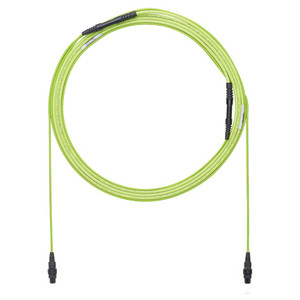
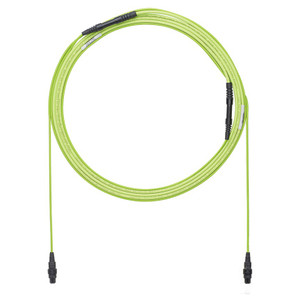
Panduit FWTYL7575KNM050 OM5 Wideband Multimode 12-Fiber Trunk Cable Assembly
The Panduit FWTYL7575KNM050 is a 50-meter OM5 wideband multimode fiber trunk cable assembly engineered for high-density data center environments where pathway space is constrained and future bandwidth scalability is non-negotiable. This 12-fiber trunk features dual PanMPO female connectors with Method A polarity, HD Flex small-diameter cable construction, and Ultra insertion loss performance that extends your power budget on 40G/100G links while preserving headroom for bidirectional SWDM transmission at four wavelengths. The Low Smoke Zero Halogen jacket meets international fire safety standards for occupied spaces and above-ceiling pathways without requiring metallic conduit in many jurisdictions. Panduit's QuickNet system delivers factory-terminated reliability that eliminates field splicing labor and the insertion-loss variability that comes with it—critical when you're designing to IEEE 802.3bm loss budgets or planning OM5's 400G-SR4.2 roadmap on existing 50µm infrastructure.
Key Features
- OM5 wideband multimode fiber supports four-wavelength SWDM (850/880/910/940nm) for 4× bandwidth capacity vs. OM4 on the same 12-fiber count—future-proofs 100G-to-400G migration without re-cabling
- HD Flex small-diameter trunk construction uses 30–40% less conduit fill than conventional fan-out designs, preserving pathway capacity for adds and changes in dense MDA/HDA deployments
- Ultra insertion loss grade delivers <0.15dB typical per mated connector pair, extending 100GBASE-SR4 reach beyond 100m and providing margin for additional interconnects or future transceiver generations
- PanMPO female-to-female connectors with Method A polarity map directly to duplex LC breakouts for spine-leaf topologies without external crossover modules or polarity-inversion labor
- Low Smoke Zero Halogen jacket complies with IEC 60754-1/-2 and produces <0.5% HCl under combustion—meets NFPA 90A plenum-equivalent performance in many international building codes without metallic raceway
- Factory-terminated and 100% insertion-loss tested at Panduit's ISO 9001 manufacturing facility—eliminates field splicing variables and provides serialized test reports for TIA-568 installation documentation
- 50-meter length suits intra-row, row-to-EOR, and EOR-to-MDA connectivity in modular data center designs where structured pathways exceed 30m but stay under OM5's 150m 100G limit
- Lime-green cable jacket provides instant visual identification of OM5 media per TIA-598-D color code, preventing cross-connection errors with OM3/OM4 infrastructure during MAC operations
- RoHS-compliant construction with halogen-free materials meets EU and California environmental regulations for equipment disposal and material declaration reporting
- Pull-proof boot strain relief and staggered latch design on PanMPO connectors withstand 100+ insertion cycles and prevent accidental disconnects in vertical cable-management arms or high-vibration transport applications
OM5 wideband multimode fiber represents the most significant advance in premises optical technology since OM4's introduction in 2009. While OM3 and OM4 fibers are optimized for single-wavelength 850nm transmission, OM5 extends the effective modal bandwidth window across four distinct wavelengths—850nm, 880nm, 910nm, and 940nm—enabling short-wavelength division multiplexing within the same 50µm core. This capability matters because 400GBASE-SR4.2 and emerging 800G standards leverage SWDM to achieve higher aggregate rates without increasing fiber count: a single OM5 duplex pair can carry what previously required four OM4 pairs. For integrators designing spine-leaf fabrics in containerized data centers or modular edge sites, this translates to fewer trunk cables between distribution areas, reduced MTP cassette counts in patching fields, and dramatically lower conduit fill when pathway infrastructure is fixed at construction time. The FWTYL7575KNM050's 12-fiber configuration supports six duplex 100G links today, three duplex 400G links with breakout modules tomorrow, or a hybrid mix as your network evolves—all on the same physical cable you install this year. Panduit's OM5 fiber meets TIA-492-AAAD and IEC 60793-2-10 Type A1a.3 specifications with >2000MHz·km effective modal bandwidth at all four SWDM wavelengths, ensuring compliance headroom even as transceiver technology pushes toward higher modulation rates.
The HD Flex cable construction in this trunk assembly is purpose-built for the pathway congestion challenges that define modern hyperscale and colocation environments. Traditional round-jacketed trunk cables create approximately 40% void space when bundled in cable trays or ladder rack—wasted cross-sectional area that counts against NEC Chapter 3 conduit fill limits and BICSI pathway loading guidelines. Panduit's small-diameter approach uses a flexible central strength member and tight-buffered fiber arrangement that achieves a 6.8mm overall diameter for this 12-fiber trunk, compared to 10–12mm for equivalent fan-out designs. That size reduction compounds across every cable in your horizontal pathways: a 4-inch cable tray that maxes out at 18 conventional trunks can accommodate 28–30 HD Flex assemblies at the same 50% fill ratio, preserving capacity for the adds-and-changes that inevitably follow initial deployment. The flexible jacket also simplifies routing through tight-radius vertical cable managers and zero-U pass-throughs in 42U racks—you can achieve the 30mm bend radius required by TIA-568 without the spring-back force that causes conventional cables to pop out of retaining clips or obstruct airflow in hot-aisle containment systems. For integrators working in retrofits where existing conduit or overhead tray is already 60–70% full, switching to HD Flex trunk cables often eliminates the need for costly pathway expansion or secondary route installation.
Method A polarity is the TIA-568-C.0 standard for duplex connectivity in array-to-array applications, and it's the configuration you need when using MTP-to-LC breakout cassettes in structured fiber patching fields. In a Method A trunk, fiber position 1 on the near-end connector maps to position 1 on the far-end connector—a straight-through physical arrangement. When you terminate this FWTYL7575KNM050 trunk into a pair of Method A cassettes (Panduit FAP or equivalent), the internal crossover in each cassette maps the array to duplex LC ports with automatic transmit-receive reversal: switch port 1 TX goes to server port 1 RX, and vice versa. This approach eliminates the need for polarity-inversion keyways, external crossover modules, or field re-termination—technicians simply plug LC duplex patch cords straight from cassette to equipment, and the link works on first insertion. The alternative, Method B, requires a physical crossover in the trunk itself (fiber 1-to-12, 2-to-11, etc.) and causes endless trouble when cassettes are swapped or modules are redeployed between projects. If you're building a greenfield data center or standardizing on a single cassette type across multiple sites, Method A with straight-through trunks is the only configuration that scales without constant polarity troubleshooting. The FWTYL7575KNM050 ships with clearly marked "A-side" and "B-side" connector boots to prevent reversal during installation, and the lime-green jacket includes sequential meter markings every 1m for precise documentation in cable-management databases.
Ultra insertion loss performance is a factory grade designation that Panduit applies to trunk assemblies tested to <0.15dB average insertion loss per mated connector pair, compared to the 0.35dB maximum allowed by TIA-568-C.3 and the 0.25dB typical grade that many manufacturers ship as standard. That 0.10–0.20dB difference per connection point becomes significant when you're designing multi-tier structured cabling with several interconnects between active equipment, or when you're planning for transceiver aging and fiber end-face contamination over a 10–15 year infrastructure lifespan. IEEE 100GBASE-SR4 allocates a 1.9dB loss budget for 100m OM4 links; after accounting for 0.75dB connector loss (2× connections at 0.35dB worst-case plus one mating adapter at 0.05dB) and 0.35dB for cable attenuation (100m × 3.5dB/km), you're left with just 0.80dB margin—barely enough for a single cleaning cycle or a dusty connector event. Deploy the same link with Ultra-grade 0.15dB connectors, and your total connector budget drops to 0.35dB (2× 0.15dB plus adapter), freeing up 1.15dB of margin. That headroom lets you add a mid-span interconnect for zone patching, extend the link to 120–130m for campus backbone applications, or accommodate the higher insertion loss that OM5 SWDM optics may introduce as 400G transceivers mature. Every Panduit QuickNet trunk ships with serialized insertion-loss and return-loss test data traceable to NIST-calibrated references, so you can populate your TIA-606-B cable-plant records with actual measured performance rather than relying on generic specification limits.
Low Smoke Zero Halogen cable construction is a fire-safety requirement in occupied buildings across Europe, Asia-Pacific, and increasingly in North American healthcare and transportation projects. When PVC or fluoropolymer jacketed cables burn, they release hydrochloric acid, hydrofluoric acid, and dense smoke that obscures egress routes and corrodes electronic equipment in adjacent spaces—a life-safety and business-continuity risk that building codes address by requiring plenum-rated cable in air-handling spaces or metallic conduit everywhere else. LSZH compounds eliminate halogenated polymers entirely, substituting mineral-filled thermoplastic elastomers that produce <0.5% hydrogen chloride gas per IEC 60754-1 and achieve <50% light transmission reduction per IEC 61034 smoke density testing. The result is a cable that self-extinguishes, emits minimal smoke, and leaves behind inert ash rather than corrosive residue. For data center operators, LSZH compliance often satisfies NFPA 75 and NFPA 76 fire-protection requirements without the cost and pathway complexity of continuous metallic conduit, and it's mandatory for submarine cable landing stations, mass-transit control rooms, and oil-and-gas offshore platforms where evacuation time is measured in minutes. The FWTYL7575KNM050's LSZH jacket is also UV-resistant and fungus-proof per MIL-STD-810, making it suitable for outside-plant runs in cable trays between building entrances and Meet-Me rooms where traditional indoor-rated cable would degrade under sunlight exposure.
The 50-meter length of this trunk assembly is optimized for intra-data-center connectivity patterns in modular and containerized designs. In a typical row-based architecture, server racks deploy in 8–12 cabinet rows with an end-of-row switch aggregating traffic to a central main distribution area. The physical distance from the last cabinet in a 45-foot row to the MDA can easily reach 30–40 meters after accounting for vertical rise to overhead tray, horizontal run to the MDA hot aisle, and vertical drop to the switch—well beyond the 30m reach of pre-terminated 100ft assemblies but far short of the 100m campus-backbone lengths that introduce unnecessary cable management bulk and cost. At 50 meters, the FWTYL7575KNM050 provides the reach you need for row-to-MDA or MDA-to-MDA ties in adjacent pods without the service loop waste that comes from over-provisioning. The lime-green OM5 jacket includes printed sequential meter marks and a serialized part number label at each end, so you can document exact installed length in DCIM software and calculate remaining pathway capacity for future cables. For integrators managing MAC-heavy colocation environments where cabinet shuffles and customer churn are constant, having five or six standard trunk lengths in inventory (15m, 30m, 50m, 75m, 100m) eliminates the lead-time and minimum-order-quantity friction of custom lengths while keeping service loops under the 3-meter maximum recommended by BICSI for structured fiber installations.
Factory termination and testing eliminate the two largest variables in field-installed fiber performance: connector end-face geometry and cleanliness. Panduit's QuickNet manufacturing process polishes each ferrule to sub-50nm surface finish using automated lapping stations with closed-loop interferometric feedback, then inspects every fiber core for scratches, pits, and contamination using high-magnification machine vision before final assembly. The result is IEC 61755-3-31 Grade B end-face geometry—less than 50nm apex offset and less than 150nm fiber undercut—across all 24 ferrule positions in this 12-fiber trunk. That consistency is impossible to achieve in the field, where hand-polishing technique varies by technician, contamination sources are everywhere, and inspection is often skipped under schedule pressure. Each FWTYL7575KNM050 assembly ships with a serialized test report documenting insertion loss and return loss at 850nm and 1300nm for every fiber pair, traceable to the manufacturing date and shift for quality-control purposes. When you're commissioning a Tier III or Tier IV data center where uptime SLAs leave no room for fiber-cleaning truck rolls or late-discovery polarity errors, factory-terminated trunks are the only approach that delivers zero-defect installation. The PanMPO connectors on this assembly also feature Panduit's push-pull latch design with staggered release points, preventing the simultaneous-release accidents that plague slide-latch MPO connectors in vertical cable managers—one technician bumping a bundle can disconnect an entire switch uplink if the latch geometry isn't pull-proof.
This Panduit FWTYL7575KNM050 trunk integrates seamlessly with the broader QuickNet pre-terminated fiber system, including FAP cassette modules, FQP HD panels, and FRME rotating media enclosures. When you're designing structured fiber patching fields for cloud-scale deployments, the interoperability between trunk cables, cassettes, and panels determines how quickly you can adapt to topology changes or scale from 10G-to-100G without forklift upgrades. Method A polarity standardization across the entire QuickNet portfolio means you can mix 12-fiber, 24-fiber, and 72-fiber trunks in the same installation, swap cassette modules between panels as port density requirements shift, and maintain duplex LC interfaces at the equipment connection points—eliminating the adapter compatibility matrices and polarity conversion charts that plague multi-vendor fiber deployments. The LSZH jacket and RoHS-compliant materials also ensure compliance with the EU Restriction of Hazardous Substances Directive and California Proposition 65, simplifying the material declaration reporting that hyperscale operators require for sustainable procurement audits and end-of-life recycling programs.