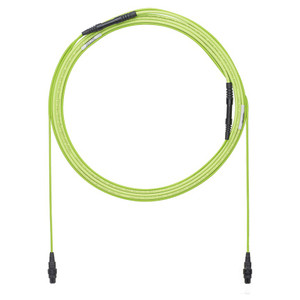
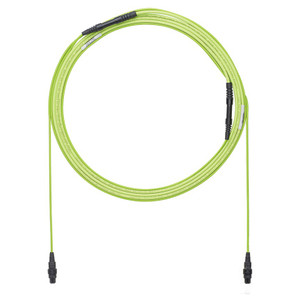
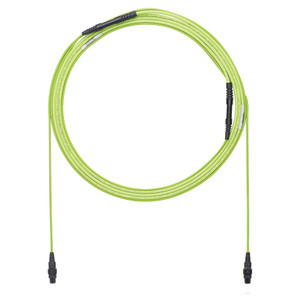
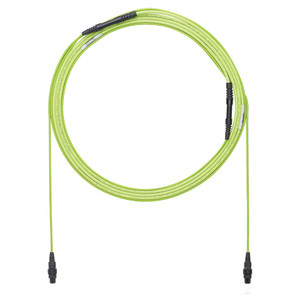
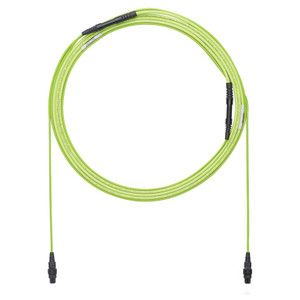
Panduit FWTYL7575LAM058 OM5 12-Fiber Trunk Cable Assembly
The Panduit FWTYL7575LAM058 is a factory-terminated 12-fiber OM5 trunk cable assembly engineered for high-density data center deployments requiring extended reach and rapid infrastructure scaling. This 58-meter (190.29 ft) QuickNet™ trunk features PanMPO female connectors on both ends, HD Flex small-diameter construction, Method B polarity, and ultra insertion loss performance. The low smoke zero halogen (LSZH) jacket meets fire safety codes for plenum-equivalent or enclosed-space installations, while the lime-green OM5 SigCore fiber supports both legacy 10G/40G Ethernet and future 100G/400G applications over extended distances—reducing the need for costly infrastructure replacements as network speeds increase.
Key Features
- OM5 wideband multimode fiber (50μm core) optimized for short-wave division multiplexing (SWDM) — supports 100GBASE-SR4 to 150m and 400GBASE-SR8 applications
- 12-fiber trunk with PanMPO female to PanMPO female connectors — enables single-connection 40G/100G links or breakout to six duplex LC channels
- 58-meter (190.29 ft) length — bridges cross-connect to end-of-row switches or spans multiple equipment rows in large data centers
- HD Flex small-diameter construction — uses 30–40% less pathway space than standard trunk cables, critical for congested overhead trays and under-floor routing
- Method B polarity (key-up to key-down) — straight-through pinout for standards-compliant duplex channel mapping when used with Method B cassettes or breakout modules
- Ultra insertion loss specification — tighter loss budget than standard grade ensures margin for future optics or additional splice points
- Low Smoke Zero Halogen (LSZH) jacket — IEC 60332 and IEC 61034 compliant for installations requiring reduced toxic gas and smoke generation during fire events
- Pulling eye on one end — simplifies installation through long conduit runs or congested pathways without damaging connectors
- Factory-terminated and tested — eliminates field fusion splicing, reducing installation time from hours to minutes per trunk and removing variability in connector performance
- QuickNet™ platform — part of Panduit's integrated fiber system with matching cassettes, patch panels, and breakout modules for end-to-end design consistency
OM5 Fiber: Future-Proofing for 100G and Beyond
OM5 (ISO/IEC 11801 designation for wideband multimode fiber per TIA-492-AAAD) uses the same 50μm core and 850nm laser optimization as OM4, but adds a wider effective modal bandwidth across the 840–953nm spectrum. This enables short-wave division multiplexing (SWDM) — transmitting four or eight wavelengths simultaneously over a single fiber pair — which is the foundation for 100GBASE-SR4 BiDi (100m reach on a duplex link) and emerging 400GBASE-SR4.2 architectures. Unlike OM3 or OM4, which require parallel optics (eight or sixteen fibers for 100G/400G), OM5 can deliver the same throughput over fewer fibers when used with SWDM transceivers. In this 12-fiber trunk, that translates to support for one 40G/100G parallel link today, or potential future use as six duplex 100G BiDi channels when SWDM optics become cost-effective for your deployment. The 58-meter length fits within OM5's 100GBASE-SR4 reach of 150m and 40GBASE-SR4 reach of 400m, providing substantial margin for any cross-connect or equipment-room layout.
PanMPO Connectors and Method B Polarity
Panduit's PanMPO connectors use the industry-standard MPO ferrule (12-fiber array in a single-row MT ferrule per TIA-604-5 / IEC 61754-7) with physical-contact (PC) polish and precision alignment pins. The female-to-female configuration on this trunk is designed to mate with male PanMPO module ports on cassettes, patch panels, or switch transceivers — maintaining proper pin/socket engagement throughout the channel. Method B polarity reverses the fiber array end-to-end (fiber 1 on connector A maps to fiber 12 on connector B), which is the TIA-568-C.0 Annex A standard for duplex channels using array connectors. When this trunk is used with Method B cassettes (which internally cross fibers 1↔12, 2↔11, etc.) or broken out to duplex LC via Method B modules, the result is a straight-through A-to-B pinout at the duplex level — transmit on one end always hits receive on the other. The key-up to key-down orientation (visible as the physical key position on each connector body) enforces this polarity; installers cannot accidentally mate two key-up ends and reverse the channel. This eliminates the field guesswork and re-termination cycles common with loose-tube or field-terminated trunks.
HD Flex Construction for High-Density Routing
HD Flex trunk cables use a reduced-diameter jacket and tight-buffered fiber bundling to achieve 30–40% smaller cross-sectional area compared to Panduit's standard round trunk cables. For a 12-fiber trunk, this typically means an outer diameter under 6mm versus 8–9mm for traditional designs. In a 4-inch-wide overhead cable tray with a 50% fill-ratio limit (per NFPA 70 / NEC Article 300.17 and TIA-568 pathway guidelines), the smaller diameter translates to fitting significantly more trunks in the same space — critical when building out leaf-spine fabrics with dozens of parallel 40G or 100G links. The reduced diameter also improves bend-radius performance; the cable remains flexible enough to route through tight 90-degree turns in vertical cable managers or around equipment-rack corners without exceeding the 10× dynamic bend radius typical for tight-buffered multimode fiber. The lime-green OM5-coded jacket is retained for instant visual identification during adds/moves/changes, preventing accidental cross-patching with OM3 (aqua) or OM4 (erika violet) infrastructure.
Ultra Insertion Loss and Link Budget
Panduit's ultra insertion loss grade tightens the per-connector loss specification below the TIA-568-C.3 maximum of 0.75 dB for multimode MPO connectors. While the exact guaranteed maximum is provided on the factory test report included with each trunk, ultra-grade assemblies typically target ≤0.35 dB per mated connector pair at 850nm — less than half the standards allowance. For this 58-meter trunk, the total channel insertion loss (two connectors plus 58m of OM5 fiber at ~2.6 dB/km per TIA-492-AAAD) would be approximately 0.7 dB connector loss + 0.15 dB fiber loss = 0.85 dB end-to-end. A 100GBASE-SR4 link budget (typically 6.0–7.0 dB depending on transceiver grade) thus has over 6 dB of margin remaining — enough to accommodate two additional mated connector pairs (for example, a cross-connect cassette and a patch cord) and still remain within budget. This margin is critical in spine-leaf architectures where a channel may traverse a main cross-connect, intermediate distribution frame, and equipment patch panel before reaching the switch. Lower insertion loss also reduces heat dissipation in the fiber, minimizing modal noise and improving bit-error-rate performance at 25Gbps-per-lane signaling rates used in 100G optics.
LSZH Jacket: Fire Safety and Code Compliance
The low smoke zero halogen (LSZH) jacket formulation replaces PVC and halogenated flame retardants with mineral-filled polyolefin compounds that emit minimal smoke and no hydrochloric acid or other corrosive gases when exposed to fire. This trunk meets IEC 60332-1-2 (single vertical flame test), IEC 60332-3-24 (bundled cable vertical flame propagation), and IEC 61034 (smoke density ≤60% light obscuration), making it suitable for installations governed by European EN 50575 CPR (Construction Products Regulation) or international building codes requiring limited-smoke cables. In North American installations, LSZH cables are commonly specified for enclosed equipment rooms, under-floor plenums in retrofitted buildings (where pulling new plenum-rated conduit is cost-prohibitive), or any space where fire-evacuation routes pass through the cable pathway. Note that LSZH is distinct from plenum (CMP) rating under NEC Article 770; verify local AHJ interpretation if installing in a true return-air plenum. The LSZH jacket also offers better chemical resistance to cleaning agents and HVAC condensation compared to PVC, extending cable lifespan in data-center hot-aisle/cold-aisle environments.
Factory Termination and Quality Assurance
Each trunk is fusion-spliced to pre-polished PanMPO connectors in a controlled factory environment, then tested for insertion loss, return loss (≥20 dB typical for PC polish), and fiber-to-fiber continuity across all twelve fibers. The test results are serialized and included with the trunk; many integrators scan and archive these reports to satisfy ISO 9001 quality-management requirements or customer-mandated documentation. Factory termination eliminates the insertion-loss variability inherent in field fusion splicing — where environmental conditions (humidity, dust, technician skill level) can introduce 0.1–0.3 dB of uncertainty per splice point. It also removes the logistical burden of coordinating fusion-splicer rental, technician certification, and on-site cleanliness controls. For a 12-fiber trunk, field termination would require twelve individual fusion splices (plus re-splices for any failures) and a half-day of labor; the factory-terminated trunk installs in under five minutes. The pulling eye on one end is a reinforced loop integrated into the cable strength member, allowing installation crews to attach pull tape and route the trunk through 50+ meters of conduit without transferring tensile load to the fiber or connectors.
QuickNet™ System Integration
This trunk is part of Panduit's QuickNet™ pre-terminated fiber platform, which includes MTP/MPO cassettes (Method A, B, and C polarity), high-density fiber enclosures (1U and 2U rack-mount, wall-mount, and zone boxes), breakout modules (MPO to duplex LC or SC), and patch cords. Using matched components from a single manufacturer simplifies design verification — polarity, insertion-loss budgets, and connector-endface geometry are all validated as a system rather than requiring integrators to cross-reference competitor datasheets. For example, pairing this Method B trunk with Panduit's FAP12WBUDLCZ 12-fiber Method B cassette (which has a male MPO port and twelve duplex LC adapters) yields a plug-and-play breakout: the trunk connects to the cassette's male port, and the cassette's internal crossover ensures that LC ports 1A/1B map to trunk fibers 1/12, LC 2A/2B map to fibers 2/11, and so on, in a TIA-compliant straight-through duplex pinout. This reduces commissioning time and eliminates the trial-and-error fiber tracing common when mixing polarity methods or manufacturers.
Deployment Context: Leaf-Spine and Structured Cabling
The 58-meter length is well-suited for several common data-center topologies. In a leaf-spine fabric, where leaf switches (top-of-rack or end-of-row) connect to a centralized spine-switch layer, a 58-meter trunk can span from an end-of-row leaf switch back to a middle-of-room or end-of-room spine enclosure — typical in facilities with 15–20 meter row depths and overhead or under-floor cable trays running the long axis of the room. For structured cabling per TIA-942 (Data Center Telecommunications Infrastructure Standard), this trunk would function as a backbone cable linking the main distribution area (MDA) to an intermediate or horizontal distribution area (HDA), or as a long horizontal run in a zone-distribution architecture. The 12-fiber count supports a single 40GBASE-SR4 or 100GBASE-SR4 parallel link (8 active fibers + 4 spare), or can break out to six duplex 10GBASE-SR channels for connecting six separate servers or switches to a central aggregation point. The lime OM5 color-coding visually distinguishes this infrastructure from legacy OM3 (aqua) 10G plants, reducing the risk of accidental speed mismatches during adds or expansions.
Installation Considerations
The pulling eye simplifies installation but requires careful handling: attach pull tape with a secure knot or swivel (not a clip that can snag on conduit couplings), and limit pulling tension to the cable's rated maximum — typically 100–150 lbf (445–670 N) for a 12-fiber trunk during installation, derated to 50 lbf (220 N) long-term. Exceeding these limits can stretch the aramid strength member or micro-bend the fiber, increasing attenuation. When routing through cable trays, use Velcro straps or J-hooks rather than plastic zip ties, which can create pinch points as the bundle settles. Maintain a minimum dynamic bend radius of 10× the cable's outer diameter (roughly 60mm for a 6mm HD Flex trunk) during installation, and a static bend radius of 15× (90mm) once dressed. The LSZH jacket is less abrasion-resistant than PVC; avoid dragging the trunk across sharp tray edges or concrete floors. After installation, label both ends with the trunk's serial number (printed on the connector boot) and record the factory insertion-loss values in your DCIM or cable-management database. This baseline is critical for future troubleshooting — if a link degrades, you can compare live OTDR measurements against the factory test to isolate whether the issue is a dirty connector, a damaged trunk, or a failing transceiver.
The Panduit FWTYL7575LAM058 meets ISO/IEC 11801 Ed.2 (generic cabling for customer premises), TIA-568-C.3 (optical fiber cabling components), TIA-604-5 / FOCIS-5 (MPO connector intermateability), and TIA-492-AAAD (OM5 fiber performance). The OM5 SigCore fiber is also compliant with IEC 60793-2-10 Type A1a.3, ensuring worldwide interoperability. RoHS compliance (EU Directive 2011/65/EU as amended by 2015/863) confirms restricted substances (lead, mercury, cadmium, hexavalent chromium, PBB, PBDE, and four phthalates) are below threshold limits, satisfying green-procurement mandates in European and California state contracts. Panduit backs this trunk with their standard manufacturer warranty; retain the factory test report and original packaging if a warranty claim becomes necessary.