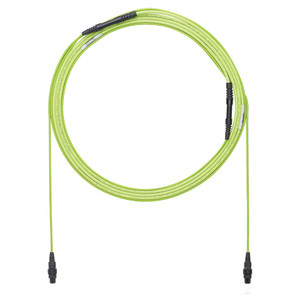
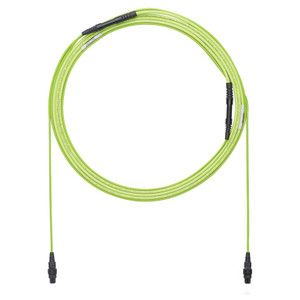
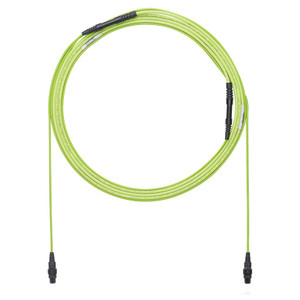
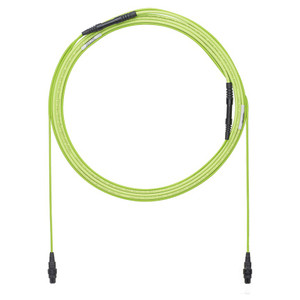
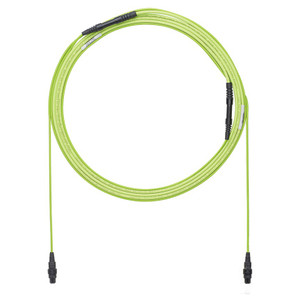
Panduit FWTYL7575LAM081 QuickNet OM5 SigCore 12-Fiber Trunk Cable Assembly
The Panduit FWTYL7575LAM081 is a QuickNet™ 12-fiber OM5 trunk cable assembly engineered for high-density data center deployments requiring extended reach and rapid infrastructure buildout. This 81-meter (265.75 ft) trunk features PanMPO female connectors on both ends with Method B polarity, SigCore fiber for ultra-low insertion loss, and an LSZH jacket rated for plenum-equivalent safety. The HD Flex Transition design delivers 30-40% smaller cable diameter compared to standard trunks—critical when conduit fill is tight or cabinet pathways are saturated. Includes an integrated pulling eye on one end to simplify installation through long horizontal or vertical runs.
Key Features
- OM5 wideband multimode fiber supports 40G/100G SR4/SR10 and 400G applications up to 150 meters
- SigCore fiber construction with ultra insertion loss performance for maximum link budget margin
- PanMPO female to PanMPO female connectors, Method B polarity for proper transmit/receive alignment
- 81-meter length handles extended horizontal runs, floor-to-floor risers, or cross-building links
- HD Flex Transition cable design reduces diameter 30-40%, freeing critical conduit and pathway space
- Low Smoke Zero Halogen (LSZH) jacket meets IEC 60332-3-24 for plenum-equivalent installations
- Lime jacket provides instant visual identification of OM5 infrastructure per TIA standards
- Integrated pulling eye on one end simplifies long-distance cable pulls and reduces installation time
- 12-fiber count supports 2-lane 100G or dual 40G links in a single trunk
- Exceeds ISO/IEC 11801, TIA-568-C.3, TIA-604-5 (FOCIS-5), and RoHS requirements
OM5 fiber represents the current multimode standard for bandwidth-intensive data center links. Unlike OM3/OM4, OM5's wideband design is optimized for short-wavelength division multiplexing (SWDM), enabling 40G and 100G over fewer fibers or pushing 400G SR8 applications out to 150 meters. The SigCore fiber core—Panduit's premium offering—delivers insertion loss well below the 0.35 dB TIA maximum, preserving critical link budget in high-speed optics and allowing for additional splice points or connectors in complex architectures. The PanMPO connectors are field-tested to 50,000 mating cycles and factory-polished for consistent sub-0.25 dB return loss. Method B polarity is the standard for parallel optics: transmit lanes on one end align to receive lanes on the other without adapter flipping, so you can connect two switches or a switch to a cassette breakout without polarity errors that cause link-down states.
The 81-meter length is purpose-built for extended horizontal runs in large data halls, floor-to-floor riser connections in multi-story colocation facilities, or building-to-building links across a campus backbone. Traditional 50-meter trunks fall short when switch aggregation rows are far from core routers or when crossing a hallway to a remote MDA. This trunk eliminates the need for field splicing or mid-span cassette breakouts, reducing points of failure and installation labor. The HD Flex Transition construction uses smaller-diameter jacketing and tighter fiber bundling to achieve 30-40% diameter reduction versus legacy trunk designs—real-world measurements show approximately 0.55" OD versus 0.75"+ for comparable 12-fiber round cables. That space savings compounds quickly: in a 4" conduit at 40% fill, you can route six HD Flex trunks instead of four legacy trunks, or in a vertical cable manager you reclaim side slots for power cords and copper patch cables. The pulling eye on one end is a field-install detail that matters: when fishing 265 feet through overhead cable tray or a long vertical pathway, attaching pull tape to a ruggedized eye is faster and safer than taping around the connector boot, which can damage the ferrule or strain the fiber-to-connector crimp.
The 12-fiber configuration delivers the right balance for most spine-leaf or aggregation-layer connections. Each PanMPO connector presents 12 fibers in a single interface, matching the lane count for 100GBASE-SR4 (4 transmit, 4 receive, 4 unused) or dual 40GBASE-SR4 links with breakout cassettes. For 400G deployments, pair this trunk with 24-fiber cassettes in a "trunk-and-branch" topology: the 12-fiber trunk runs spine-to-leaf, then breaks out to 24 duplex LC connections at the leaf switch—eliminating the cost and complexity of running individual duplex fibers across long distances. The lime jacket color instantly identifies OM5 infrastructure during moves/adds/changes: when you open a patch panel or enclosure, lime means 50 µm wideband multimode, distinct from aqua (OM3/OM4) or yellow (single-mode). This visual distinction prevents accidental cross-connection of incompatible fiber types, which causes immediate link failure or intermittent bit errors under load.
The LSZH jacket is essential for installations under international building codes (IBC, NFPA 90A) or in occupied spaces where PVC smoke toxicity is prohibited. LSZH-rated cables produce significantly less smoke opacity and halogen acid gas during combustion, meeting IEC 60332-3-24 flame propagation and IEC 61034 smoke density tests. Most European and Asian data centers mandate LSZH; North American facilities increasingly specify it for raised-floor and above-ceiling spaces even when not legally required, as part of risk mitigation for catastrophic fire scenarios. The jacket maintains flexibility down to -20°C, critical when routing through unheated spaces or outdoor conduit transitions between buildings. Panduit's LSZH formulation resists UV degradation and moisture ingress better than commodity LSZH compounds, extending service life in mixed indoor/outdoor pathways or humid tropical environments.
This trunk ships factory-tested and serialized with an individual test report showing insertion loss and return loss across all 12 fibers. Each fiber meets TIA-568-C.3 channel loss requirements (≤2.28 dB at 850 nm for an 81 m channel), and the SigCore fiber typically measures 0.15-0.20 dB per connector pair—well below the 0.35 dB maximum. That headroom matters when designing links with multiple cassette breakouts or planning for future adds: you can budget an extra 0.5-1.0 dB for field splices or additional mated pairs without violating the optics' receive sensitivity. The PanMPO connectors use Panduit's zero-insertion-force alignment system, which centers the ferrule without requiring rotational torque that can crack the ceramic endface or shift fiber cores out of alignment. Field techs report these connectors seat with an audible click and require no special tools or training—just push until you hear the latch engage, then verify link light.
Installation speed is a primary QuickNet design goal. The integrated pulling eye on one end accepts standard pull tape or rope, distributing tensile load across the cable jacket rather than concentrating stress at the connector boot. When pulling through 100+ feet of conduit, that eye prevents the boot-to-cable transition from separating or the internal furcation from shifting—both failure modes that cause field terminations to pop loose under load. The 81-meter length is supplied on a reel or in a figure-eight coil depending on order configuration, with clearly marked directionality so you pull from the correct end. The HD Flex Transition jacket is slick-coated to reduce friction in conduit or cable tray; field reports show 20-30% lower pull tension versus matte-finish LSZH cables of the same diameter, which translates to longer maximum pull distances and reduced risk of jacket deformation at bend points.
This trunk is a factory-terminated solution that eliminates field-polish labor and the quality variance of on-site terminations. Every connector is machine-polished to a sub-50 nm endface geometry, inspected under 400× magnification, and tested for insertion loss and return loss before shipping. That level of precision is unachievable with field-install kits, which rely on hand-polishing and visual inspection under 200× scopes. For integrators bidding large data center projects, factory trunks reduce per-port labor from 20-30 minutes (field terminate + test + rework) to under 5 minutes (route + plug + verify), cutting installation time by 60-70% and freeing techs for higher-value work like switch configuration and documentation.
Compliance with ISO/IEC 11801, TIA-568-C.3, and TIA-604-5 (FOCIS-5) ensures this trunk integrates into standards-based structured cabling systems from any vendor. The OM5 fiber meets TIA-492-AAAD and IEC 60793-2-10 Type A1a.3 specifications for modal bandwidth (4700 MHz·km at 850 nm, 2470 MHz·km at 953 nm), which guarantees rated reach for 40G/100G/400G applications without additional link budget analysis. RoHS compliance certifies lead-free construction and restricted hazardous substance limits, meeting EU procurement requirements and most corporate environmental procurement standards. This trunk is backed by Panduit's standard manufacturer warranty and is manufactured in ISO 9001-certified facilities with full batch traceability for supply chain auditing.