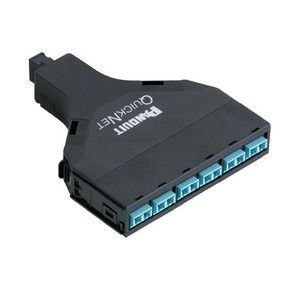
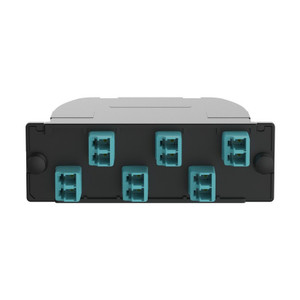
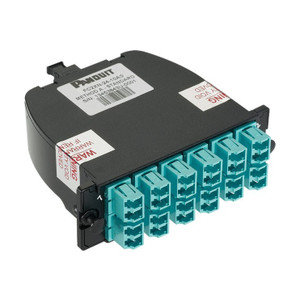
Panduit FC2ZN-12-10U Opticom OM4 MPO-12 to LC Duplex Fiber Cassette
The Panduit FC2ZN-12-10U is a 12-fiber OM4 cassette that converts a single MPO-12 trunk connection into six LC duplex ports, delivering the high-density fiber breakout datacenter and enterprise network operators need when deploying 40G/100G-ready infrastructure in space-constrained enclosures. Designed for Panduit's FHD (Fiber-Duct High-Density) cassette-based patching systems, this module installs in seconds—slide it into any FHD panel slot, plug your MPO trunk cable into the rear, and you've got six clean LC duplex channels on the front for server, switch, or storage connectivity. The OM4 (50μm) laser-optimized multimode fiber supports 100 meters at 40 Gb/s and 150 meters at 10 Gb/s per channel, giving you the bandwidth headroom to migrate from 10G to 40G to 100G SR4 without ripping out horizontal cabling. The polycarbonate housing withstands repeated insertions in high-churn environments, and the factory-terminated MPO interface eliminates the field-termination risk that kills so many fiber deployments. If you're building or expanding a structured cabling system where rack space costs more than the optics and every RU counts, cassette modules like the FC2ZN-12-10U are the only sane way to scale past 144 fibers per panel without turning your cable management into a rat's nest.
Key Features
- MPO-12 male rear connector breaks out to 6× LC duplex ports on a single cassette module
- OM4 laser-optimized 50μm multimode fiber rated for 100m @ 40G, 150m @ 10G per channel
- Slide-in cassette form factor installs tool-free in Panduit FHD panels and compatible enclosures
- Black polycarbonate housing designed for 500+ insertion cycles in production environments
- Factory-terminated MPO interface eliminates field polishing and the associated failure modes
- 12-fiber count supports full 6-duplex channel capacity for 40GBASE-SR4 or 6× 10G links
- Opticom sub-brand quality—Panduit's tier-1 fiber product line for mission-critical deployments
- Ships in 10-unit bulk cartons for multi-rack installations and staging efficiency
The core value of the FC2ZN-12-10U is architectural: it turns the mess of traditional fiber patching—where every connection requires two bulkhead adapters, two connectors, and two chances for contamination—into a clean modular system where the only field connection is a single pre-terminated MPO trunk cable. On the rear of the cassette, the MPO-12 male connector mates with an MPO female trunk cable (typically a 12-fiber OS2 singlemode or OM4 multimode MTP trunk running from your telecom room to the distribution frame). Inside the cassette, factory-spliced breakout legs route each of the 12 fibers to the front-facing LC duplex adapters, which present as six standard duplex ports ready for LC patch cords to your switches, servers, or storage arrays. This architecture solves the density problem that's plagued fiber deployments since 10G became baseline: a traditional 1RU fiber panel with discrete LC adapters maxes out at 24 duplex ports (48 fibers) before you run out of faceplate real estate; cassette-based FHD panels push that to 144 duplex ports (288 fibers) in the same 1RU by stacking 24 cassettes, each carrying 6 duplex channels. The trade-off is MPO infrastructure on the trunk side, but once you're deploying more than 48 fibers per rack, the cost of the MPO trunk cables is dwarfed by the savings in panel space, cable management labor, and the reduced failure rate from fewer hand-terminated connections. The FC2ZN-12-10U specifically uses OM4 fiber, which is the sweet spot for enterprise multimode deployments: it supports 40GBASE-SR4 (4× 10G lanes) out to 100 meters and 100GBASE-SR4 out to 70 meters, versus OM3's 100m/150m limits that force costly OM5 or singlemode upgrades when you hit the performance wall. For integrators installing new horizontal fiber or upgrading from OM3, OM4 is the minimum viable future-proofing—it buys you one more speed-grade migration before you need to re-cable, and the cost delta over OM3 is negligible on a per-port basis when you're already paying for cassette modules and MPO trunks.
Installation workflow for the FC2ZN-12-10U follows the standard cassette-module pattern: first, verify your FHD panel is properly grounded and your MPO trunk cables are routed with the correct polarity (Type A, B, or C—confirm with your trunk cable vendor and ensure the cassette polarity matches; Panduit cassettes are typically Type B straight-through, meaning Pin 1 on the MPO maps to Fiber 1 on Port 1, but always verify against the datasheet or label on the cassette itself). Slide the cassette into an open slot in the panel until it clicks—there are no screws, no latches, just a friction-fit guide rail that holds the module in place while allowing tool-free removal for testing or reconfiguration. Plug your MPO trunk cable into the rear MPO port; you should feel a positive click as the push-pull tab engages. Then inspect the front LC ports with a fiber microscope before inserting any patch cords—even factory-terminated cassettes can pick up dust or oils during shipping, and a single contaminated end-face will tank your link budget or cause intermittent errors that are hell to troubleshoot. Clean every port with a one-click cleaner (LC-specific, not the universal cassette-tip type that leaves residue), inspect again under 200× magnification, and only then insert your LC patch cords. On the patch cord side, use OM4-rated duplex LC cables (aqua jacket for multimode, yellow for singlemode if you're mixing media types in the same rack, though that's rare for cassette deployments). Once cabled, test each duplex link with an OTDR or power meter to confirm insertion loss is within spec—Panduit publishes a 0.75 dB max insertion loss for the cassette itself, so your total link budget (trunk cable + cassette + patch cord) should stay under 2.5 dB for OM4 at 850nm, well below the 40G SR4 allocation of 4.5 dB. If you see higher loss, re-inspect the MPO trunk connector (MPO end-faces are notorious for debris in the guide-pin holes) or swap the cassette to isolate whether the issue is in the module or the trunk. For large deployments, stage and pre-test cassettes off-rack before go-live—plug each cassette into a test MPO cable, verify all six duplex ports light up with a visual fault locator, and label the cassette with a rack/slot ID so your Day 2 team knows exactly which module maps to which circuit ID when they're troubleshooting a down link at 2 AM.
The FC2ZN-12-10U differentiates itself in the Panduit Opticom line through build quality that matters in production environments: the polycarbonate housing resists impact and flexing better than the ABS plastic used in economy cassettes, the internal breakout legs use 900μm tight-buffered fiber (not the 250μm bare fiber that some manufacturers use to save cost, which is fragile and prone to microbend loss), and the LC adapters are bronze-sleeve split-sleeve designs that maintain <0.2 dB repeatability across 500+ insertions. For integrators deploying cassette systems in environments where Day 2 adds, moves, and changes are constant—think enterprise datacenters, healthcare imaging networks, or university research facilities where every semester brings new equipment and new fiber demands—the durability delta between a premium Panduit cassette and a no-name import becomes obvious after the third or fourth time you re-patch the same port. The 10-unit carton quantity is purpose-built for rack-scale deployments: if you're installing a pair of distribution switches in a new datacenter row and you need 48 duplex fiber links per switch (8 cassettes per switch), you'll order 20 units (2 cartons), have 4 spares on hand for testing or future expansion, and avoid the nickel-and-dime procurement overhead of ordering cassettes one at a time as circuits come online. The UPC (61305656696) ties directly to Panduit's warranty and RMA process, which for Opticom products is a lifetime warranty against manufacturing defects—if a cassette fails in the field (cracked housing, broken LC tab, intermittent MPO contact), you get a replacement, no questions, no pro-rated depreciation, which is the kind of backing you need when your SLA says 99.99% uptime and a single failed cassette can take down six 10G links and cost you $10K/hour in lost revenue. Mount this in a properly designed FHD system with clean MPO trunks and quality OM4 patch cords, follow basic fiber hygiene (inspect, clean, inspect again), and the FC2ZN-12-10U will give you a rock-solid 12-fiber breakout that scales your network to 40G and beyond without the cable-spaghetti chaos that kills so many high-density fiber projects.