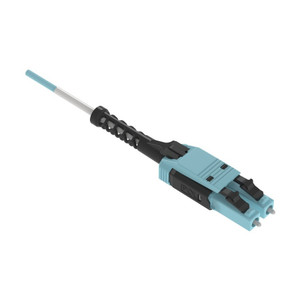
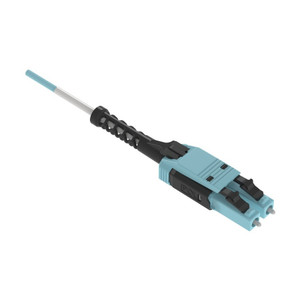
Panduit FS2RPU1U1NNM003 Signature Core OM4+ LC Duplex Uniboot Fiber Patch Cord
The Panduit FS2RPU1U1NNM003 is a 3-meter OM4+ multimode fiber patch cord engineered for demanding 40GBASE-SR4 and 100GBASE-SR4 data center and enterprise network deployments. Part of Panduit's Signature Core™ portfolio, this cable delivers ultra-low insertion loss through precision-manufactured 50μm OM4+ fiber and factory-terminated LC duplex uniboot connectors with integrated pull-boot assemblies. The plenum-rated (OFNP) aqua jacket meets building and fire code requirements for air-handling spaces, while the space-saving uniboot form factor reduces congestion in high-density fiber enclosures and simplifies polarity management during moves, adds, and changes. Factory-tested to TIA/EIA-568-C.3 and ISO/IEC 11801 standards, this patch cord ships ready for deployment in spine-leaf networks, storage area networks, main distribution areas, horizontal distribution frames, and equipment distribution zones where consistent performance and code compliance are non-negotiable.
Key Features
- OM4+ Signature Core 50μm multimode fiber supporting 40G/100G Ethernet over extended distances with effective modal bandwidth exceeding 4700 MHz·km at 850nm
- LC duplex uniboot connectors on both ends for compact footprint, reduced panel congestion, and simplified field polarity reversal
- Ultra-low insertion loss specification (typically under 0.15 dB per mated pair) for maximum link budget and performance headroom
- Plenum-rated OFNP jacket for installation in air-handling spaces per NEC Article 770 and local fire codes
- Integrated pull-boot assemblies for field serviceability, strain relief, and clean extraction from high-density panels
- 3-meter (9.84 ft) length optimized for intra-rack, cross-rack, and short inter-row connections in structured cabling systems
- Aqua jacket color per TIA-598-D standard for immediate OM4+ fiber identification and prevention of cross-connection errors
- Factory-terminated and tested to TIA/EIA-568-C.3, ISO/IEC 11801, TIA-604-3 (FOCIS-3), and TIA-604-10 (FOCIS-10) performance criteria
- RoHS compliant per Directive 2002/95/EC for hazardous substance restrictions
- Ships as single unit; packaged 10 units per carton for inventory management and bulk deployments
Panduit Signature Core OM4+ fiber delivers laser-optimized 50μm core geometry with effective modal bandwidth (EMBc) exceeding 4700 MHz·km at 850nm, enabling 100-meter 40GBASE-SR4 links and 150-meter 100GBASE-SR10 links when deployed with OM4+-rated interconnects and transceivers. The ultra-low insertion loss specification—typically under 0.15 dB per mated pair and well below the 0.75 dB maximum allowed by TIA-568-C.3—preserves precious link budget in multi-connector channels and extends maximum reach in loss-limited applications. This matters in spine-leaf data center architectures where aggregate switch uplinks traverse multiple patch panels, in storage-area networks where Fibre Channel 16G/32G operates near the edge of modal bandwidth limits, and in any deployment where you're designing to the edge of the loss budget or planning for future 200G/400G upgrades using PAM4 modulation over multimode fiber. Factory termination eliminates the variability, labor cost, and field-failure risk of on-site connectorization. Each cable undergoes automated end-face geometry inspection and insertion-loss testing before it ships, so you're deploying known-good assemblies with full traceability back to Panduit's manufacturing data and serialized quality records.
The LC duplex uniboot connector consolidates two simplex LC connectors into a single-boot assembly roughly the width of one SC connector, cutting required panel density in half compared to traditional duplex LC cables with separate boots. This becomes critical in 1U fiber enclosures serving 40G/100G switch ports where every millimeter of panel width counts and where installers are routing 48 or 96 fibers through a single rack unit. The integrated pull-boot design allows you to extract the connector from crowded panels without damaging the cable jacket, disturbing adjacent connections, or requiring needle-nose pliers to grip a slippery boot. Push the molded tab, pull straight back, and the boot releases cleanly with controlled force. For polarity management, the uniboot design permits in-field reversal of the fiber pair within the connector body, eliminating the need to stock both Method A and Method B cables or rely on polarity-flip cassettes and adapters. Installers set polarity at the time of deployment based on the specific trunk-to-transceiver mapping, and if you need to change duplex to reversed-duplex for a transmit-receive swap during troubleshooting or reconfiguration, you open the boot, flip the internal fiber clip 180 degrees, and close it back up—no new cable purchase, no panel rewire, no change order.
The plenum-rated OFNP jacket meets National Electrical Code (NEC) Article 770 requirements for cables installed in environmental air spaces, including ceiling plenums, raised-floor plenums, and HVAC return-air pathways where building air circulation could spread smoke and combustion byproducts in the event of a fire. Plenum rating is a hard requirement in most commercial builds, and spec'ing OFNP from the start avoids costly rework when the fire marshal flags non-plenum cable during final inspection or when a tenant-improvement project triggers a code-compliance audit. The aqua jacket color conforms to TIA-598-D color-coding guidelines for OM4 multimode fiber, giving technicians immediate visual confirmation of fiber type during troubleshooting, inventory audits, and MAC work, and preventing accidental cross-connection between OM3, OM4, and singlemode infrastructure that could result in link flapping, bit errors, or complete circuit failure. This 3-meter length is optimized for top-of-rack switch to in-rack server connections, adjacent-rack switch uplinks in row-based architectures, equipment-distribution-area patch fields, and intra-room horizontal cross-connects where you need a clean, dressed run without excessive slack, service loop, or cable congestion blocking airflow in hot aisles or cold aisles.
The duplex LC interface is the de facto standard for 10G/40G/100G multimode transceiver modules including SFP+, QSFP+, QSFP28, and QSFP56 form factors from Cisco, Juniper, Arista, Dell, HPE, and whitebox ODM suppliers. Each LC connector ferrule is factory-polished to sub-micron end-face geometry tolerances and inspected under interferometric microscopy to ensure core concentricity, apex offset, and radius of curvature fall within FOCIS-3 limits. This level of manufacturing control is what delivers repeatable low insertion loss across production runs and what prevents the 0.3 dB to 0.5 dB connector-loss variation you often see with field-terminated assemblies or low-cost offshore patch cords that skip end-face inspection. In a four-connector channel (two patch cords plus two equipment cords or cassette jumpers), cutting per-connector loss from 0.3 dB to 0.12 dB recovers nearly 0.75 dB of system margin—enough to extend your maximum backbone distance by 20 meters or to absorb an additional splice or connector pair without exceeding the application's loss budget.
Panduit Signature Core components are tested as a complete system—cable assemblies, breakout trunks, cassettes, enclosures, and patch panels—so you're deploying a characterized channel rather than hoping that mixed-vendor parts will hit performance targets when integrated in the field. Signature Core OM4+ cable is tested with Signature Core connectors and mated to Signature Core adapter modules to validate end-to-end insertion loss, return loss, and far-end crosstalk under worst-case polarity and mating conditions. This systems-level validation is what allows Panduit to publish application assurance tables showing supported distances for 10G, 40G, 100G, and future 200G/400G protocols, and it's what gives you defensible documentation when a network engineer questions whether your fiber plant will support a planned technology refresh. For hyperscale data centers, colocation providers, enterprise campuses, and healthcare networks running 40G/100G spine fabrics today with an eye on 200G/400G leaf-to-spine migration paths, this OM4+ patch cord delivers the headroom, consistency, and upgrade-in-place capability you need to build the physical layer once and re-light it with faster optics as transceiver economics improve.
Deployment of OM4+ uniboot patch cords in structured cabling systems follows TIA-568-C.0 guidelines for horizontal and backbone fiber distribution. At the main distribution area (MDA), use these 3-meter assemblies to cross-connect incoming backbone trunks to core switch ports or to interconnect adjacent fiber enclosures within the same equipment row. At the horizontal distribution area (HDA) or intermediate distribution frame (IDF), deploy them as equipment cords from patch panels to active switch ports, observing the 2-connector or 3-connector channel models defined in TIA-568-C.3 Annex B. In equipment distribution areas (EDA) at the rack level, use them for top-of-rack switch uplinks to spine switches in adjacent racks or for server NIC connections in hyper-converged infrastructure where compute and storage nodes require 40G or 100G east-west bandwidth. The uniboot form factor is particularly valuable in breakout applications where a 24-fiber MPO trunk fans out to 12 duplex LC uniboot patch cords at a cassette module—each uniboot connector occupies half the panel width of a traditional duplex LC, allowing you to fit a 12-port breakout into the same 1U footprint that would normally accommodate only six traditional duplex ports.
Compliance with TIA/EIA-568-C.3, ISO/IEC 11801 Ed. 2.2, TIA-604-3 (FOCIS-3 for LC connector physical dimensions and end-face geometry), TIA-604-10 (FOCIS-10 for MPO/MTP trunk compatibility), and the European Union Directive 2002/95/EC (RoHS hazardous substance restrictions) ensures interoperability with standards-compliant transceivers, media converters, cassettes, enclosures, and test equipment from any manufacturer. The FS2RPU1U1NNM003 ships with documented test results traceable to NIST-referenced calibration standards, providing the basis-of-design documentation required for LEED submissions, government contract compliance, and warranty validation on active equipment where vendors require certified structured cabling as a condition of support agreements.