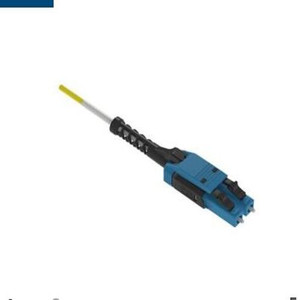
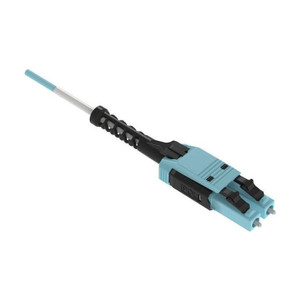
Panduit FZ2RLU1U1NNM036 QuickNet 36m OM4 LC Uniboot Fiber Assembly
Pre-terminated 36-meter OM4 fiber assembly engineered for rapid deployment in datacenter backbone and horizontal runs where field termination isn't practical. The LC uniboot connector design consolidates both fibers into a single boot with tool-free polarity reversal, cutting panel density requirements in half compared to duplex LC and simplifying MACs in 10/40/100GBASE-SR environments. LSZH jacket meets international building codes for enclosed spaces without plenum infrastructure. Ships factory-tested with insertion loss and return loss reports, eliminating on-site certification delays. Panduit QuickNet assemblies are built on automated polishing lines to tighter tolerances than field-term connectors — you're deploying to the same spec every time, not gambling on tech skill or inspection discipline.
Key Features
- OM4 50/125µm multimode fiber supports 10GBASE-SR to 400m, 40GBASE-SR4 to 150m, 100GBASE-SR4 to 100m per TIA-568.3-D
- LC uniboot connector with push-pull tab and integrated polarity-reversal latch — no separate tools, no accidental A-to-B swaps during rework
- 36-meter length bridges typical IDF-to-MDF runs in multi-story buildings or long horizontal spans in warehouse datacenter layouts
- Low Smoke Zero Halogen (LSZH) jacket complies with IEC 60754-1/2 and produces <0.5% HCl under combustion — required for European installations and increasingly specified in U.S. healthcare, education, and transport facilities
- 2mm round cable diameter vs. 3mm duplex zip-cord reduces pathway fill and bend radius stress in congested ladder rack or overhead J-hook runs
- Factory-terminated and tested to <0.35dB insertion loss, eliminating field splicing labor and the need for OTDR certification before turn-up
The uniboot form factor matters most in high-port-count switch deployments. A 48-port 10G switch with traditional duplex LC connectors consumes 48 connector positions; with uniboot, you're managing 24 physical cables instead of 48 legs, which translates to cleaner cable management arms, less strain on the first-rank cable, and faster MAC work when you need to trace a link. The push-pull tab is oversized compared to generic uniboot designs and remains accessible even when surrounded by adjacent connectors, so you're not fighting a fingernail under a 1mm edge to release the latch. Polarity reversal happens in the boot with a sliding clip — you're not pulling the cable, not opening the panel, not relabeling. For Method B or Method C polarity schemes, you can flip transmit/receive at the device end without retracing the entire horizontal run.
OM4 was developed specifically for short-reach 40G and 100G links using 850nm VCSELs, with effective modal bandwidth of 4700 MHz·km versus OM3's 2000 MHz·km. In practical terms: 10GBASE-SR on OM4 reaches 400 meters, twice the OM3 distance, buying you future-proofing if your current IDF-to-MDF run is 220 meters and you're planning a 10G-to-25G migration in three years. The 50/125µm core is backward-compatible with OM2 and OM3 optics, so you can deploy this cable today with SFP+ modules and upgrade to QSFP28 or QSFP-DD without rewiring the physical layer. Panduit's manufacturing process for QuickNet assemblies uses automated ferrule polishing to consistent 3-5° angles and inspects every endface with interferometry, not go/no-go visual scopes, so you're seeing <0.3dB typical insertion loss and >35dB return loss out of the box. The spec sheet in the box includes per-connector IL/RL numbers and a serial-tracked test date, which satisfies audit requirements for TIA-942-B Tier III/IV datacenters and Defense Information Systems Agency (DISA) STIGs.
LSZH jacketing is mandatory in EU Euroclass network installations and in any U.S. facility where cable is run in air-handling spaces without plenum-rated conduit. The material produces less than 0.5% hydrogen chloride gas and significantly lower smoke density than PVC during combustion, reducing toxicity and visibility hazards during fire evacuation. The trade-off is slightly reduced flexibility compared to PVC — LSZH minimum bend radius is typically 10× cable diameter (20mm for this 2mm cable) versus 8× for PVC, so you'll want to avoid sharp 90° turns in tight wire management fingers. The cable is rated for -20°C to +60°C operation, which covers ASHRAE-compliant cold-aisle containment environments and outdoor IDF cabinets with climate control.
This 36-meter length is purpose-cut for installations where standard 15m or 30m assemblies fall short and 50m is excessive slack. Common use cases: raised-floor datacenter with 3-meter underfloor plenum plus 30 meters of horizontal ladder rack run to perimeter MDA cabinet; two-story IDF interconnect with 25 feet of vertical riser plus 90 feet of horizontal building distribution; warehouse with ceiling height at 20 feet and equipment separation at 80 feet. The alternative — splicing two shorter assemblies with a bulkhead coupler — adds 0.3-0.75dB insertion loss per mated pair, burns two connectors, introduces a failure point, and requires accessible mounting space mid-run. Single continuous assemblies eliminate all three problems. If your run measures 34.5 meters and you're debating 30m vs. 36m, take the 36m; coiling 1.5 meters of service loop in a J-hook or wire management ring is faster and cleaner than troubleshooting a link budget failure because your measurement didn't account for vertical riser transitions.