Panduit FZ2ELQ1SNSNM042 QuickNet OM4 LC to SC Duplex Fiber Trunk Cable
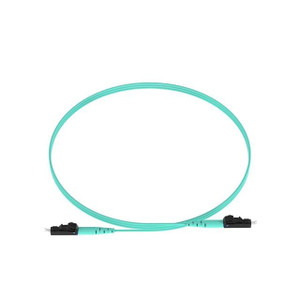
The Panduit FZ2ELQ1SNSNM042 is a factory-terminated 42-meter (137.8 ft) OM4 multimode fiber trunk cable engineered for mission-critical data center and enterprise network deployments where 40/100GbE bandwidth, rapid installation, and strict fire-code compliance intersect. This 2-fiber duplex assembly runs LC push-pull connectors on one end to SC duplex on the other, bridging equipment configurations common in hybrid fiber infrastructures — typically LC-equipped active switches feeding SC-legacy patch panels or storage arrays. The 1.6mm reduced-diameter LSZH jacket meets IBC plenum-equivalent fire ratings without the PVC halogen burden, making it the go-to trunk for European installations, healthcare facilities, and any project where smoke toxicity during fire is a liability concern.
Key Features
- OM4 50/125µm multimode fiber — 550-meter reach at 10GbE, 150 meters at 40/100GbE (SWDM4), qualified for 400GbE SR8 applications per TIA-568.3-D
- LC to SC duplex configuration — Purpose-built for mixed-generation architectures: LC-equipped ToR/EoR switches to SC fiber distribution panels or SAN storage heads
- Push-pull LC connector design — Single-action latch release prevents accidental disconnects in dense 1U switch faceplates and high-vibration environments
- Low Smoke Zero Halogen (LSZH) jacket — IEC 60332-3-24 flame-retardant, produces <0.5% HCl under burn, meets EN 50575 CPR Cca-s1a,d1,a1 classification for European building codes
- 1.6mm reduced-diameter cable — 40% smaller cross-section than standard 3.0mm duplex cables, increasing pathway fill capacity and airflow in overhead cable trays
- Factory-terminated and polarity-tested — Each assembly tested for <0.35dB insertion loss (LC end) and <0.50dB (SC end) at 850nm per IEC 61300-3-4, ships with individual test report
- 42-meter optimized length — Matches typical datacenter row-to-MDA distances (130 ft), minimizes mid-span slack and eliminates field splicing labor on long horizontal runs
- TIA-942-B Tier III/IV compliant — Supports structured cabling requirements for uptime-rated datacenters, including segregated fire zones and multi-path redundancy
OM4 multimode fiber delivers 50µm core diameter optimized for 850nm VCSEL transceivers — the economics sweet spot for campus backbones and datacenter leaf-spine fabrics where reach requirements stay under 150 meters but port density and power efficiency matter. The aqua-jacketed cable uses laser-optimized 50/125 glass with <3.0 dB/km attenuation and 4700 MHz·km EMBc (effective modal bandwidth), qualifying it for 40GBASE-SR4 and 100GBASE-SR4 applications that were outside OM3's capability window. While singlemode fiber owns long-haul and metro applications, OM4 dominates the 10–150 meter range where transceiver cost per port ($45 MM vs. $180 SM) and SFP+ power draw (0.8W vs. 1.5W) aggregate into six-figure OpEx differences across a 400-port spine switch deployment. The LC-to-SC asymmetric connector pairing solves the generation-gap problem in phased datacenter upgrades: newer Arista/Cisco Nexus switches ship with LC-dominated faceplates, while incumbent fiber distribution areas (FDAs) and storage networks built 2010–2018 remain SC-centric. This trunk eliminates the LC/SC adapter bulk and insertion-loss penalty (typically +0.3 dB per mated pair) that comes from using homogeneous LC-LC or SC-SC cables with field adapters. Panduit's push-pull LC variant uses a spring-loaded shuttle mechanism — press the tab, the ferrule retracts, the connector releases. No twisting, no pinch-grip finger gymnastics in a 1RU faceplate where 48 ports sit on 8mm centers. The SC end remains the legacy push-on/pull-off design, but the reduced 1.6mm cable diameter gives installers the bend-radius margin to route cables vertically out of panel strain relief without kinking below the 10× diameter minimum (16mm).
The LSZH jacket construction addresses two deployment contexts: European Union building codes (EN 50575 CPR mandates Cca or better for fixed installations) and any facility where life safety during fire outweighs cost. Standard PVC-jacketed cables release hydrochloric acid and dense black smoke when burned — a fatal combination in enclosed elevator shafts, hospital corridors, and subway tunnels where evacuation time is measured in minutes. LSZH compounds substitute polyolefin or fluoropolymer resins that produce <0.5% hydrogen chloride, 60% less smoke opacity, and zero dioxin emissions per IEC 61034-2 testing. The trade-off: LSZH cables cost 15–25% more and exhibit lower abrasion resistance than PVC, making them a poor fit for temporary event installations or industrial plants where jacket scuffing against cable tray edges is routine. The 42-meter length sits in the Goldilocks zone for row-based datacenter designs: long enough to span from an end-of-row (EoR) aggregation switch in hot-aisle containment to a main distribution area (MDA) at the room perimeter (typical run: 35–45 meters), short enough to avoid the cost and attenuation penalties of 100-meter bulk spools. Pre-terminated trunks eliminate field fusion splicing (15 minutes per splice, $400 kit amortization) and the 0.1–0.3 dB per splice loss that accumulates across a 96-strand backbone. Panduit's factory process uses automated polishing stations and IEC-mandated interferometry to guarantee <0.35 dB insertion loss on LC ends — tighter than the 0.50 dB that field techs achieve with portable polishing pucks and visual fault locators. Each cable ships with a serialized test report showing actual IL/RL values at 850nm and 1300nm, giving you the loss budget documentation that TIA-942-B Annex G requires for Tier III certification audits.
This assembly meets TIA-568.3-D performance criteria for OM4 (4700 MHz·km EMBc minimum, verified per FOTP-220 differential mode delay testing), ISO/IEC 11801 Category OM4 international cabling standards, and ANSI/TIA-942-B structured cabling requirements for telecommunications rooms in uptime-rated datacenters. The LC/SC hybrid configuration directly supports the polarity Method B (straight-through) and Method C (array-flipped) architectures defined in TIA-568.0-E Annex A, making it compatible with MTP-to-LC breakout cassettes in 40G QSFP+ SR4 migration scenarios. For integrators managing DCIM cable-plant databases, Panduit's QuickNet trunk cables carry laser-etched sequential footage marks every meter and a printable jacket label field for asset tagging — a small detail that prevents the "which cable goes where" guessing game when you return to a 2,000-strand installation six months later for adds-and-changes.