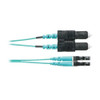
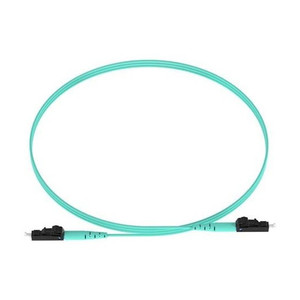
Panduit FZ2ERLNSNSNM4.5 QuickNet OM4 Pre-Terminated Fiber Assembly
Pre-terminated fiber trunk cables eliminate field splicing, reduce deployment time by 70%, and deliver factory-certified insertion loss for 10/40/100 Gigabit Ethernet links. The Panduit FZ2ERLNSNSNM4.5 is a 4.5-meter OM4 multimode assembly with LC Duplex on one end and SC Duplex on the other, built on 1.6mm zipcord cable rated OFNR for riser pathways. This configuration handles typical rack-to-patch-panel connections in data centers, telecommunications rooms, and equipment distribution areas where you need reliable 50/125µm multimode links without the cost and skill overhead of field termination.
Key Features
- OM4 multimode 50/125µm fiber supports 10GBASE-SR up to 400m, 40GBASE-SR4 up to 150m, 100GBASE-SR10 up to 150m
- Pre-terminated LC Duplex (one end) to SC Duplex (opposite end) with factory-polished Physical Contact (PC) ferrules
- 4.5-meter (14.76 ft) length suits rack-to-overhead tray, vertical riser, or adjacent-rack patch panel connections
- 1.6mm zipcord cable construction for flexible routing in congested pathways and tight-radius bends
- OFNR (Optical Fiber Nonconductive Riser) flammability rating meets NEC Article 770 for vertical cable runs between floors
- Panduit QuickNet factory termination delivers less than 0.15 dB typical insertion loss and better than -55 dB return loss per connector
- Aqua jacket color-codes OM4 per TIA-598-D, preventing mix-ups with OM3, OM5, or single-mode infrastructure
- TIA-568.3-D, ISO/IEC 11801, and ANSI/TIA-942-B compliant for enterprise and data center structured cabling systems
OM4 multimode fiber delivers 50/125µm core/cladding geometry optimized for 850nm VCSEL transceivers, the dominant short-reach optic in modern data centers. The 4.5-meter length bridges typical vertical distances in two-post relay racks or handles horizontal patch panel to switch connections with enough slack for proper cable management. LC Duplex connectors—the de facto standard for SFP/SFP+ transceivers—terminate one end, while SC Duplex connectors on the opposite end mate with legacy patch panels or backbone trunk ports still prevalent in telecom rooms. This mixed-connector configuration eliminates the need for LC-to-SC adapter panels when integrating new 10G/40G switches with existing SC-based structured cabling.
Factory pre-termination is the decisive advantage. Field splicing multimode fiber requires fusion splicers, cleaving tools, skilled labor, and per-splice insertion loss variability that can push marginal links into error. Panduit's QuickNet process terminates both ends in a controlled environment, tests insertion loss and return loss on every connector, and ships assemblies with guaranteed sub-0.15 dB typical loss per connection. You pull the cable, plug it in, and the link comes up—no splice trays, no consumables, no rework. The 1.6mm zipcord construction uses two 900µm tight-buffered fibers in a single jacket, delivering the flexibility needed for congested vertical manager routing and the durability to survive repeated handling during MAC (moves, adds, changes) work.
OFNR rating is the minimum flammability classification for riser cables—vertical runs between floors that do not penetrate air-handling plenums. NEC Article 770.113 permits OFNR cable in riser spaces, equipment rooms, and horizontal pathways, but not in environmental air spaces (which require OFNP plenum-rated cable). If your data center or telecom room uses overhead ladder rack or J-hooks in non-plenum spaces, OFNR cable costs less than plenum-rated equivalents while meeting code. The 4.5-meter length is long enough to reach from a floor-mounted rack to an overhead pathway entrance or to span two adjacent relay racks with proper service loop, but short enough to avoid excess coiling that wastes pathway space and creates failure points during future reconfigurations.
LC Duplex connectors use push-pull latching and a 1.25mm ferrule, packing two fibers into the same footprint as one SC connector. SFP+, SFP28, and QSFP+ transceivers—used in 10G, 25G, and 40G switches—almost universally ship with LC duplex ports. SC Duplex connectors, with their 2.5mm ferrules and push-pull latching, remain common in legacy patch panels and backbone trunk ports installed before the LC standard gained traction. Having both connector types on a single assembly means you can connect a modern switch to an older infrastructure without adapter panels that add insertion loss, cost, and failure points. If your patch panel is all LC Duplex, you simply need a different assembly; the FZ2ERLNSNSNM4.5 is specifically for LC-to-SC mixed environments.
OM4 supports 10GBASE-SR Ethernet up to 400 meters, 40GBASE-SR4 (via MPO breakout) up to 150 meters, and 100GBASE-SR10 up to 150 meters when used with standards-compliant transceivers. These distances cover the overwhelming majority of data center and campus backbone links. OM4's effective modal bandwidth (EMB) of 4700 MHz·km at 850nm reduces modal dispersion compared to OM3 (2000 MHz·km), allowing longer reach or higher data rates over the same fiber. The aqua jacket follows TIA-598-D color coding: OM1 is orange or gray, OM2 is orange, OM3 is aqua, OM4 is aqua with a printed OM4 designation (or erika violet in some cases), and OM5 is lime green. Consistent color coding prevents accidental connection of incompatible fiber types during MAC work, which can cause link budget failures or transceiver damage.
Physical Contact (PC) polishing creates a slightly convex ferrule endface that ensures fiber cores touch when mated, minimizing the air gap that causes return loss (back-reflection). PC polishing delivers -30 to -55 dB return loss, adequate for multimode links where modal dispersion dominates over reflection effects. (Single-mode links often require Ultra Physical Contact or Angled Physical Contact polishing for lower return loss.) Panduit's factory termination process includes automated polishing, interferometric inspection, and per-connector insertion loss testing, ensuring every assembly ships with documented performance. Field-terminated connectors, even with skilled technicians, introduce variability—epoxy curing, cleave angle, polishing pressure—that factory processes eliminate.
The 1.6mm zipcord cable uses a figure-8 or dual-jacket cross-section with two 900µm tight-buffered fibers. Tight-buffered construction applies a 900µm plastic buffer directly over the 250µm fiber coating, providing crush resistance and handling durability superior to loose-tube designs used in OSP (outside plant) cables. Zipcord can be split (ripped apart) for breakout applications, though this assembly is intended for duplex patch connections rather than breakout. The small diameter navigates vertical managers, horizontal wire basket tray, and tight-radius bends near patch panels without exceeding the 10× minimum bend radius under no-load conditions (16mm) or 20× under load (32mm) specified in TIA-568.3-D.
TIA-568.3-D is the North American structured cabling standard for optical fiber; it specifies installation practices, connector performance, and testing procedures for multimode and single-mode links. ISO/IEC 11801 is the international equivalent, covering similar ground with some regional differences in channel nomenclature. ANSI/TIA-942-B is the data center telecommunications infrastructure standard, defining pathways, spaces, and performance tiers for Rated-1 through Rated-4 facilities. Compliance with all three standards ensures the FZ2ERLNSNSNM4.5 fits into any enterprise or data center cabling design without compatibility questions.
QuickNet is Panduit's brand for pre-terminated fiber assemblies, covering trunk cables, harnesses, and cassette modules. The value proposition is speed and certainty: a 12-fiber trunk takes 20 minutes to pull and plug in versus 3-4 hours to splice in the field, and factory test reports document insertion loss for every connector, eliminating the will-it-certify question that plagues field terminations. For integrators billing time-and-materials, factory termination shifts labor from low-margin field work to higher-margin design and project management. For design-build or fixed-price jobs, pre-terminated cable reduces schedule risk and rework cost.
The 4.5-meter length is a sweet spot for vertical riser connections in standard 42U or 45U relay racks. A rack is roughly 2 meters tall; adding 1 meter of vertical rise to an overhead pathway and 1.5 meters of service loop and horizontal routing at both ends consumes the entire 4.5 meters without excess. If your patch panel is at the top of one rack and your switch is at the bottom of an adjacent rack (common in hot-aisle/cold-aisle layouts), 4.5 meters provides enough length with a small service loop for future rearrangement. Shorter assemblies (1-2 meters) suit same-rack connections; longer assemblies (10-30 meters) handle cross-row or inter-floor backbone links. Having the right length avoids the coiled-cable mess that blocks airflow and creates maintenance hazards.
This assembly ships individually (Pack 1) with a minimum order quantity of 10 per the PK1MOQ10 designation. That packaging structure reflects data center procurement patterns: projects rarely need just one cable, but buying in units of 10 rather than bulk 100-packs allows right-sizing inventory for small expansions or MAC work. The OFNR jacket is non-conductive (no metallic elements), eliminating ground-loop and lightning-surge concerns in vertical pathways shared with copper cables—though best practice still separates fiber and copper to avoid physical damage from sharp copper cable edges.
Panduit provides complete structured cabling ecosystems: LC and SC patch panels, fiber enclosures, MPO trunk cables, cable management, and labeling. Using a single vendor for passive infrastructure simplifies warranty, reduces compatibility risk, and streamlines procurement. The FZ2ERLNSNSNM4.5 mates with Panduit FAP patch panels (LC), FMP modular panels (SC), and FQP QuickNet cassettes (MPO-to-LC or MPO-to-SC breakout). For installations following TIA-942 Rated-3 or Rated-4 requirements—which mandate redundant pathways, zone cabling, and centralized fiber distribution—having factory documentation for every cable assembly accelerates the final certification process.
OM4 multimode fiber remains the cost-effective backbone for short-reach 10G, 40G, and 100G links in enterprise data centers. Single-mode fiber offers longer reach and future-proofs for 400G or 800G, but transceiver costs are 2-3× higher and the additional reach is wasted for links under 300 meters. OM5 (wideband multimode) supports short-wave wavelength-division multiplexing (SWDM) for 40G and 100G over fewer fibers, but adoption has been slow due to limited transceiver availability. OM4 hits the price-performance sweet spot: widely available transceivers, proven interoperability, and enough bandwidth for the next equipment refresh cycle. The FZ2ERLNSNSNM4.5 delivers that performance in a plug-and-play form factor, letting you deploy reliable 10G or 40G links in the time it takes to pull cable and plug it in—no splicing, no field testing, no insertion loss variability.
Compliance with TIA-568.3-D, ISO/IEC 11801, and ANSI/TIA-942-B ensures this assembly meets the physical, optical, and mechanical requirements for structured cabling in commercial buildings and data centers. Panduit factory testing certifies insertion loss, return loss, and ferrule geometry for every connector, with test results available on request. The 4.5-meter length and LC-to-SC mixed-connector configuration address the specific integration challenge of connecting modern LC-equipped switches to legacy SC-based patch panels, reducing installation time, eliminating adapter panels, and delivering a clean, maintainable fiber link that will support multiple equipment upgrade cycles without requiring cable replacement.