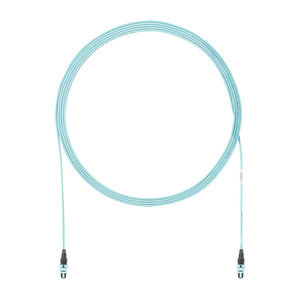
Panduit FRZTL77Y001M007 Opti-Core OM4 12-Fiber LSZH Interconnect Cable 7m
Pre-terminated OM4 fiber trunk assemblies eliminate field termination time and certification risk in mission-critical data center deployments. This 12-fiber interconnect delivers factory-tested 50/125µm OM4 multimode channels across a 7-meter span with Low Smoke Zero Halogen jacketing for enclosed telecom spaces. Panduit Opti-Core assemblies ship with end-to-end insertion loss certification and polarity documentation, letting integrators deploy 40GBASE-SR4 and 100GBASE-SR4 links in minutes instead of hours while meeting TIA-568.3-D and ISO/IEC 11801 structured cabling standards.
Key Features
- OM4 50/125µm multimode fiber supports 40G Ethernet to 150m and 100G to 100m per IEEE 802.3ba
- 12-fiber configuration supports six duplex LC channels or single MTP/MPO trunk applications
- Factory-terminated connectors with insertion loss ≤0.35dB typical, eliminating field polish variables
- LSZH (Low Smoke Zero Halogen) outer jacket meets IEC 60754 for plenum and riser installations
- 7-meter (23-foot) length optimized for intra-rack, rack-to-rack, and equipment distribution area connections
- Panduit Opti-Core quality assurance includes individual test results and serialized traceability
- TIA-568.3-D, ISO/IEC 11801, and ANSI/TIA-942-B compliant for structured cabling compliance
OM4 fiber optic cable assemblies represent the most cost-effective multimode infrastructure for 40G and 100G Ethernet deployments in enterprise data centers and telecommunications facilities. The 50/125µm core-cladding diameter optimized for 850nm VCSEL transceivers supports 10GBASE-SR to 400 meters, 40GBASE-SR4 to 150 meters, and 100GBASE-SR4 to 100 meters—covering the majority of horizontal and vertical data center pathways without the expense of singlemode infrastructure. Pre-terminated assemblies deliver guaranteed optical performance because every connector undergoes automated factory endface inspection and insertion loss testing before shipment. Field termination of multimode fiber requires specialized epoxy-polish or mechanical splice tooling, skilled labor, and post-termination OTDR or light source certification; a single 12-fiber trunk can require 45 minutes to two hours of technician time plus consumables. Factory assemblies reduce that installation window to under five minutes while eliminating the risk of improper endface geometry, contamination, or polarity errors that can cause link failure or intermittent packet loss.
The 12-fiber count in this assembly provides architectural flexibility for both duplex LC and parallel optics deployments. In traditional 10G SFP+ environments, the trunk supports six independent duplex channels when broken out via MTP-to-LC fan-out cassettes or modules—enough for three server dual-port NICs or six individual access links. For 40G and 100G parallel optics (QSFP+ and QSFP28 transceivers), the 12-fiber trunk can be used as a single MTP/MPO interface supporting one 40G SR4 link with four active fiber pairs (eight fibers) and four spares, or configured with polarity keying for bi-directional 100G transmission. The 7-meter length is purpose-built for equipment distribution area (EDA) and main distribution area (MDA) interconnects where fiber paths run between adjacent racks, across hot-aisle/cold-aisle configurations, or from top-of-rack switches to end-of-row aggregation equipment. This length avoids the service loop excess of longer pre-terminated cables while providing enough slack for proper bend radius management and future cable repositioning during maintenance events.
Low Smoke Zero Halogen jacketing is a critical safety requirement for telecommunications rooms, data centers, and any installation pathway in occupied buildings where plenum-rated cable would traditionally be specified. LSZH compounds contain no fluorine, chlorine, bromine, or iodine; during combustion or high-heat events, LSZH cables produce significantly less smoke opacity and zero corrosive halogen acid gases compared to PVC-jacketed cables. This matters in enclosed equipment rooms where visibility and breathability during evacuation can be life-safety factors, and in data centers where halogen acid byproducts can corrode sensitive electronics and copper grounding infrastructure. IEC 60754-1 and IEC 60754-2 test protocols verify halogen content below 0.5% and acid gas evolution below specified limits; many European and Asia-Pacific jurisdictions mandate LSZH for all indoor cable installations, and U.S. data center operators increasingly specify LSZH as a risk mitigation measure even when not required by local code. Panduit Opti-Core LSZH assemblies meet these international flammability and toxicity standards while maintaining the same optical performance and mechanical durability as standard riser-rated alternatives.
Factory testing and certification differentiate Panduit Opti-Core assemblies from commodity fiber jumpers. Every cable ships with insertion loss test results for each fiber pair, endface inspection images verifying connector geometry per IEC 61300-3-35, and a serialized label linking the physical asset to manufacturing traceability records. This documentation satisfies TIA-568 Tier 1 field test requirements without requiring integrators to carry optical test equipment to the job site—critical for projects with aggressive commissioning schedules or limited access to OTDR and light source meters. The factory insertion loss specification of ≤0.35dB typical (≤0.50dB maximum) ensures that even worst-case assemblies leave sufficient link budget for 40G and 100G applications; IEEE 802.3ba allocates 1.5dB for multimode fiber channel loss at 100 meters, so a 7-meter trunk with 0.35dB connector loss and ~0.07dB fiber attenuation (0.01dB/m at 850nm) consumes only 0.42dB—leaving 1.08dB margin for mated connection loss, contamination, and aging.
Panduit Opti-Core assemblies carry TIA-568.3-D recognition for balanced twisted-pair and optical fiber cabling, ISO/IEC 11801 compliance for international structured cabling installations, and ANSI/TIA-942-B certification for telecommunications infrastructure in data centers. These standards govern fiber type selection, connector performance, polarity schemes, installation practices, and testing methodologies—ensuring that every component in the optical channel meets interoperability and performance benchmarks. For integrators working on LEED-certified buildings, government contracts, or corporate data centers with formal change management processes, third-party standards compliance provides the audit trail and technical justification required to close out structured cabling submittals and O&M documentation packages.