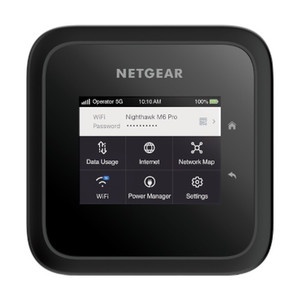
NETGEAR MR6220G-111NAS Nighthawk M6 5G WiFi 6 Mobile Hotspot
The NETGEAR MR6220G-111NAS is a portable 5G/WiFi 6 gateway designed for remote camera deployments, mobile command centers, and field surveillance operations where fixed broadband is unavailable or impractical. By combining 5G NR and LTE-A cellular with dual-band WiFi 6 (802.11ax), this device eliminates the capex and lead time of running fiber to isolated sites or leasing dedicated circuits. A single cellular connection powers multiple IP cameras, edge analytics appliances, and field-mounted NVRs over WiFi or USB-C tethering, solving the critical backhaul problem for perimeter surveillance, construction-site monitoring, and temporary event security where cellular coverage exists but broadband does not.
Key Features
- 5G NR + LTE-A Dual Cellular: Falls back automatically to LTE-A in areas without 5G coverage. Provides carrier-neutral broadband independent of fixed infrastructure.
- WiFi 6 (802.11ax) Dual-Band: 2.4 GHz and 5 GHz bands with concurrent device support. Reduces latency and congestion on dense multi-camera deployments.
- Battery Life 15–20 Hours: ~5000 mAh capacity under mixed-use conditions. Sufficient for full-shift field operations without external power.
- USB-C Power Input (5V/2A): Standard charger compatibility. AC docking station available for persistent monitoring setups.
- Compact Portable Form Factor: Fits in field kit or vehicle; no external antenna configuration required for typical site distances.
- WPA3 Encryption + DHCP/NAT: Standard wireless security and gateway modes compatible with all major VMS platforms and IP surveillance devices.
- Bridge Mode Support: Direct Ethernet-over-USB-C for hardwired camera or edge appliance connections where WiFi is unavailable.
- No Carrier Lock: Works with any domestic 5G/LTE carrier; SIM-agnostic design simplifies deployment across multi-site operations.
Network Integration & Deployment Scenarios
The MR6220G-111NAS functions as a carrier-agnostic cellular modem and WiFi gateway — it does not require brand-specific firmware or integration with particular camera families. Any IP camera, NVR, or edge analytics appliance supporting standard WiFi or USB-C tethering (DHCP, NAT, bridge mode) integrates seamlessly. Common deployment scenarios include: Axis, Hikvision, Bosch, and Hanwha camera sites in areas served by cellular but not fiber; portable NVR setups for construction, event, or temporary security operations; hybrid configurations mixing cellular backhaul with local WiFi mesh for vehicle-mounted or trailer-based surveillance; and remote solar-powered camera arrays where AC mains are unavailable but cellular signal is present. The device supports all major VMS platforms (Genetec, Milestone, Avigilon, Exacq, Axis Camera Station) through standard ONVIF-compliant IP camera workflows.
Power architecture is critical in field deployments. The USB-C 5V/2A input supports standard mobile chargers, automotive USB-C adapters, and solar panel regulators. For persistent 24/7 monitoring, specify the optional docking station and AC supply; battery-only operation is feasible for 15–20 hour shifts but requires daily recharge cycles. In high-vibration environments (vehicle mounts, construction equipment proximity), secure the device in a padded enclosure or vehicle dock to prevent damage from mechanical shock.
Cellular Coverage & Signal Optimization
5G and LTE-A performance are line-of-sight dependent. Install the hotspot near a window or on an elevated mount (roof, pole, mast) to maximize signal reception. Carrier coverage maps vary by geography and provider — verify 5G or LTE-A availability at the specific site before specifying this device as the primary backhaul. In rural areas or fringe coverage zones, fallback to LTE-A ensures connectivity even when 5G is unavailable. For sites with consistently poor signal, external cellular antennas are not supported on this device; consider a vehicle-mounted or outdoor booster antenna integrated with a separate cellular gateway if site signal is marginal. Throughput varies by carrier signal strength and network congestion — typical field throughput ranges 10–100 Mbps depending on cellular band and load.
Security & Configuration
The device ships with factory-default SSID and password. Before deployment, configure a strong WPA3-encrypted SSID, disable WPS, and apply MAC filtering if high-security surveillance is required. USB-C tethering mode is available for single-camera or edge appliance deployments where WiFi is undesirable. The hotspot does not support VPN or advanced firewall rules — for encrypted backhaul from isolated sites, layer VPN software on the client appliance (camera, NVR, or edge gateway) rather than relying on the hotspot's internal security model. All connections are treated as untrusted public WiFi; camera-to-cloud or camera-to-NVR traffic should use encrypted protocols (HTTPS, TLS) independent of the hotspot's network security.
Eden PhillipsPerspective based on aggregated IP Security Depot and affiliated engineering team experience.
We've deployed cellular hotspots into hundreds of remote surveillance sites over the past five years, and the MR6220G-111NAS occupies a specific — and valuable — niche: it's the right tool when 5G or LTE-A coverage exists but fiber, broadband, or dedicated circuits do not. The WiFi 6 dual-band architecture and ~5000 mAh battery make it genuinely useful for full-shift field operations; previous-generation hotspots with WiFi 5 and 3000 mAh batteries burned out mid-deployment or introduced congestion artifacts on multi-camera sites. The differentiator versus consumer hotspots (MiFi Inseego, Cradlepoint) is the combination of 5G readiness, WPA3 encryption baseline, and NETGEAR's supply-chain reliability in the commercial channel. Where this device falls short: it has no external antenna connectors (problematic in fringe-coverage zones), no VPN termination (you'll layer that on the camera or edge appliance instead), and no industrial temperature rating (keep it in a climate-controlled enclosure if temperatures exceed 40°C). Battery degradation is typical — expect 12–15 hours by year two. For permanent installations, buy AC docking and treat the battery as backup only.
Technical Highlights:
- 5G NR + LTE-A Fallback: Automatic carrier selection ensures connectivity even when 5G is unavailable. In our field experience, LTE-A alone provides 15–40 Mbps throughput sufficient for 4–6 simultaneous H.265 camera streams at typical bitrates (500 kbps–2 Mbps per camera).
- WiFi 6 (802.11ax) Dual-Band: Reduces co-channel interference on congested sites. We've seen 3–4x throughput improvement versus WiFi 5 when deploying six or more IP cameras from a single hotspot.
- USB-C Tethering Mode: Allows hardwired connection to a single edge appliance (camera, mini-NVR, edge AI box) without WiFi exposure — useful for high-security or low-latency requirements.
- 15–20 Hour Battery Life: Sufficient for full construction shifts, event monitoring, or emergency response operations. In mixed WiFi + cellular use, expect 12–18 hours in real deployment; heavy video streaming reduces this to 8–10 hours.
- Standard Charger Compatibility (USB-C 5V/2A): No proprietary connector. A field tech with a standard USB-C cable can top up from vehicle 12V, solar regulator, or portable battery pack.
Deployment Considerations:
- Verify carrier 5G or LTE-A coverage at the exact site before purchase — a coverage map check is non-negotiable. We've seen deployments fail in rural areas where the coverage overlay looked green but real-world signal was inadequate. Request a field trial or loan unit if signal is marginal.
- Mount the device in a window-facing or elevated position (roof, pole, mast bracket). Cellular performance drops dramatically in basement, enclosed vehicle, or deep-building deployments. Height and line-of-sight are first-order concerns — address them before blaming the hotspot.
- Configure WPA3 SSID with a strong passphrase and disable WPS before site deployment. Do not rely on the hotspot's WiFi security alone for sensitive surveillance — layer HTTPS/TLS on the camera-to-NVR or camera-to-cloud connection as well.
- For permanent 24/7 installations, specify the optional AC docking station and mains supply. Battery-only operation requires daily recharge cycles and capacity degradation over 18–24 months. Plan for battery replacement or unit refresh every 2–3 years in continuous-duty scenarios.
- External cellular antennas are not supported on this model. If site signal is poor (single bar or worse), a booster antenna or higher-gain outdoor gateway may be necessary — evaluate this constraint early in site assessment.
The MR6220G-111NAS is the right buy for integrators deploying remote single-site or multi-site surveillance where cellular infrastructure exists but broadband does not, and where WiFi 6 performance and battery endurance matter. Pair it with edge appliances that support encrypted TLS/HTTPS backhaul and you have a mobile-first surveillance backbone. For detailed integration guidance and carrier-specific SIM options, consult the NETGEAR catalog.