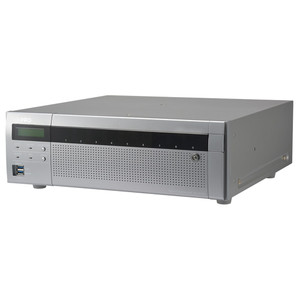
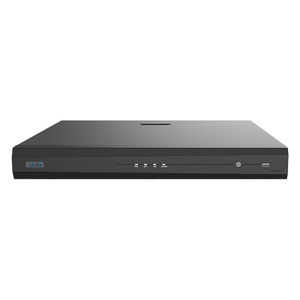
i-PRO WJND400/3000T3 Rack-Mount Network Video Recorder
The i-PRO WJND400/3000T3 is a rack-mount network video recorder designed for centralized surveillance infrastructure in professional security deployments. This NVR consolidates video recording, playback, and management into a single 19-inch rack-compatible appliance, reducing footprint overhead in equipment rooms and monitoring centers. The 3TB internal HDD provides extended retention capacity, while H.264 compression balances storage efficiency with image quality across multi-camera installations.
Key Features
- 3TB Storage Capacity: 3,000GB HDD enables extended recording retention; duration depends on camera count, resolution, and compression settings—typical deployments see 30-90 days of 24/7 footage on mid-sized systems.
- H.264 Compression: Industry-standard video codec reduces bitrate and storage footprint while maintaining playback fidelity across forensic review workflows and evidence export.
- Flexible Bandwidth Control: Client port settings range from 32 kbps to 10 Mbps, plus unlimited option; operators can throttle playback bandwidth per client connection, critical on congested networks or multi-site WAN deployments.
- 8 Camera Groups with Custom Titling: 8 grouping categories support up to 16-character titles per group—simplifies logical organization of multi-building or multi-floor deployments without requiring external management software.
- D-sub 25-pin Control Interface: External device integration for relay outputs, PTZ control, and third-party alarm systems; enables closed-loop automation without API overhead.
- Emergency Recording Input: Dedicated alarm input triggers priority recording on detection; power outage detection input protects against unexpected shutdown.
- Operating Range +5°C to +45°C: Suitable for climate-controlled equipment rooms, server closets, and indoor facilities; does not require supplementary cooling in standard commercial HVAC environments.
- Rack-Mount Form Factor: 19-inch rack integration consolidates NVR with network switches, PoE injectors, and UPS—reduces cable runs and simplifies physical security of recording infrastructure.
The WJND400/3000T3 follows a traditional appliance recording model: video streams from network cameras are received, compressed, and written to local storage on a continuous or event-triggered schedule. The 280x960 output resolution supports multi-monitor display configurations for real-time operator visualization. Bandwidth controls allow fine-grained tuning of playback streams; on networks with constrained uplink capacity (e.g. DSL, satellite), the ability to cap individual client connections to 256 kbps or 512 kbps prevents saturating WAN links during remote review sessions.
Storage lifecycle and retention planning are fundamental to NVR deployment. With 3TB capacity, a 16-camera system recording at mid-bitrate (500 kbps aggregate) will cycle recordings approximately every 30-40 days; larger installations or higher-bitrate streams will require shorter retention or external archival. The included PC viewer software (CD-ROM) enables download of forensic clips without proprietary export appliances, reducing evidence chain-of-custody overhead for law enforcement handoffs or litigation discovery.
Integration with third-party VMS platforms (Genetec, Milestone, Avigilon) depends on the upstream camera ecosystem; if cameras feed the WJND400/3000T3 over ONVIF, the NVR acts as a transparent recording backplane. Direct camera-to-NVR connections via RS-422 or proprietary protocols lock recording to that vendor's ecosystem. Confirm camera compatibility with your integrator before final specification.
The D-sub 25-pin control interface enables hardwired alarm integration—motion relay from an access control panel, tamper switch from a PTZ dome, or emergency activation from a panic button—without requiring network connectivity. This failsafe path is critical in high-security facilities where network saturation or failure must not disable recording triggers.
Ted PerryPerspective based on aggregated and affiliated engineering team experience.
We've deployed the WJND400/3000T3 in mid-tier centralized surveillance setups—government offices, retail chains with 2-4 locations, warehouse operations—where the volume of simultaneous streams and retention window justify a dedicated rack-mount appliance rather than a tower NVR. The real strength is simplicity: no complex VMS licensing, no cloud subscription overhead, no vendor lock-in on analytics. It records video reliably to local disk, and operators can review or export footage using the included viewer. That straightforward model appeals to system integrators managing a dozen sites on a predictable capex and opex. The bandwidth controls are particularly valuable in hybrid deployments where some cameras feed the NVR locally (corporate HQ, warehouse) and others stream over WAN (remote retail). You can cap remote playback to 512 kbps without starving the local recording pipeline. We've also found the emergency recording input indispensable—wiring a motion relay from an access control panel or a tamper switch from a dome directly to the NVR ensures that high-value events trigger priority recording even if the network monitoring software is offline. The trade-off: 3TB storage is modest. On a 16-camera system at full bitrate, you're looking at 30-50 days of continuous recording before the disk rolls over. Larger deployments need either higher bitrate discipline (reduce resolution or frame rate on non-critical cameras) or external archival strategy. Also, the 280x960 output resolution is a ceiling—you cannot exceed that display width on a single monitor without external scaling. Confirm your operator display requirements early. Don't deploy this NVR expecting real-time IP camera stream multicasting or ONVIF discovery integration unless the upstream cameras explicitly support it; assume vendor-specific protocols unless evidence says otherwise.
Technical Highlights:
- H.264 Compression at Device Level: Video is encoded to H.264 on arrival; bitrate tuning per group reduces aggregate network load. On a 16-camera system, this can cut WAN bandwidth 50-70% versus uncompressed or lightly compressed streams from the cameras themselves.
- Flexible Client Bandwidth Allocation: Each remote playback client can be capped independently (32 kbps to 10 Mbps, or unlimited). In a 4-site deployment with a single 10 Mbps WAN link, you can serve 4 simultaneous remote operators at 2 Mbps each during business hours, then unlock to 10 Mbps for archive retrieval after hours.
- Emergency Recording + Power Failsafe: Hardwired alarm inputs bypass network logic entirely. A relay closure from an access control panel will trigger immediate priority recording even if network monitoring software is unresponsive—critical in high-security environments or theft-prone retail locations.
- 3TB Capacity with Local Lifecycle: Disk rollover is predictable; with proper bitrate tuning, you know your retention window. External archival (burn to USB/external HDD) is supported via the PC viewer; no complex NAS or cloud integration required.
- Rack-Mount Integration: 19-inch form factor fits standard racks alongside PoE switches and UPS; eliminates the need for separate furniture or cable glands for a tower appliance.
Deployment Considerations:
- Confirm upstream camera protocol (ONVIF, RS-422, proprietary). The WJND400/3000T3 will integrate with multi-vendor cameras only if they share a common standard; otherwise, you are locked to a single camera family.
- Plan storage lifecycle early. 3TB on a 16-camera system at 500 kbps aggregate bitrate gives approximately 40 days of 24/7 recording. Larger sites or higher retention windows require external archival workflow or multiple NVR units.
- The D-sub 25-pin control interface is legacy but robust—test relay logic (motion input, alarm output) on a bench before final installation to confirm pin assignments and relay voltage compatibility with upstream access control panels.
- Operating temperature range +5°C to +45°C is suitable for climate-controlled equipment rooms but not outdoor or uncontrolled environments. Verify your server room HVAC setpoint; emergency generator rooms or uninsulated closets may exceed the upper limit.
- Display output is 280x960 max. If you require full HD or 4K operator displays, scale video externally or plan multi-monitor tiling—the NVR itself will not exceed that resolution.
The i-PRO WJND400/3000T3 is the right choice for integrators building mid-tier centralized recording systems where simplicity, local storage reliability, and vendor independence matter more than cutting-edge analytics or cloud integration. Avoid it if you need real-time 4K playback, extensive forensic metadata extraction, or VMS-native management—those requirements call for modern IP-native appliances. For traditional CCTV-to-IP migration or small-to-mid commercial sites where reliable local recording and straightforward export matter most, this is a proven workhorse. Explore more options in the i-PRO catalog.