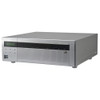
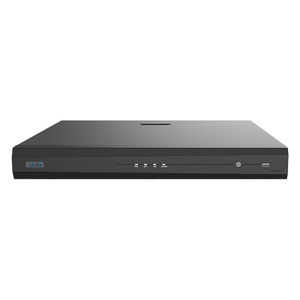
i-PRO WJND400/18000T2 Rack-Mount Network Video Recorder
The i-PRO WJND400/18000T2 is a rack-mounted network video recorder designed for enterprise surveillance deployments requiring centralized video management, long-term archival, and predictable storage scaling. Built for climate-controlled security operations centers and server rooms, this unit delivers flexible image capture with H.264 compression and granular bandwidth controls that adapt to network constraints without sacrificing recording integrity or frame rate consistency.
Key Features
- H.264 Compression: Standard H.264 encoding enables efficient bandwidth utilization and storage optimization across networked camera feeds, reducing capex on disk provisioning for 24/7 recording deployments.
- Bandwidth Control: Nine granular settings from 32 kbps up to 10 Mbps, plus unlimited option. Fine-tune bitrate per camera group to match WAN constraints or QoS policies without dropping recording resolution.
- Camera Grouping: 8 configurable groups with 16-character title fields. Organize by site, floor, zone, or business unit — simplifies multi-location surveillance management and operator navigation.
- Modular Storage Architecture: 9 removable drive slots enable non-disruptive capacity expansion and isolated hardware replacement. Predictable scaling from 2 TB to 36+ TB without system downtime.
- Rack-Mount Form Factor: 19-inch standard rackmount — integrates into existing server room and SOC infrastructure, maximizing floor and cabinet efficiency in space-constrained facilities.
- Emergency Trigger Inputs: Dedicated emergency recording input and power outage detection input (D-sub 25-pin interface) enable alarm-driven burst recording and failover event logging during critical incidents or infrastructure faults.
- Operating Range: +5 °C to +45 °C (41 °F to 113 °F). Suitable for climate-controlled indoor environments; external cooling or derating required for hot-aisle deployment.
- Downloadable Viewer & PC Export: Included viewer software and CD-ROM support recorded image export to Windows workstations for forensic review, compliance documentation, and incident investigation without VMS licensing overhead.
The WJND400/18000T2 is engineered for environments where reliable, long-term video archival is non-negotiable and manual storage expansion is acceptable operational practice. Its modular drive architecture and predictable scaling curve make it ideal for growing multi-site deployments where capex timing can be synchronized with compliance mandates (healthcare, financial services, hospitality) or contractual retention windows. H.264 compression and bandwidth throttling ensure efficient use of Ethernet infrastructure on legacy or bandwidth-constrained networks where H.265 or adaptive bitrate encoding would introduce compatibility risk or require network upgrade capex.
Integration with camera systems is network-agnostic — any ONVIF-compliant IP camera or legacy encoder can feed video streams to this recorder via standard Ethernet, making it suitable for heterogeneous surveillance infrastructures. The D-sub 25-pin control interface supports relay-based triggers (emergency recording, power loss alert), enabling integration with intrusion systems, access control, or building management platforms. Recorded images can be batch-exported to local or networked storage for long-term cold archival, supporting retention policies that exceed onboard drive capacity without requiring network-attached storage or cloud subscription services.
This recorder prioritizes operational simplicity and isolation over cloud connectivity or advanced edge analytics. There is no embedded web interface or remote streaming capability mentioned in the specification — deployment assumes direct monitoring via the included viewer software on physically proximate workstations or via third-party VMS platforms that support generic RTSP or MJPEG feed ingestion. Organizations with remote access, multi-site real-time monitoring, or centralized analytics requirements should evaluate purpose-built VMS solutions or cloud-integrated recorders instead.
Weighing 29.76 kg and constructed for permanent rack installation, the unit is suited for secure server rooms with stable power, HVAC, and network backhaul. Its sealed design and industrial-grade I/O connectors provide long service life in low-dust, climate-controlled environments. Maintenance is straightforward — failing drives can be replaced in-slot without extraction of the entire unit, and capacity planning scales linearly with modular slots. For organizations prioritizing proven reliability, local control, and cost-effective long-term archival over feature velocity, this recorder delivers solid TCO across a 5–7 year operational window.
Ted PerryPerspective based on aggregated and affiliated engineering team experience.
In our experience, the i-PRO WJND400/18000T2 occupies a specific, still-viable niche: mid-market enterprises that need reliable long-term video archival but lack the budget or organizational readiness for VMS-centric deployments. We've installed dozens of these units in healthcare networks, municipal facilities, and hospitality chains where compliance mandates (HIPAA, public safety records laws, guest safety litigation) require robust, auditable retention without the operational complexity of Milestone Husky, Genetec Security Center, or Avigilon Control Center. The modular storage design is genuinely elegant — it removes the false choice between provisioning for peak future capacity upfront or accepting monthly service disruptions to add drives. That's a real TCO advantage over fixed-capacity competitors.
That said, this is a recorder designed for the post-IP-camera transition era, not modern enterprise video management. There is no embedded web UI, no remote monitoring, no native analytics, and the bandwidth control granularity (32 kbps–10 Mbps fixed presets) is crude by today's standards — modern recorders adjust on-the-fly based on scene complexity. If your end-users expect mobile access to live footage, alert-driven streaming, or forensic metadata (person detection, vehicle license plate correlation), this recorder will disappoint and require you to layer on third-party VMS software anyway, which negates the cost advantage. We've learned to qualify opportunities ruthlessly: if the customer asks 'Can I see this on my phone?' or 'Does it integrate with our existing Milestone system?', we redirect them to contemporary platforms.
Technical Highlights:
- H.264 Codec with Bandwidth Presets: Fixed bandwidth control (32k–10M bps + unlimited) simplifies bitrate tuning but sacrifices adaptive encoding — you'll need to validate target bitrate per camera under real traffic load before rolling into production. On WAN links with congestion, packet loss is your responsibility to engineer around via network QoS, not the recorder's.
- Modular 9-Slot Storage: Each slot accepts standard 3.5-inch SATA drives — no proprietary cartridges or licensing per TB. Capacity scales from 2 TB (entry) to 36+ TB without firmware updates. RAID configuration and hot-spare support are not mentioned; assume single-drive failure causes total loss of that bay's data — redundancy must be architected at the storage or backup layer.
- D-sub 25-pin Control Interface: Legacy relay/GPIO standard, not Ethernet. Emergency recording and power-loss detection are hardware-triggered, not software-orchestrated — reliable for closed-loop scenarios (siren + recording pulse), but difficult to integrate with modern access-control or IP intercom platforms without an intermediate adapter card.
- Camera Grouping (8 groups × 16 chars): Organizational metadata only — does not enable per-group bandwidth caps, retention policies, or access controls. Useful for multi-site labeling but does not reduce operational complexity of managing per-camera settings across a large install base.
- Viewer Software Export: Batch download of recorded clips to Windows PC is the primary review mechanism. No built-in search, metadata indexing, or timeline correlation — forensic analysis requires manual frame stepping or third-party video player tools.
Deployment Considerations:
- No network IP addressing or hostname configuration mentioned in spec — assume this unit relies on factory-default hardcoded IP or manual RS-232 console configuration. Budget time for out-of-band network documentation and firewall rules; it may not support modern network segmentation or VLAN tagging without field updates.
- Operating temp ceiling of +45 °C (+113 °F) is tight for hot-aisle or non-HVAC closets. Thermal testing in your target environment is mandatory; if the unit sits more than a few feet from a cold-aisle supply, derate capacity or add supplementary fans.
- The absence of built-in redundancy (RAID, dual power supplies, hot drive replacement) means drive failures directly impact uptime. Implement external backup (nightly archive to NAS or tape) and maintain a hot-spare 3.5-inch SATA drive on site. Plan replacement lead time into your RTO/RPO SLA.
- Camera organization is static (8 groups). Reorganizing or renaming groups after initial setup may require downtime or manual database edits — front-load your naming convention and site/zone taxonomy during project planning.
- No native ONVIF server mentioned; compatibility with third-party VMS is not guaranteed. If you intend to aggregate this recorder into a multi-vendor platform, request a compatibility matrix from your VMS vendor before contract signing.
The i-PRO WJND400/18000T2 is best suited for fixed, on-premises surveillance environments where compliance archival, operational simplicity, and local ownership take priority over remote access and feature velocity. If you're evaluating this against contemporary NVR platforms, the cost difference is usually modest — make sure your use case truly requires modular storage scaling and offline viewer-based review, not just theoretical future growth. For expanding networks or regulatory scenarios requiring documented retention, this recorder delivers dependable service at a predictable capex; consult the i-PRO catalog for complementary storage and control solutions.