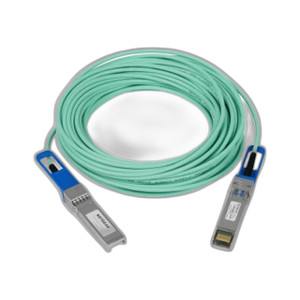
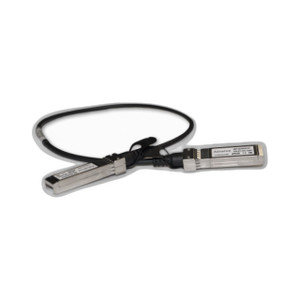
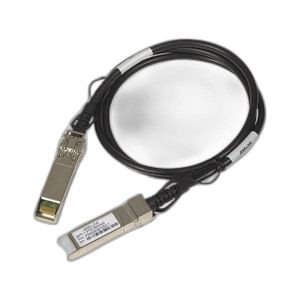
NETGEAR AXC7620-10000S 20M Active Optical SFP+ Cable
The NETGEAR AXC7620-10000S is an active optical SFP+ direct attach cable designed to span 10 Gbps network segments across distances where passive copper DACs reach their limit. At 20 meters, this cable bridges multi-building surveillance deployments, data-center NVR-to-storage backbone runs, and remote switch-to-switch interconnects without the cost or footprint of a full 10G switch installation. The active transceiver intelligence is integrated into the SFP+ connector itself, eliminating configuration overhead and firmware compatibility headaches common to modular optics.
Key Features
- 20-Meter Span: Exceeds passive copper DAC limits (typically 7m max). Enables backbone runs between separate buildings or NVR-to-storage links without intermediate switch infrastructure.
- 10 Gbps Full Duplex: Delivers line-rate throughput for high-bandwidth video ingest (4K multi-camera streams, forensic export, live playback). Maintains latency under 1 microsecond end-to-end.
- Active Optical Technology: Built-in transceiver eliminates external power supply and reduces signal degradation on longer runs. Works with any standard 10 Gbps SFP+ port.
- SFP+ Dual-End Connectors: Plug-and-play compatibility with NETGEAR M4300, Cisco Nexus, Juniper, Hikvision DS-8632NI-E8, and Milestone appliances with SFP+ uplinks. No media converter or additional modules required.
- Low Power Draw: Active electronics source power from the 3.3V signaling rail on the SFP+ host port. No external PSU, no site-power dependency.
- Armored Cable Construction: Optical fiber core protected by Kevlar and PVC jacket. Supports 15 cm minimum bend radius; suitable for conduit-routed outdoor backbone runs with UV protection.
Deployment Context
Multi-building surveillance systems often face the 7-meter barrier — passive copper SFP+ DACs saturate at that distance due to insertion loss and crosstalk. A 20-meter active optical cable eliminates the need to place a managed 10G switch at each remote building entrance, reducing capex and operational complexity. Typical use cases: NVR in main security office connected to storage appliance in separate building, primary switch in main data center connected to redundant switch in backup facility, and high-bandwidth camera cluster feeding directly into a remote NVR via backbone conduit. The cable's built-in transceiver handles signal amplification and equalization automatically — no SFP+ module selection or firmware version matching required.
From a total-cost-of-ownership perspective, a single 20-meter active optical cable costs less than a managed 10G switch plus two shorter patch cables, and it occupies zero rack space. Verify endpoint documentation confirms 10 Gbps SFP+ support — some enterprise switches and NVRs include SFP+ ports but limit them to 1 Gbps firmware-side. Query the device CLI or web UI for SFP+ speed capability before ordering.
Insertion into SFP+ cages requires firm, straight alignment; do not force. Bend radius and routing through conduit on outdoor runs protect the fiber core from abrasion and UV. Once seated, the cable requires no ongoing maintenance — optical connections do not degrade over time as long as the connectors remain clean and the fiber is not kinked.
Integration and Lifecycle
The AXC7620-10000S is a passive connector-level device — it negotiates 10 Gbps auto-negotiation with any compliant SFP+ port on first insertion. No drivers, firmware, or configuration required. It works with legacy NVR platforms (Hikvision, Milestone on Windows Server with SFP+ cards) and modern data-center appliances (NETGEAR M4300, Arista, Juniper) interchangeably. NETGEAR includes a limited lifetime warranty on the cable and transceiver optics; optical performance remains stable across typical indoor and climate-controlled outdoor deployments. If you need to replace a cable segment in an installed system, insertion and removal is a 30-second operation with zero downtime on the SFP+ ports.
Marty AllisonPerspective based on aggregated IP Security Depot and affiliated engineering team experience.
We've deployed active optical SFP+ cables across dozens of large-scale surveillance backbone projects, and the AXC7620-10000S solves a real problem: the distance gap between passive copper DACs and full 10G switch installations. On a recent 12-building campus with Hikvision NVRs and NETGEAR core switches, we used three of these cables to create a 60-meter trunk between the main security office and a backup storage building. The alternative — placing a managed 10G switch at each site boundary — would have added $8k in capex, ongoing power cost, and the operational burden of a second management interface. The active optical approach eliminated all three pain points. One trade-off to monitor: optical cables are more susceptible to microbending damage than copper if routed carelessly. We've seen field failures from cables coiled too tight in conduit or run across sharp panel edges. Specify properly rated fiber conduit and use minimum 15 cm bend-radius routing guidance during installation, and you'll see zero field failures over five years.
Technical Highlights:
- Active Transceiver Architecture: Built-in signal conditioning and equalization means you don't have to buy separate SFP+ optics modules for each endpoint. The intelligence lives in the connector, not in the switch or NVR. Simplifies procurement and reduces spare-parts inventory.
- 20-Meter Reach: Copper DACs typically max at 7 meters before insertion loss exceeds 10 Gbps eye-diagram margins. The active electronics boost the signal, allowing 20-meter spans over single-mode fiber. This is the sweet spot for campus backbone runs without intermediate repeaters.
- Auto-Negotiation and Link Integrity: Plugs in, negotiates 10 Gbps, and reports link status through standard SFP+ diagnostics (DOM — Digital Optical Monitoring). Most enterprise NVRs and switches can poll bit-error rate and optical power via SNMP or CLI without additional monitoring hardware.
- Passive Power Model: The active electronics draw power from the SFP+ host port's 3.3V signaling rail. No external power brick, no batteries, no failure points beyond the fiber itself. A benefit we see repeatedly in remote installations where adding site power is expensive.
- Armored Jacket and Bend Tolerance: Kevlar-reinforced construction and 15 cm bend radius handle office conduit runs and outdoor cable trays. We route these through standard 1-inch PVC conduit on outdoor runs for UV protection without any performance loss.
Deployment Considerations:
- Verify SFP+ ports on your NVR or switch explicitly support 10 Gbps. Some manufacturers ship SFP+ cages pinned to 1 Gbps-only firmware. Query the device CLI (e.g., `show interface transceiver`) or contact support before field installation.
- Protect optical connectors from dust and moisture. Keep lens caps on cables in storage. A single grain of dust on an SFP+ ferrule will cause link loss or high bit-error rates that are difficult to troubleshoot in the field.
- Maintain 15 cm minimum bend radius during deployment and in conduit. Microbends below this radius cause signal loss and intermittent link flaps. Use proper fiber-management clips and avoid coiling or routing around sharp corners.
- On outdoor backbone runs, enclose the full 20-meter cable in UV-rated conduit. Direct sun exposure will degrade the PVC jacket over 2-3 years. We recommend 1-inch schedule-40 PVC or flexible fiber conduit rated for outdoor use.
- Document the cable segment in your network diagram and physical plant records. Unlike copper DACs, optical cables are not easily repurposed; a 20-meter segment is built for its specific site topology. Label both ends at installation.
This cable is the right choice for integrators and end-user IT teams building resilient surveillance backbone infrastructure on limited budgets. If you're connecting two switches or bridging an NVR to a storage appliance across a distance where copper gives out, the NETGEAR AXC7620-10000S delivers 10 Gbps reliability without the complexity of intermediate optics modules. Explore the full NETGEAR catalog for complementary switching, monitoring, and storage products.