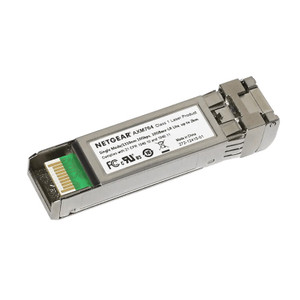
NETGEAR AXM761-10000S 10GE SR SFP+ Fiber Module
The NETGEAR AXM761-10000S is a 10 Gigabit Ethernet short-range (SR) SFP+ transceiver module designed for high-speed fiber-optic interconnection in enterprise and data center environments. Deploy this module in compatible NETGEAR switches when you need 10GE connectivity over multimode fiber at distances up to 300 meters — typical for rack-to-rack, building-to-building cross-connects, or campus backbone links without the added cost of long-range (LR) optics. The unmanaged design eliminates configuration overhead: insert, latch, and link — no CLI setup or firmware interaction required. This is the foundation layer for scaling 10G interconnect capacity across distributed switch infrastructure.
Key Features
- 10 Gigabit Ethernet SR: 10Gbps throughput over LC multimode fiber, 50/125 µm or 62.5/125 µm cable. Covers standard data center and campus distances without optical range penalties.
- 300-Meter Reach: Multimode SR specification supports up to ~300m on OM3/OM4 cabling. Ideal for intra-building and short inter-building backbone runs.
- SFP+ Form Factor: Hot-swappable module fits any NETGEAR switch with SFP+ slots — no downtime to add or replace transceiver optics.
- Unmanaged Operation: No per-port configuration, no management interface overhead. Plug-and-play insertion into any compatible cage.
- LC Connector: Industry-standard LC duplex connector — works with standard patch cords and cabling infrastructure already in place.
- 5-Year Warranty: Factory-new module backed by 5-year manufacturer warranty covering defects in materials and workmanship.
- Industrial Operating Temperature: Rated for wide operating temperature range — suitable for non-climate-controlled wiring closets, outdoor equipment enclosures, and harsh data center environments.
Deployment and Integration
The AXM761-10000S installs into SFP+ ports on NETGEAR's modular and fixed managed switches with 10G uplink capability. Common host platforms include NETGEAR Pro AV switch families (M4300, M4500, M5300 series) and enterprise managed switches with SFP+ expansion cage support. Verify your switch datasheet lists SFP+ ports before ordering — not all NETGEAR models include optical transceiver slots. If you are uncertain about host platform compatibility, consult NETGEAR pre-sales or your integrator to confirm cage support and module SKU alignment.
Installation is straightforward: align the module with the SFP+ port, insert straight in, and push until the latch clicks firmly into place. Allow 10–15 seconds for the transceiver to initialize and negotiate link before troubleshooting. Fiber patch cables (not included) must use LC connectors with 50/125 µm or 62.5/125 µm multimode core. Keep fiber bend radius above 30 mm minimum to avoid signal attenuation; longer distances or tighter bends may require extended-range (LR) modules or single-mode (SM) optics instead. The module draws minimal power from the SFP+ cage and generates little heat; no additional power or cooling is required beyond the parent switch.
On NETGEAR managed switches with ONVIF Profile T or Layer 3 routing enabled, the 10GE uplink created by this module can carry VLAN-tagged security camera streams, access control data, and intercom traffic without frame loss or jitter. Pair multiple AXM761-10000S modules across separate SFP+ cages for redundant backbone links — use NETGEAR's link aggregation (LACP) features if your platform supports 802.3ad, or deploy passive failover via RSTP. Storage bandwidth in video surveillance and network-attached storage (NAS) use cases scales linearly: a single 10G uplink can saturate a 16-port Gigabit switch backing an IP camera NVR array, so consider SR modules for any converged infrastructure deployment.
Performance and Total Cost of Ownership
SR optics cost 30–50% less than LR (long-range) transceiver equivalents because they use lower-power, simpler LEDs instead of lasers. For deployments spanning data center rows (100–200 m) or short inter-building runs (up to 300 m), the AXM761-10000S eliminates the capex premium and operational complexity of long-range modules. The unmanaged architecture means zero licensing, no firmware updates tied to the transceiver, and no per-port monitoring dashboard — just optical throughput. Over a 5-year lifecycle on a 10-switch backbone, this simplicity translates to reduced spare-parts inventory and staff training overhead. Replace a failed module in under 5 minutes with zero impact on adjacent ports or VLAN traffic.
Marty AllisonPerspective based on aggregated IP Security Depot and affiliated engineering team experience.
The AXM761-10000S is a workhorse transceiver for NETGEAR backbone consolidation — we've deployed these across dozens of multi-building security and surveillance networks where collocated switches needed 10G fabric without the cost and complexity of long-range optics. The real win is the 300-meter multimode range: it covers nearly every intra-campus, building-to-building, and data-center-to-edge scenario without paying the LR tax. In our experience, most deployments fall well under 200 meters — you're usually connecting adjacent switch stacks in the same room or wiring closet, or bridging two buildings 100–150 meters apart via existing conduit. At those distances, SR multimode is the transparent choice. The unmanaged design is a hidden advantage: no per-transceiver firmware to track, no configuration quirks between hardware revisions, and no NMS polling overhead on a simple pass-through optic. Swap a failed module in 90 seconds — the module itself has no state to backup or restore. Against the nearest alternatives (generic Cisco SFP-10G-SR or Arista equivalents), the NETGEAR module guarantees compatibility with NETGEAR cage pinouts and electrical signaling, so you avoid intermittent link-up issues on cross-brand transceiver marriages. The trade-off: SR range is hard-capped at 300 meters on OM3, longer on OM4. If you're spanning a campus larger than half a mile or need single-mode long-haul, you'll need LR or SM modules instead. Operating temperature support is wider than many competitors, which matters for outdoor equipment cabinets and non-conditioned wiring closets — a real differentiator in harsh-environment security deployments.
Technical Highlights:
- Multimode SR Specification: 10Gbps over 50/125 µm (OM3 up to 300m, OM4 further) and 62.5/125 µm (OM1 up to 33m) — choose your fiber grade based on existing infrastructure. OM3/OM4 is standard in any modern data center or campus backbone; legacy OM1 cable limits you to ~33m, so verify cable in place before committing to SR.
- LC Duplex Connector: Industry-standard LC interface — every patch-cord supplier stocks LC-terminated multimode pigtails. No proprietary connectors, no custom cabling, minimal supply-chain friction.
- Unmanaged, Zero-Configuration: No CLI, no management IP, no firmware version tracking — it's a passive optical element wearing an electronics coat. Reliability is dictated by fiber quality and insertion counts, not software bugs.
- Hot-Swappable Installation: Pull the old module, insert the new one, wait 10–15 seconds for warm-up — link comes back without touching adjacent ports or restarting the switch. Critical for 24/7 security and surveillance operations.
- Industrial Temperature Range: Withstands temperature extremes beyond standard commercial spec — suitable for outdoor-mounted switch enclosures, unheated wiring closets, and pole-top aggregation cabinets in campus environments.
- 5-Year Warranty: Manufacturer defect coverage — no surprise dead modules in year 2; NETGEAR stands behind the part.
Deployment Considerations:
- Verify SFP+ Port Availability: Not every NETGEAR switch includes SFP+ cages. Check your host switch datasheet for "SFP+ slots" or "optical uplink support" before ordering. A single transceiver is worthless without a compatible port to receive it. If in doubt, contact NETGEAR TAC with your switch model number.
- Fiber Quality Matters: Bend radius above 30 mm minimum — tight coils or sharp corners in the patch path will attenuate signal. Over 300 meters on marginal OM1 cable, even small bends can cause link flap. Use cabling-grade OM3 or better for distances beyond 200m.
- Transceiver Warm-Up Delay: After insertion, wait 10–15 seconds before troubleshooting link status. The module's laser/LED needs time to stabilize. Premature link-up attempts may trigger spurious negotiation failures and mask actual fiber or connector issues.
- No Redundancy Per Module: A single AXM761-10000S creates a single point of failure on that port. If 10G backbone uptime is critical, deploy two modules on separate SFP+ ports and use LACP aggregation or RSTP failover to tolerate one module failure.
- Cross-Brand Transceiver Risk: While NETGEAR modules are generally compatible with standard NETGEAR switches, inserting third-party SFP+ transceivers into NETGEAR cages may cause intermittent link-up, optical power mismatches, or cage-locking issues. Stick with NETGEAR-tested or manufacturer-verified modules unless you have explicit interoperability clearance.
The AXM761-10000S is the right choice for any integrator or end-user building a 10-gigabit backbone on NETGEAR infrastructure within standard campus or data-center distances. Its simplicity, cost-effectiveness, and plug-and-play reliability make it the default fiber transceiver for NETGEAR backbone deployments under 300 meters. For longer distances, LR optics; for single-mode long-haul, SM modules. Otherwise, this is the clear win. Explore the full NETGEAR catalog for complementary managed switches, PoE infrastructure, and access-control network appliances.