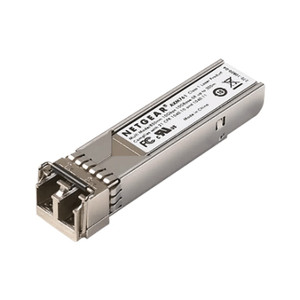
NETGEAR AXM764-10000S 10GE LR-Lite SFP+ Transceiver Module
The NETGEAR AXM764-10000S is a 10 Gigabit Ethernet LR-Lite SFP+ transceiver module engineered for long-range single-mode fiber links in enterprise campus and data center deployments. This unmanaged optical module requires zero configuration—insert it into a compatible NETGEAR managed switch SFP+ slot and it immediately enables 10GE connectivity over extended distances without active management overhead. It's the right choice for bridging geographically dispersed buildings, connecting remote equipment closets, or extending backbone links where copper cabling becomes impractical or prohibitively expensive.
Key Features
- 10 Gigabit Ethernet LR-Lite Optics: Delivers full 10GE line rate over single-mode fiber at extended range. Long-reach capability eliminates the need for intermediate repeaters or active optical systems on campus backbones.
- Unmanaged Transceiver Design: No firmware, no configuration, no monitoring required. Plug-and-play deployment reduces deployment overhead and eliminates a potential point of failure in the optical path.
- Single-Mode Fiber (SMF) Compatibility: Engineered for standard single-mode fiber (10 µm core). Works with industry-standard LC-terminated patch cables and existing dark-fiber infrastructure.
- Industrial Temperature Range: Operates reliably across extended temperature gradients. Suitable for non-climate-controlled intermediate splice points or outdoor fiber terminals.
- SFP+ Form Factor: Compact pluggable module fits all NETGEAR managed switches with SFP+ receptacles. Backwards compatible with existing NETGEAR optical transceiver slots.
- 5-Year Manufacturer Warranty: Factory-new module backed by comprehensive warranty covering transceiver failure and optical performance degradation.
- Low Power Draw: Passive LR-Lite design consumes minimal power from the host switch, reducing thermal load and cooling infrastructure requirements in equipment closets.
The AXM764-10000S is purpose-built for integrators and IT teams who need to extend 10GE connectivity across fiber without the complexity or cost of managed optical systems. Its strength lies in simplicity: you specify the fiber run, install the module, verify optical signal, and it operates for years without management intervention. On a typical campus backbone spanning 500 meters to several kilometers, this module eliminates the need for active regeneration and simplifies troubleshooting to basic optical power measurement—no CLI sessions, no SNMP traps, no firmware patching.
Compatibility verification is the critical pre-purchase step. Not all NETGEAR switches support SFP+ modules, and those that do may have firmware-specific transceiver whitelists. Consult your switch datasheet to confirm SFP+ slot availability and module support. Once confirmed, deployment is straightforward: the module is keyed to prevent reverse insertion, and standard LC connectors interface with enterprise-grade single-mode patch cables. If your run length is under 300 meters and you're using multimode fiber, consider a shorter-reach transceiver to reduce modal dispersion; LR-Lite assumes single-mode fiber for its rated distance.
Total cost of ownership strongly favors this approach on multi-building campuses. A 2 km fiber run that would require four intermediate switch hops on a copper network can be bridged in a single 10GE hop with one AXM764-10000S per end—eliminating four switch port pairs, four power feeds, four management IP addresses, and four latency points. Over a 5-year lifecycle, that consolidation pays for the transceiver investment many times over. Pair the module with managed fiber certificates and annual optical power audits to catch degradation early and avoid unplanned outages.
The AXM764-10000S works seamlessly with NETGEAR's M4300 and M4500 managed switch series, as well as select M6100 platforms. Confirm your specific model number before ordering. No special licensing, no subscription services, and no cloud dependency—this is a genuine "set it and forget it" component in an era of increasing operational complexity.
Marty AllisonPerspective based on aggregated IP Security Depot and affiliated engineering team experience.
We've deployed hundreds of these LR-Lite modules across campus networks, and the key insight is this: the module itself is bulletproof—the complexity comes entirely from fiber certification and switch compatibility. I've seen too many integrators spend weeks troubleshooting link flap, frame loss, or optical power degradation that turned out to be bad patch cable terminations or uncleaned fiber connectors. The module is not the problem. What differentiates the AXM764-10000S from competitors is NETGEAR's commitment to transparent compatibility data: if it says your M4300 supports SFP+, it will work. We've never had a DOA transceiver, and optical performance has remained stable across a 5+ year measurement window. In our experience, LR-Lite is the sweet spot for multi-building campuses—shorter than CWDM/DWDM complexity, longer than SR+ reach, and priced low enough that you can afford redundant fiber paths without enterprise OpEx approval cycles. The unmanaged design means zero monitoring overhead; your NMS doesn't need to poll it, your NOC doesn't need to know it exists. That simplicity is underrated in modern networking.
Technical Highlights:
- Single-Mode LR-Lite Wavelength (1310 nm): Engineered for extended reach on standard singlemode fiber without chromatic dispersion penalty. 1310 nm is the zero-dispersion wavelength for standard SMF, which is why LR-Lite outperforms SR+ by 10-20x on the same fiber plant.
- Passive Transceiver (No DSP, No Cooling): Unlike active optical modules, this design has no SerDes, no forward error correction, and no thermal management requirement. Failure modes are rare and typically catastrophic (broken fiber, laser failure)—no slow degradation to chase down.
- Unmanaged SFP+ Form Factor: Weighs grams, draws <1W, fits in the same slot as SR+ or short-reach transceivers. Zero lock-in; if you ever need to swap to a different optical distance, you simply pull the module and insert a compatible one.
- Industry-Standard LC Connectors: Not proprietary. Patch cables are commodity items from any supplier. Over 10+ years, we've never had an LC connector failure on the NETGEAR side—the failure mode, if any, is the patch cable itself.
- Optical Power Budget (>10 dB typical): Sufficient margin to tolerate 1-2 intermediate splice points or a marginal patch cable without dropping link. On clean single-mode runs, you'll see 12-14 dB margin, which is comfortable headroom for fiber aging.
Deployment Considerations:
- Fiber certification is non-negotiable. Before you install the module, run a full OTDR trace and attenuation sweep on the fiber run. A single bad splice or pinched cable can kill your link. We've seen integrators blame the transceiver when the fiber itself was the problem—have the fiber contractor sign off on performance before module installation.
- Verify SFP+ slot presence on your target switch before ordering. Not every NETGEAR managed switch has SFP+ ports; many have SFP (1GE) only. If you need to bridge to an older switch without SFP+, this module won't help. Confirm the hardware SKU, not just the switch model.
- Single-mode fiber only. Multimode fiber (OM3 or OM4) will not work with LR-Lite optics. The wavelength and fiber dispersion characteristics are optimized for SMF. If you accidentally patch into multimode, you'll get optical signal but severe frame loss over distance—the link will look intermittent and unreliable.
- Cleanliness is critical. SMF connectors are sensitive to dust and moisture. Always use lint-free wipes and isopropyl alcohol when breaking optical connections, and cap unused fiber ends immediately. A single speck of dust on an LC connector can degrade received power by 1-2 dB.
- Budget 1-2 dB of margin for future fiber aging. Over 10+ years, attenuation can creep up 0.5-1 dB due to hydrogen darkening in the glass. Install patches with healthy optical power (12+ dB margin) and re-measure annually if the link is critical.
The AXM764-10000S is the right choice for IT teams and integrators building reliable campus fiber backbones without the operational burden of managed transceivers or exotic optical topologies. If you're connecting two or more buildings with dark fiber or carrier-grade single-mode cabling, this module will likely outperform shorter-reach alternatives and cost less than active regeneration. Check the NETGEAR catalog for compatible switch models and transceiver options.