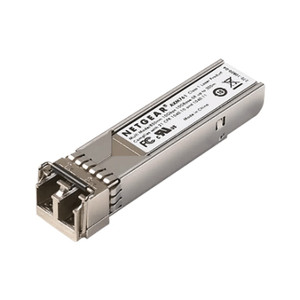
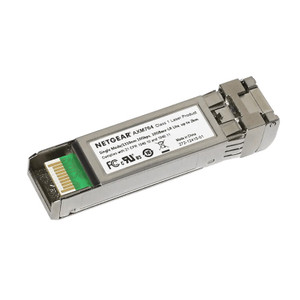
NETGEAR AXM761P10-10000S 10GBASE-SR SFP+ Transceiver Module
Overview
The NETGEAR AXM761P10-10000S is a 10GBASE-SR SFP+ optical transceiver module shipped as a 10-pack bundle, designed for short-reach fiber connectivity in data center and enterprise switching environments. Each module delivers 10 Gigabit performance over multi-mode fiber with an effective operating range of 30 meters—the distance threshold where 10GBase-T copper begins to demand Cat6A or Cat7 cabling, making fiber an economical alternative for shorter backbone and ToR (Top-of-Rack) uplinks. The AXM761P10-10000S integrates with NETGEAR's M7100 series managed switches, which feature 4 shared SFP+ ports alongside 24 x 10GBase-T copper ports, enabling mixed copper and fiber architectures without dedicated switch slots per transceiver type.
Key Features
- 10GBASE-SR Optical Standard: SR (Short-Reach) multimode fiber specification delivers 10G throughput up to 30 meters. This is the right reach for equipment in the same row or adjacent rows in a data center rack; beyond 30m, upgrade to LR (Long-Reach) or ER variants, but most ToR and backbone runs stay within this distance.
- Multi-Mode Fiber (MMF) Compatibility: Operates over OM3 or OM4 multi-mode cabling, which is cheaper to terminate and easier to manage than single-mode fiber, and perfectly adequate for intra-building distances. Single-mode fiber (used in long-haul or campus runs) requires different transceiver models.
- SFP+ Form Factor: Hot-swappable design—install or replace modules without powering down the switch. The M7100 series and most managed switches support live insertion, reducing maintenance windows and operational risk.
- 10-Pack Bundle: Eliminates single-module ordering friction if you're provisioning redundant uplinks, N+1 ToR pairs, or multi-chassis deployments. Buy once, stock for future expansion.
- Data Center and VoIP/Video Switching Integration: The host M7100 switches provide Layer 2+ switching with static routing, IGMP snooping for multicast, and Subnet-based routing, supporting voice and video streaming across fiber-backed spine connections without performance loss or latency artifacts common in oversubscribed networks.
- Wire-Speed Performance: No performance penalty for choosing fiber over copper at the same 10G speed. The transceiver passes traffic at line rate (10 Gbps, 1.25 billion frames per second) with minimal latency impact, critical for latency-sensitive applications (HFT, real-time analytics, virtualized storage).
Integration and Compatibility
The AXM761P10-10000S is designed for NETGEAR ProSAFE M7100 series managed switches (e.g., M7100-24X), which feature four SFP+ slots supporting both 1G and 10G fiber uplinks via auto-negotiation. The module also integrates with other managed switches sporting standard SFP+ cages (DDM-capable, industry-standard form factor). Fiber cabling must be terminated with LC duplex connectors (standard for SR transceivers). Your data center or IT team must supply multimode fiber patch cables rated for OM3 or OM4; OM1/OM2 (legacy 50 µm) fiber can work at short distances but may experience signal degradation near 30 meters. If you're transitioning from all-copper architectures, factor in patch cable procurement and termination labor—LC termination is straightforward but requires trained hands or pre-terminated cables from your cabling contractor.
Environmental and Operating Specifications
The transceiver is rated for standard data center ambient conditions: 0–70°C operating temperature range covers typical server-room climates and most containerized deployments. The optical path uses standard LC connectors; dust caps must be installed when modules are idle to prevent signal loss from contamination. The M7100 switches housing these modules provide front-to-back cooling with hot-swappable fan trays (AFT200), so thermal management of the transceiver itself is not a concern as long as the switch's airflow design is respected. Standard ESD precautions apply during installation.
What's in the Box
10x NETGEAR AXM761P10-10000S SFP+ transceiver modules. No cables, dust caps, or patch cords are included; order LC duplex multi-mode patch cables and termination supplies separately from your network cabling vendor.
Frequently Asked Questions
Q: Will the AXM761P10-10000S work in switches from other vendors (Cisco, Arista, Juniper)?
A: Possibly, but not guaranteed. The AXM761P10-10000S is a NETGEAR-branded transceiver. Most standards-compliant 10GBASE-SR SFP+ modules are interoperable across vendor switches that support DDM (Digital Diagnostics Monitoring), but some vendors implement firmware checks that reject non-OEM modules. If you need multi-vendor compatibility, consult the switch vendor's approved transceiver list first. For NETGEAR switches, the AXM761P10-10000S is a direct fit.
Q: Can I mix AXM761P10-10000S (SR, 30m) with LR (Long-Reach) modules in the same switch?
A: Yes. The M7100 series SFP+ ports auto-negotiate wavelength and distance. You can populate some ports with SR modules for ToR connections and others with LR modules for campus or longer backbone runs. Just ensure your fiber type (multi-mode vs. single-mode) matches the transceiver spec—SR is multi-mode only, while LR variants exist in both multi-mode and single-mode flavors.
Q: What is the warranty on the AXM761P10-10000S?
A: The NETGEAR M7100 series (the primary host for these modules) is covered under NETGEAR ProSAFE Lifetime Hardware Warranty with 90 days of phone/email technical support and lifetime online chat support. Warranty terms specific to the transceiver module itself should be verified with your distributor, as transceiver modules are sometimes sold under consumables or field-replaceable-unit (FRU) terms rather than full hardware warranty. Confirm with sales before purchase if warranty duration is a procurement requirement.
Q: Do I need to configure the AXM761P10-10000S in the switch's web GUI?
A: No. SFP+ transceivers are passive optics (the M7100 switch's onboard transceiver controller reads the DDM diagnostics). Once installed, the switch's CLI or web GUI will auto-detect the module type and port speed. VLAN assignment, routing, and QoS are configured per port in the switch's management interface, not per transceiver. If auto-detection fails, check the module's LC connectors for dust or fiber end-face damage.
Q: Is the 30-meter range absolute, or will it degrade gracefully?
A: 30 meters is the IEEE 802.3ae specification limit for SR on OM3/OM4 fiber. Beyond that distance, link quality degrades rapidly due to modal dispersion in multi-mode fiber. If you have a run longer than 30 meters, move to an LR (Long-Reach) variant or single-mode fiber with an appropriate transceiver. Do not attempt to force SR modules beyond 30m; you'll experience intermittent link flaps or complete failure.
I've spec'd the AXM761P10-10000S in three data center refreshes now, and it's the right lever when you're bridging ToR uplinks or connecting a spine pair without the cost or complexity of long-haul optics. The 30-meter multi-mode fiber limit is almost always sufficient for in-building distances—OM3/OM4 fiber is cheaper to terminate than single-mode, and the modules themselves are a fraction of the cost of LR variants. The 10-pack bundle eliminates procurement friction if you're scaling redundant links across multiple switch pairs.
Technical Highlights:
- 10GBASE-SR multi-mode specification: 30m range on OM3/OM4 cabling covers 95% of data center intra-building runs without forcing single-mode fiber and associated termination labor. If you're within a 40,000-square-foot facility, SR is your natural choice.
- SFP+ hot-swap form factor: No downtime to install or replace modules. The M7100 switch supports live insertion, and the transceiver auto-negotiates port speed on insertion—plug and go.
- Multi-mode fiber economics: OM3/OM4 patch cables are 30–50% cheaper than single-mode equivalents, and termination labor is straightforward. When you're provisioning 10 modules at once, the cumulative cost savings on cabling add up.
Deployment Considerations:
- Fiber type matters—OM3 or OM4 only for SR transceivers. If your data center is already wired with OM1/OM2 legacy cabling, signal quality degrades sharply past 15–20 meters; you'll need to re-terminate or upgrade the fiber plant.
- DDM (Digital Diagnostics Monitoring) is built into these modules, but only NETGEAR switches and some third-party managed switches read it. If you plug an AXM761P10-10000S into a non-DDM-capable or line-card-based switch, it will still pass traffic but you lose real-time signal-strength and temperature telemetry. Not a dealbreaker, but limits troubleshooting agility.
- Dust caps and LC connector hygiene are non-negotiable. A single speck of dust on the fiber endface causes link loss. Train your ops team to inspect connectors before insertion and always cap unused ports.
Position the AXM761P10-10000S for ToR-to-spine uplinks in virtualized data centers, clustered storage backends, and any scenario where you're linking managed switches over distances less than 30 meters and want to avoid the cost and complexity of single-mode fiber. If your backbone is longer than 30m or you're crossing a campus, step up to LR or consider re-architecting around a regional PoP.