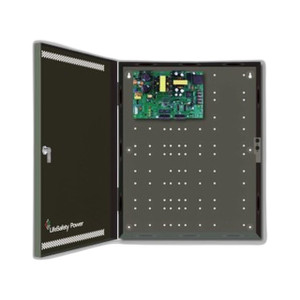
Lifesafety Power RS250-M16 150W Power Supply with 8 Relay Lock Outputs
The Lifesafety Power RS250-M16 is a mid-capacity power distribution unit designed for access-control installations requiring independent relay-switched lock control and auxiliary power distribution. Rated 150W at 12A/12V or 6A/24V, it delivers eight relay-controlled lock outputs (each fused at 3A, field-selectable for failsafe or failsecure operation) plus sixteen 2.5A-limited DC auxiliary outputs across dual buses. Pre-assembled in an E6 enclosure with Mercury MR52 control board and Panduit internal routing, it reduces on-site wiring labor and integration risk for multi-door access-control installations spanning up to eight doors.
Key Features
- Dual Output Configuration: 8 relay-controlled lock outputs (3A fused per output) + 16 Class 2 power-limited auxiliary outputs (2.5A per output). Supports mixed failsafe/failsecure lock configurations on a single supply.
- Selectable Voltage & Current: Configured 12A/12V or 6A/24V at factory or field-switchable. Choose 12V for magnetic locks; 24V for extended runs and higher noise immunity on control wiring.
- Independent Failsafe/Failsecure Control: Each relay output selectable for FAI (monitored), failsafe, or failsecure operation. Eliminates need for external relays or hybrid boards on mixed-mode installations.
- Dual Bus Architecture: Sixteen auxiliary outputs split between Bus1 and Bus2 for independent power sequencing and isolation. Reduce nuisance lockouts when one ancillary subsystem (door holder, sensor, etc.) draws transient spikes.
- Pre-wired Mercury MR52 Board: Factory-mounted control board with Panduit routing and Mercury back plate. Cuts assembly time vs. bare power supplies and ensures consistent internal layout across jobs.
- E6 Steel Enclosure (30H × 23W × 6.5D): Shallow depth fits standard ADA-compliant door-frame cabinets; industrial-grade steel chassis rated for wall or DIN-rail mounting.
- Monitored Relay Outputs: Each lock relay is fused independently; auxiliary outputs Class 2 current-limited for safety and code compliance on low-voltage circuits.
- Eight-Door Ready: Supports up to eight independently controlled locking points with one power source, reducing panel count and consolidating access-control distribution.
The dual-voltage design (12V/24V switchable) accommodates both short-run mag-lock arrays and longer wire runs where 24V reduces voltage drop and improves coil response time. Each relay output's failsafe/failsecure setting is independently selectable, meaning you can deploy a single RS250-M16 across a mixed-security floor plan—emergency egress doors set to failsafe, secured back-office doors set to failsecure—without additional relay modules. The sixteen auxiliary outputs, split across two buses, allow independent power management: for example, isolate a door-holder circuit on Bus2 from motion-sensor power on Bus1, preventing sensor false-alarms when the door holder draws startup current.
The Mercury MR52 control board integrates directly into the enclosure, with Panduit internal wire management pre-installed. This factory assembly cuts integration labor dramatically: instead of receiving a bare power chassis and wiring terminals to a separate relay board, your installer receives a partially assembled unit requiring only field-side connection (lock solenoids, sensors, access-control panel inputs/outputs). On an eight-door project, that translates to 4–8 hours of saved shop labor and reduced chance of cross-wired outputs on-site.
Input power is standard 120 VAC or 240 VAC (field-selectable); output is regulated DC. Fusing is distributed: lock relays at 3A per output, auxiliary outputs at 2.5A per branch. This granular protection prevents a single malfunctioning lock solenoid or sensor from blanking the entire distribution. Class 2 current limiting on auxiliary outputs ensures NEC/UL compliance on mixed loads (door holders, motion sensors, request-to-exit buttons, LED status lights).
Install this unit in a frame-mounted access cabinet (behind a secured door, electrical room, or comms closet) where its shallow 6.5-inch depth prevents excessive panel recess. The eight-door capacity is well-matched to a typical floor wing or multi-entry lobby scenario. If your project exceeds eight doors, parallel two RS250-M16 units on separate access-control bus segments or deploy a larger Lifesafety power chassis. For smaller (1–4 door) installations, evaluate the RS50 or RS100 series; for larger campuses, consider the RS400 or RS900 rack-mount platforms.
The unit ships factory-configured with Mercury control board and pre-routed internal harnesses; Mercury integration with Lifesafety access-control systems (if applicable) is straightforward. Confirm your access-control panel supports dual-bus auxiliary power architecture or 16-output distribution before specifying. Standard RS232/Wiegand inputs from your panel integrate with the Mercury board via field-supplied control ribbon; no firmware updates typically required.
Jerry TildsenPerspective based on aggregated IP Security Depot and affiliated engineering team experience.
We've installed dozens of Lifesafety RS250-M16 units across mid-sized office parks, healthcare facilities, and light industrial sites. The real differentiator is the factory-mounted Mercury control board and Panduit routing—it eliminates the tedious on-site assembly work that eats time and introduces wiring errors on cheaper bare power supplies. The eight-relay architecture, combined with independent failsafe/failsecure selection per output, means you rarely need supplementary relay modules or hybrid boards. On a recent 8-door medical clinic project (mix of ADA-compliant emergency egress and staff-only room access), a single RS250-M16 replaced what would have been two smaller supplies plus an external relay bank. The dual-bus auxiliary architecture has saved us headaches too: isolating a door-holder power source from sensor circuits prevents that classic gotcha where a mag-lock solenoid's inrush current causes momentary brownout on PIR sensors or request-to-exit buttons. That trade-off—dual-bus isolation vs. marginal cost—almost never gets mentioned in spec sheets, but it's operational gold on retrofit jobs.
Technical Highlights:
- 150W Capacity (12A/12V or 6A/24V): Adequate for 6–8 magnetic locks (typical 18–24W per lock) plus ancillary draws (door holders, sensors, status lights). Choose 12V for standard short-run installations; 24V for extended conduit runs (100+ feet) where voltage drop would otherwise starve the solenoid coil.
- Independently Fused Relay Outputs (3A per relay): A failed lock solenoid or short circuit on one output won't kill power to the other seven relays. Each relay is hot-swappable; no need to power down the entire panel to replace a relay.
- Class 2 Current-Limiting Auxiliary Outputs (2.5A per output, 16 total): Meets NEC low-voltage safety code without add-on current-limiting modules. Supports door holders, motion sensors, buzzers, LED indicators, and request-to-exit buttons without over-current risk.
- Dual Bus Selectable Auxiliary Outputs: Each auxiliary can be assigned to Bus1 or Bus2 independently. Prevents cascading brownouts when high-inrush loads (door holders) start up; sensors on the opposite bus maintain stable power.
- Mercury MR52 Pre-mounted Control Board: Integrates relay switching logic and auxiliary power sequencing on a single board. Reduces on-site troubleshooting; no need to trace wiring between separate relay panels and power chassis.
Deployment Considerations:
- Shallow Depth (6.5 inches): Fits standard ADA-compliant door-frame cabinets and narrow electrical closets. Confirm clearance before ordering; if your recess is shallower than 6.5 inches, you'll need surface-mount or a different form factor.
- Eight-Door Practical Limit: While technically you can daisy-chain multiple units, a single RS250-M16 is optimized for 8 doors. Larger campuses (16+ doors) should step up to an RS400 or RS900 rack chassis to avoid daisy-chain wiring complexity and single-point-of-failure risk on the access-control bus.
- 24V Voltage Drop on Extended Runs: If your site uses 24V but has wire runs exceeding 200 feet to distant locks, calculate voltage drop (V_drop = 2 × length × current / wire_gauge). A 50-foot run at 2A on 18 AWG copper drops ~0.8V; acceptable. At 150 feet, plan for 2.4V drop—marginal for a 24V solenoid. Pre-install larger gauge (16 AWG) or add intermediate 24V supplies in the field.
- Access Control Panel Compatibility: Confirm your panel (Honeywell, Salto, Genetec, etc.) supports relay-driven outputs and dual-bus auxiliary sequencing. Some legacy panels expect single-bus auxiliary; you'll need to jumper Bus1 and Bus2 together if so.
- Failsafe/Failsecure Jumper Settings: Each relay's fail mode is set via removable jumper on the Mercury board. Labeling and photographing jumper positions before shipment prevents callbacks. Document the setting for each door in your commissioning report.
The RS250-M16 is the right choice for mid-sized access-control installations (4–8 doors) where you need independent failsafe/failsecure control, robust auxiliary power distribution, and minimal on-site assembly overhead. It shines in healthcare, office, and light-industrial settings where reliability and simplicity are as important as upfront cost. For more, explore the full Lifesafety Power catalog.