Lifesafety Power RGS150 150W Rack Mount Power Supply
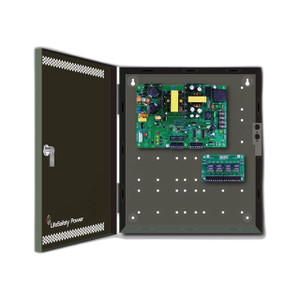
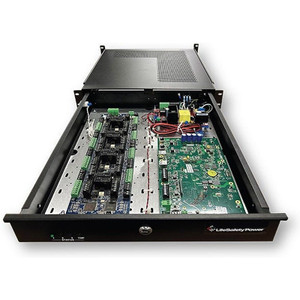
The Lifesafety Power RGS150 is a 150W rack-mounted power supply designed for mid-scale surveillance and access control deployments. Configured for dual-output operation at either 12A/12V or 6A/24V, the RGS150 consolidates power distribution for camera systems, access control hubs, intercoms, and networked security sensors into a single 2U chassis. The compact 19-inch rack profile (3.50″H × 20.50″D) centralizes infrastructure in equipment rooms without sacrificing depth, making it ideal for integrators who need to densify security power on a single 19-inch rail.
Key Features
- Dual-Voltage Output: 12A@12V or 6A@24V (150W total). Supports both legacy 12V camera ecosystems and higher-efficiency 24V industrial sensors and motorized devices in the same deployment.
- 2U Rack Mount Form Factor: 19.00″W × 3.50″H × 20.50″D. Integrates into standard 19-inch racks; no external housing needed, reducing floor footprint in congested equipment rooms.
- Lifesafety Power Ecosystem Integration: Works with networked power management and monitoring software (RG Software) for remote outlet control, usage tracking, and failover coordination across multiple supplies.
- Terminal Block Output: Industry-standard DC output connectors allow flexible field wiring; sized for AWG 10–14 conductors depending on run length and current draw.
- Redundancy Ready: Can be paired with a second RGS150 for N+1 failover configurations, critical for continuous-operation installations (hospitals, data centers, 24/7 monitoring NOCs).
- Standard Industrial Operating Range: Designed for typical equipment-room environments; confirm thermal limits and ambient temperature tolerance with Lifesafety Power for installations above 40°C or continuous full-load duty.
The RGS150 is engineered for integrators who need centralized power distribution without over-specifying capacity. A typical mid-scale deployment—8–12 dome cameras (5–10W each), two access control readers (3–5W each), and an intercom hub (8–12W)—draws 60–120W, leaving sufficient headroom for future expansion or peak transient loads (IR boost on outdoor cameras, PTZ motor surge).
Power budget calculations are critical: calculate aggregate wattage of all endpoints assigned to a single output. Most fixed cameras operate at 5–10W; motorized PTZ units and multi-sensor hubs can draw 15–25W. At 24V, the 6A limit yields 144W total; oversizing the per-output amperage by even one endpoint can trigger thermal foldback or nuisance shutdowns. Field cable runs longer than 100 feet should use AWG 10 or heavier to minimize voltage drop—a 50-foot run at full 6A on AWG 12 can lose 0.5–1.0V, risking camera resets on marginal power budgets.
Integration with Lifesafety Power's networked management platform (RG Software) enables remote outlet cycling, power-event logging, and multi-supply failover orchestration. This is particularly valuable in multi-site or multi-floor deployments where a centralized security team monitors power faults across dozens of supplies. ONVIF-compatible cameras and access control devices connect to the supply outputs independently; the RGS150 does not insert itself into the network stack, eliminating single points of failure in the data path.
The RGS150 is suitable for commercial office buildings, retail networks, warehouse access control, and mid-size school or municipal security systems where consolidated rack-mounted power eliminates cable clutter and simplifies troubleshooting. It does not include integrated battery backup (UPS)—for mission-critical systems, pair the RGS150 with a separate UPS module or evaluate Lifesafety Power's battery-backed supply portfolio if extended outage tolerance is required.
Marty AllisonPerspective based on aggregated IP Security Depot and affiliated engineering team experience.
The RGS150 is a workhorse in mid-scale surveillance installs where you need to consolidate power for a mixed-voltage environment without breaking equipment-room real estate. In our experience, integrators choose this supply when they're serving 8–15 camera deployments across multiple buildings on a single power backbone, or when site constraints force power distribution into a single 19-inch rack. The dual-voltage flexibility is the real operational advantage—you're not forced to standardize on one voltage, so you can cherry-pick the best camera or sensor for each location without a separate supply for every voltage island. That said, the 150W budget is genuinely limited. A handful of times, we've seen integrators overestimate their headroom and load three or four motorized PTZ cameras onto a single output, consuming 60–80W with a single unit. The RGS150 doesn't fail catastrophically—it throttles—but you lose pan-tilt responsiveness and the customer perceives a fault. Load calculations need to be honest and conservative.
Technical Highlights:
- 12A@12V or 6A@24V Output: The 24V option is key for long runs and high-current devices. A 100-foot cable run to a PTZ camera at 12V can drop enough voltage to cause intermittent reset; 24V at the same distance keeps headroom. The trade-off is that 24V endpoints are less common in the budget camera segment—cost your BOM accordingly.
- Lifesafety Power RG Software Integration: Remote outlet control and event logging are standard. This means you can toggle power to a faulty camera or access reader from the NOC without a truck roll. Multi-supply stacking and failover orchestration let you build N+1 resilience; if one RGS150 fails, a second supply seamlessly takes load. Invaluable in 24/7 operations.
- 2U Compact Profile: 20.50″ depth is shallow by modern standards—fits neatly into crowded telecom or network closets without requiring a dedicated rack. Saves floor space and keeps wiring complexity down in retrofit projects where rack depth is already constrained.
- Standard Terminal Block Wiring: No proprietary connectors. You're buying standard industrial-grade DC distribution—any electrician can troubleshoot, and replacements are straightforward. Conductor sizing (AWG 10–14) is straightforward; use a voltage-drop calculator for runs over 100 feet to avoid nuisance resets on 12V endpoints.
- No Battery Backup: This is not a UPS. If mains power fails, the RGS150 shuts down. For installations requiring 2–4 hours of backup runtime, budget for a separate UPS module or a battery-backed supply. The RGS150 is designed for always-on environments with mains redundancy (dual circuits, generator backup).
Deployment Considerations:
- Load calculation discipline is non-negotiable. Document every endpoint's power draw (read the datasheet—don't estimate) and sum per output before commissioning. Leave 20% headroom for motor surge and thermal margin. A 6A output at 24V is 144W peak; don't approach that number under sustained load.
- Voltage drop on long field runs kills 12V deployments. If your camera is more than 80–100 feet from the RGS150 at 12V, either use AWG 8 cable (expensive and difficult to terminate) or switch to 24V output and a 24V endpoint. The math is non-negotiable: V_drop = (2 × L × I) / (K × A), where L is run length, I is current, K is conductivity (56 for copper), and A is conductor cross-section. Use a voltage-drop calculator; it saves customer callbacks.
- The RGS150 does not include UPS or battery backup. Mains outages disconnect all endpoints immediately. If your site requires >30 minutes of backup power, integrate a separate battery supply or UPS module on the input side. Lifesafety Power offers battery-backed models; specify that if uptime is critical.
- Environmental operating range (temperature, humidity) should be confirmed with the manufacturer if your equipment room will exceed 40°C or run continuous full load. Thermal margins are tightest in hot climates or under-ventilated closets. Request the thermal derating curve if you're in doubt.
- RG Software monitoring is optional but highly recommended for multi-site deployments. Remote outlet cycling and power-event logging transform troubleshooting from blind truck rolls to surgical reboots. Budget for the software license if you're running 4+ supplies across multiple sites.
The RGS150 is the right choice for integrators building mid-scale commercial or institutional surveillance networks where power consolidation, dual-voltage flexibility, and networked management add demonstrable ROI. It's not suited for single-location small deployments (where a standalone supply per camera is simpler) or ultra-high-density data-center environments (where you'd specify industrial-grade three-phase distribution). See the Lifesafety Power catalog for battery-backed and higher-wattage alternatives.