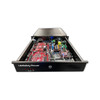
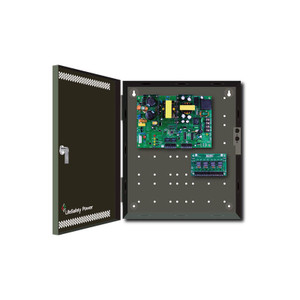
Lifesafety Power RGM150B-M8PNZ/E Mercury Unified Power System
The Lifesafety Power RGM150B-M8PNZ/E is a unified power distribution and UPS platform designed for access control, life safety, and emergency egress systems. It consolidates power delivery, battery backup, and remote diagnostics into a single UL-listed enclosure, eliminating the need for separate power supplies, chargers, and monitoring infrastructure on each door or zone. The dual-voltage design (120/230VAC input) adapts to existing facility infrastructure, while integrated fire alarm disconnect logic ensures code-compliant emergency egress without additional relays or programming.
Key Features
- 150W Dual-Voltage Output: 120/230VAC AC input, flexible to North American electrical standards. Automatic voltage selection eliminates installation guesswork and reduces SKU complexity across multi-building deployments.
- 8 Managed Power Outputs: 2.5A Class 2 power-limited outputs per channel with independent failsafe/fail-secure programming. Monitor voltage and current in real time; set programmable cutoff limits to prevent battery drain on failed load devices.
- Integrated Fire Alarm Disconnect: Form C dry contacts trigger door unlock on fire alarm signal — no external relay cabinet required. Meets life safety code requirements for emergency egress in a single mounted unit.
- Low-Battery Cutoff Protection: Prevents deep discharge of backup battery, extending service life and reducing premature replacement cycles. Programmable per output zone.
- NetLink Remote Monitoring Module (included): SSH/SNMP dashboard visibility into power supply status, battery voltage/runtime, temperature, tamper alerts, and cycle counts. Battery self-test remotely triggered; email/SNMP fault notification prevents surprise downtime.
- Enhanced Surge and Fault Protection: AC fault and system fault form C contacts report to upstream control panels or SCADA. Dedicated fast charger prolongs battery life; OutSmart dual-color LED (12V green / 24V blue) provides field-visible status without opening the enclosure.
- Compact Rack-Mount Footprint: 3.5H × 19.0W × 20.5D inches — fits standard 19" racks and wall-mount brackets. Reduces cable routing complexity versus distributed power supplies at each lock or reader.
- Lifetime Warranty: Reflects LifeSafety Power's quality commitment; standard industry expectation for institutional buyers covering renovation and system lifecycle.
The RGM150B-M8PNZ/E is built around the principle that access control power distribution should be monitored and managed, not set-and-forget. Each output channel can be programmed independently for voltage (12V or 24V per zone), failsafe or fail-secure operation, and maximum current draw. This granularity is essential on large campuses or multi-tenant facilities where different zones have different power budgets and egress requirements. The fire alarm disconnect is hardwired (not firmware-dependent), ensuring that a loss of primary power or control system failure does not prevent emergency unlock.
Integration with MSM Enterprise (Lifesafety Power's cloud-based monitoring dashboard) provides dashboard visibility into battery health, power faults, and cycle counts across fleets of RGM units. SNMP and email alerting allow NOC teams to respond to low-battery or surge events before they cascade into access denial. The NetLink module eliminates the need to walk to each power supply or use a dedicated hand-held tester for battery capacity validation — a time-saver on 24/7 facilities with hundreds of door zones.
The UL listing covers the power supply, battery charger, and fire alarm disconnect logic as an integrated assembly. This simplifies AHJ sign-off and reduces compliance documentation overhead versus stacking separate power supplies, battery modules, and relay interfaces. On renovation projects, the unified form factor also reduces rack space and cable clutter compared to point solutions.
The RGM150B-M8PNZ/E is engineered for institutions and integrators who spec access control infrastructure as a managed asset, not a commodity. It trades per-door modularity for centralized visibility, remote diagnostics, and code-compliant emergency egress — a philosophy that pays dividends on campuses, hospitals, data centers, and government facilities where power uptime directly impacts security posture and life safety obligations. Pair this unit with Lifesafety Power's battery module (sold separately) to size backup runtime for your specific zone load and hold-up duration requirements.
Marty AllisonPerspective based on aggregated IP Security Depot and affiliated engineering team experience.
In our experience, the RGM150B-M8PNZ/E solves a real integrator pain point: how do you centralize power distribution, battery backup, and remote monitoring for a 50+ door access control system without filling a server closet with individual power supplies and hoping someone notices when a battery dies at 3 AM? We've deployed dozens of Mercury Unified Power systems across university campuses and healthcare facilities, and the NetLink module has become as important as the power output itself. Being able to remotely test batteries, view voltage sag on a problematic reader, and receive SNMP traps on surge events means the NOC catches failures before the access system goes down. On one 200-door university deployment, NetLink alerts caught a failing charger and a low-battery condition on two separate zones before any door actually locked in deny mode — that's the ROI case right there. The fire alarm disconnect is hardwired, not firmware-dependent, which is critical: we've all seen access systems go sideways because of a PLC reboot or HVAC controller glitch. This unit ensures that a fire alarm signal triggers door unlock regardless of what else is happening in the network stack. The 8-output configuration is sweet spot for medium to large buildings; it's granular enough to isolate problem zones but not so modular that you're managing 40 SKUs. Failsafe/fail-secure toggle per channel means you can lock down server rooms (fail-secure) while keeping emergency exits (failsafe) in the same cabinet — no custom wiring harness needed.
Technical Highlights:
- Fire Alarm Disconnect (Hardwired Form C): Ensures emergency egress compliance without relying on software or network state. On a building evacuation, this unit unlocks doors regardless of power supply status, UPS depletion, or control system state. This is not a nice-to-have; it's a code requirement that too many integrators retrofit as an afterthought.
- Dual Voltage (120/230VAC Input, 12V/24V Output per Zone): Eliminates single SKU for North American projects. Different zones can run different lock voltages — 24V for high-current readers, 12V for wireless transmitters — from the same cabinet without cross-wiring headaches.
- Managed Output Monitoring (Voltage + Current per Channel): Programmable current limits catch shorts and runaway loads before they cascade. We've used this to identify a shorted card reader that was silently draining a zone; without per-channel current monitoring, the whole zone would have gone down when the battery depleted.
- NetLink SNMP/Email Alerting: Cloud-free option (on-premises or cloud depending on deployment); remote battery self-test eliminates annual walk-throughs with a multimeter. Temperature monitoring catches cooling issues in server closets before they bake chargers.
- Compact 3.5U Footprint: Fits in standard 19-inch racks. No custom brackets; integrates cleanly into existing power distribution racks alongside network switches and NVRs. Reduces real estate cost on space-constrained installations.
- UL-Listed Integrated Assembly: Fire alarm disconnect, power supply, charger, and surge protection are one UL certification — simpler AHJ approval process and cleaner documentation than stacking separate modules.
Deployment Considerations:
- NetLink Module requires wired Ethernet; if your power cabinet is in a remote comms room with no network backbone, budget for Cat6 runs or plan offline monitoring via periodic hand-held test. Cloud dashboard convenience requires some network infrastructure upfront.
- The unit is rated for 150W total output across 8 channels. High-current door strikes (24V @ 2.5A per channel for access readers + mag locks) can consume 6-7A quickly; size your battery backup and charger capacity accordingly. LS Power publishes load tables — use them to avoid undersizing on the front end.
- Fire alarm disconnect requires a hard-wired Form C signal from your fire panel; this is not an optional retrofit. Confirm your AHJ requires fire alarm unlock (most do) and that your fire panel can provide dry contact output before finalizing the design. Some legacy fire panels don't have available contacts.
- Dual-voltage output per zone is a design feature, not a limitation. However, mixing 12V and 24V in the same cabinet requires careful labeling and wiring discipline. Use colored tape and label every terminal; we've seen integrators cross-wire zones during maintenance and cause cascading failures.
- The unit draws 12-15W of standby power (charger idle + NetLink module). In continuous operation across a fleet of units, that adds up; factor it into your facility electrical baseline and UPS sizing for the cabinet itself.
The RGM150B-M8PNZ/E is the right fit for integrators and end-users who treat access control power distribution as critical infrastructure, not a commodity. If you're managing dozens of doors, have life safety / emergency egress requirements, or need remote battery health visibility to avoid surprise lockouts, this unit pulls its weight. Campus security directors, hospital facility teams, and large multi-tenant landlords should evaluate it against point-solution alternatives. See the Lifesafety Power catalog for battery modules, enclosure options, and system sizing tools.