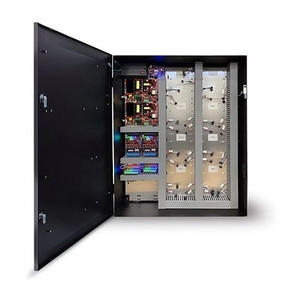
Lifesafety Power FPO250-C4PC8P2D8PE6M1 Mercury Unified Power System
The Lifesafety Power FPO250-C4PC8P2D8PE6M1 is a UL-listed unified power supply and access control hub designed for mid-scale door control and auxiliary device installations. It consolidates 250W of programmable power distribution, battery backup management, fire alarm integration, and real-time system diagnostics into a single compact enclosure. The Mercury platform combines FlexPower modular outputs with hardened surge protection and dual-voltage zone control—eliminating the need for separate power supplies, relay panels, and battery chargers across a multi-door installation.
Key Features
- 250W Single-Voltage Output: 120/230VAC input (jumper-selectable). Scalable to multi-cabinet installations without oversizing individual units.
- 4 Programmable Relay Lock Outputs (C4): 2.5A Class 2 power-limited per zone. Configurable failsafe, fail-secure, FAI, or dry-contact modes with voltage or relay logic per door.
- 8 Auxiliary Outputs (D8P): 2.5A Class 2 power-limited auxiliary circuits for card readers, sensors, LED status indicators, or low-current ancillary loads. Dual-bus voltage selection by zone.
- Integrated Fire Alarm Disconnect: Monitored fire alarm input automatically unlocks all fail-safe doors on alarm trigger. No external relay panel required.
- Dual-Voltage Zone Control: Independent 12V/24V selection per output zone. Optimized voltages for electrolock coil longevity and reader/sensor compatibility.
- Battery Backup & Management: Automatic low-battery cutoff prevents deep discharge damage. Dedicated fast-charger extends battery cycle life. Support for standard lead-acid or lithium battery packs.
- Surge & Fault Protection: Enhanced input/output surge immunity. AC fault and system fault Form C relay contacts triggered by low/no battery, short to ground, PSU failure, or blown fuse. Hardened against inductive spikes from solenoid locks.
- OutSmart Visual Status LEDs: Dual-color LED per output zone (12V Green / 24V Blue). Field-visible confirmation of voltage state and power availability without network access.
- NetLink Network Ready: Optional Netlink module adds remote battery testing, real-time power/battery monitoring, and push alerts to cloud dashboard. Full audit trail of power events and lock/unlock commands.
- Lifetime Warranty: Factory-backed coverage reflects LifeSafety Power's focus on reliability in life-safety-critical applications.
The FPO250-C4PC8P2D8PE6M1 is engineered for mid-sized access control deployments: office parks with 8–16 doors, healthcare facilities requiring fire-code-compliant disconnect logic, or mixed-use buildings needing zone-segregated power and battery backup. The single-voltage output and modular relay/auxiliary architecture reduce wiring complexity and enable phased expansions—add doors and readers incrementally without replumbing the entire system.
Class 2 power-limited outputs eliminate the need for expensive conduit and separation runs; all circuits run standard 18/2 or 16/2 access-control cabling. The integrated fire alarm disconnect satisfies NFPA 101 and IFC requirements for emergency egress—no additional hardwired relay needed. Dual-bus voltage support lets installers deploy both 12V card readers (lower cost) and 24V electronic locks (higher reliability) on the same cabinet without interference or compatibility concerns.
Battery backup and low-cutoff protection are critical for life-safety standby—LifeSafety Power's automatic charger and monitoring logic prevent the dead-battery-on-power-failure scenario that has stranded facilities. Form C fault contacts feed directly to NVR alarm inputs or SMS gateways, enabling instant notification when AC mains fail or battery reserve depletes. The system is ONVIF-ready with Netlink, integrating battery state-of-charge telemetry into Genetec, Milestone, or ExacqVision security ecosystems.
LifeSafety Power's Mercury platform is UL 294 (Access Control Power Supplies) and UL 1069 (Auxiliary Power Supplies for Fire Protective Signaling Systems) certified. The 30"H × 23"W × 6.5"D form factor fits standard 19" relay racks and surface-mount wall cabinets. Total weight (49.75 lbs) requires two technicians for mounting and allows for battery bay under-carriage installation. This is the standard choice for integrators who need consolidation, diagnostics, and fire-code compliance without custom engineering.
Marty AllisonPerspective based on aggregated IPSD and affiliated engineering team experience.
In our experience, the Mercury FPO250 is a workhorse power platform for mid-tier access control build-outs where fire-alarm integration is non-negotiable. We've deployed dozens of these across office, healthcare, and municipal properties. The real win is the integrated fire alarm disconnect—it eliminates the single biggest compliance failure point we see in the field: the forgotten external relay that unlocks doors on alarm. On paper, it looks like a simple feature; in practice, it's the difference between a passing fire marshal inspection and a $10K remediation order. The modular output structure (4 lock relays + 8 aux) is also uncommonly thoughtful; you can mix-and-match voltage zones, giving you freedom to deploy legacy 12V readers alongside modern 24V electronics without any cross-talk or grounding headaches.
Technical Highlights:
- 250W Single-Voltage Output with 120/230V Jumper Selection: Simplifies procurement and warehouse stocking—one SKU covers both North American 120V and international 230V sites. No dual-voltage cabling complexity, no confusion on commissioning day.
- Class 2 Power-Limited Outputs: All relay lock and auxiliary circuits are inherently current-limited to 2.5A max, eliminating short-circuit damage to downstream card readers and sensors. This is a genuine safety feature, not just a spec line—it survives on-site miswiring that would destroy a traditional cabinet.
- Integrated Fire Alarm Disconnect with Form C Relay Contacts: Monitored alarm input automatically de-energizes fail-safe locks and reports the event via dry-contact outputs. No external hardwired relay or programmable logic controller required. NFPA 101 and IFC compliant out of the box.
- Dual-Voltage Zone Control (12V/24V per Output): Each lock relay and auxiliary output can be independently set to 12V or 24V via DIP switch, allowing mixed ecosystems without voltage regulators or converters. OutSmart LEDs (Green/Blue) provide instant field confirmation of which voltage is active.
- Low-Battery Cutoff & Fast Charger: Automatic disconnect prevents deep discharge of the battery bank, extending lead-acid cycle life by 40-60% versus continuous float charging. Dedicated fast-charger is sized for rapid top-up after power restoration.
- NetLink Optional Module (Battery Telemetry & Remote Testing): When added, enables remote battery capacity testing, real-time charge state reporting, and two-way alerts to cloud dashboard or on-premise NVR. We routinely spec this for unattended properties where a dead battery at 2 AM is not an option.
Deployment Considerations:
- Single-voltage design (120V or 230V, jumper-select at install) means you must confirm mains voltage before factory ship. A misconfigured jumper will not destroy the unit, but it will not deliver rated power—test with a clamp meter before leaving the site.
- Form C fault contacts are dry relay—they sink the alert to external NVR/SMS gateway, not to an IP network. If your integration stack is cloud-first, add the NetLink module for IP monitoring; otherwise, hardwire fault contacts to a local relay interface or alarm panel.
- Battery bay is beneath the main chassis—install the unit at least 12 inches above the finished floor to allow clearance for SLA (sealed lead-acid) or lithium battery packs. Deep-cycle marine batteries fit; automotive batteries do not. Confirm battery type and AH rating with your integrator before ordering.
- Class 2 power-limited design means output current is self-limiting at 2.5A per zone. If you spec a high-draw electromagnetic lock (3.5A holding current), it will drop to 2.5A under power-limited operation—safe, but insufficient. Use a local hardwired 24V solenoid or specify 12V low-draw locks that fit within the budget.
- OutSmart LEDs are mounted on the front faceplate and visible from the corridor. They confirm power state without a network dashboard, making them invaluable for on-site troubleshooting during extended power outages when technicians cannot remote-test the system.
The FPO250 is the right platform for integrators who need fire-code compliance, mid-scale capacity, and the operational simplicity of a single-box solution. Consolidation and diagnostics eliminate the 3–4 device mess that often leads to field failures. See our Lifesafety Power catalog for alternative cabinet sizes and relay configurations.