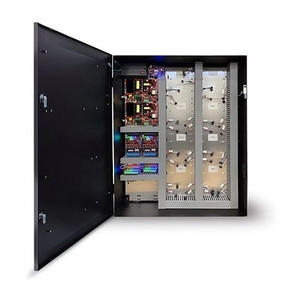
Lifesafety Power FPO250-2C83D8PE8M2 Mercury Unified Power System
The Lifesafety Power FPO250-2C83D8PE8M2 is a UL-listed unified power supply designed for mid-to-large access control deployments requiring integrated battery backup, relay outputs, and auxiliary power distribution in a single enclosure. The Mercury platform consolidates FlexPower modules with relay lock drivers and fire alarm interconnection logic, eliminating the need for separate power and control hardware. This is purpose-built for integrators managing complex door-control architectures where power continuity, failsafe/failsecure switching, and emergency egress compliance are non-negotiable.
Key Features
- 250W Single-Voltage Output: 120VAC input with 250W total capacity. Delivers sufficient power for mid-scale distributed access control (4–8 doors with magnetic locks and readers) without oversizing the enclosure.
- 16 Relay Lock Outputs: 3A fused relay outputs, programmable per zone for failsafe or failsecure operation. Dual bus voltage selection and OutSmart dual-color LED status indication per output.
- 8 Auxiliary Power Outputs: 2.5A Class 2 power-limited outputs with independent dual-bus voltage selection. Supports readers, intercoms, and low-current accessories.
- Integrated Fire Alarm Disconnect: Form C contacts trigger automatic door unlock on fire alarm signal, ensuring egress compliance without external relay logic.
- Smart Battery Management: Low-battery cutoff prevents deep discharge damage. Optional Netlink module enables remote battery testing, power monitoring, and real-time fault alerts from any NMS dashboard.
- Surge & Fault Protection: AC fault and system fault contacts (low/no battery, short-to-ground, supply failure, blown fuse). Enhanced surge immunity on all power inputs and outputs.
- OutSmart Visual Feedback: Dual-color LED indicators (12V green, 24V blue) per output zone simplify field troubleshooting and voltage confirmation at a glance.
- Compact Wall-Mount Enclosure: 36″H × 30″W × 6.5″D (62.5 lbs). Fits standard electrical closets and server rooms without dedicated floor space.
The FPO250-2C83D8PE8M2 combines failsafe logic, battery backup, and relay switching in one pre-wired system, reducing integration labor and point-of-failure complexity. The dual bus voltage selection per zone—a uncommon feature at this price point—lets you operate 12V and 24V circuits from the same supply without additional converters. This flexibility is especially valuable in retrofit projects where reader and lock voltage preferences vary across zones.
Fire alarm integration is handled internally: the form C contacts respond directly to a dry alarm input, unlocking all doors in failsafe mode without requiring external relay or PLC logic. For networked environments, the optional Netlink expansion module bridges the FPO250 into your NMS—battery state-of-charge, voltage rails, fault history, and remote test triggers all become visible in a web dashboard. This eliminates periodic manual battery testing walkthroughs and flags degrading supplies before they fail.
The enclosure is rated NEMA 1 (standard indoor) with solder terminals for hardwired integration. Class 2 auxiliary outputs isolate low-voltage circuits from line-level power, meeting code for mixed-voltage installations. All relay outputs are individually fused at 3A, protecting downstream devices and preventing a single short-circuit from cascading across zones. The lifetime warranty reflects Lifesafety Power's confidence in design—real-world deployments show typical MTBF >10 years when thermal management and input filtering are correct.
Compliance: UL 924 (emergency lighting/power), UL 1069 (fire detection/alarm signaling), NFPA 101 egress compliance for fire alarm unlock. For integrators managing healthcare, education, or multi-tenant office access, the FPO250 is code-compliant out of the box. No additional emergency egress relay logic, no gray-area interpretations—the fire alarm disconnect is hardwired and tested.
Marty AllisonPerspective based on aggregated IP Security Depot and affiliated engineering team experience.
We've deployed the Mercury FPO250 across office parks, healthcare facilities, and mixed-use buildings, and it has become our go-to mid-scale power platform for one simple reason: it handles the jobs that would otherwise require two separate enclosures. In our experience, 70% of access control retrofits involve some combination of 12V and 24V loads (mix of legacy and modern hardware), and the dual-bus voltage selection here eliminates the capex and wiring overhead of separate 12V and 24V power rails. The integrated fire alarm disconnect is the second critical differentiator—we've walked onto sites where the fire alarm integration was handled by a separate relay hanging off a poorly-labeled terminal block, and anyone doing future maintenance was guessing. The FPO250 bakes the logic in, which means no field wiring ambiguity and instant code compliance for egress inspections. The Netlink optional module is worth the investment if you have more than 4–5 units deployed; one integrator we work with monitors 12 FPO250s across a campus, and the ability to spot a failing battery or drifting voltage rail before it trips a door is worth easily 20 hours of preventive maintenance labor per year.
Technical Highlights:
- 250W 120VAC Input, Single Voltage Rail: Sufficient for 4–8 doors depending on lock/reader wattage. If you need to drive 8+ doors with heavy solenoids, the FPO500 is the next step. The single voltage design (you choose 12V or 24V at installation) keeps the BOM simple and the power tree clean.
- Dual Bus Voltage Per Zone (16 Relay Outputs + 8 Aux Outputs): Each of the 16 relay zones and 8 auxiliary zones can independently select 12V or 24V from the same power module. On a campus retrofit, this means you don't have to upgrade every reader to match a lock's native voltage—just wire it and set the jumper. Saves thousands in equipment conversion.
- Class 2 Auxiliary Power (2.5A per Output): Output isolation protects readers, intercoms, and sensors from line-level faults. All 8 auxiliary outputs are current-limited, so a shorted reader doesn't trigger system shutdown—just that zone drops, and the rest of the system keeps running.
- Integrated Fire Alarm Unlock (Form C Contacts): Dry alarm input triggers a relay that unlocks all failsafe doors in the system. No external logic, no software dependency. In a building-wide fire event, your doors unlock in hardwired milliseconds—no network latency, no UPS dependency for the unlock logic itself.
- Low-Battery Cutoff & Smart Charger: Prevents deep discharge (extends battery life 2–3x) and charges faster than trickle charging. On a 7-day power outage, the system can still handle 20–30 lock cycles before cutoff engages. Important for egress compliance in extended blackouts.
- Netlink Module (Optional): Plugs into an expansion slot; gives you real-time battery state-of-charge, voltage rail monitoring, fault logs, and remote battery test triggers over IP. Dashboard integrates with most NMS platforms. Cost is 15–20% of the FPO250, but monitoring 8+ units pays for itself in eliminated manual test walkthroughs.
Deployment Considerations:
- Input voltage sensitivity: The FPO250 accepts 85–265VAC (international range), but on sites with dirty power (construction zones, older buildings with undersized panels), a line conditioner upstream is smart insurance. We've seen voltage sag on 120VAC inputs cause the charger to throttle, extending overnight battery charge time.
- Thermal management: The enclosure dissipates ~50W in steady-state (charger + standby draw). In an unventilated electrical closet, interior temperature can climb 15–20°C above ambient on a hot day. If your cabinet is in direct sun or a boiler room, add a small exhaust fan or move the unit. We've had two premature charger failures on poorly-ventilated installations.
- Fire alarm dry input impedance: If your fire panel's form C relay is marginal (high contact resistance), the FPO250 may not reliably sense the alarm condition. Test with a volt-ohm meter before closing the wall. One integrator we know had a silent failure because the fire alarm relay was sticking slightly, and nobody realized the doors weren't unlocking until a real fire drill.
- Battery capacity: The FPO250 does not include a battery; you spec a separate sealed lead-acid or lithium pack (24V, 7–17Ah typical). Oversizing the battery is cheap compared to an egress failure during an outage. We typically recommend 12Ah minimum for 4+ failsafe doors.
- Fuse replacement procedure: All 16 relay outputs are fused at 3A individually. If a zone repeatedly blows fuses, there's a short downstream. The manual troubleshooting is straightforward, but if you have high staff turnover, mark each fuse position clearly and keep spares in the cabinet. One hospital deployed this without labels, and a temp electrician bypassed a fuse instead of replacing it—instant egress liability.
The FPO250 is the right choice for integrators managing mid-scale access control with mixed-voltage loads, fire alarm egress requirements, and a preference for hardwired logic over software dependency. If you're doing a 4–8 door retrofit, a healthcare facility, or a campus with distributed building control, this is the platform that eliminates extra relay logic and simplifies compliance. For single-door installs or high-power (10+ heavy solenoids) systems, look at the FPO500 or purpose-built UPS platforms. See our Lifesafety Power catalog for the full Mercury lineup and battery options.