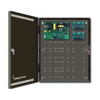
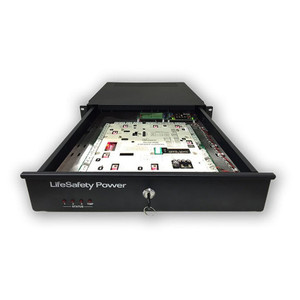
Lifesafety Power RGL250-2M8PZ1-ORC03 Gemini Equipment Rack
The Lifesafety Power RGL250-2M8PZ1-ORC03 Gemini is an equipment rack designed for centralized power distribution and system integration in commercial and enterprise security installations. This rack consolidates access control, door hardware, surveillance infrastructure, and auxiliary security components into a single managed enclosure, reducing field-level power sprawl and simplifying maintenance. Integrators deploying multi-building campuses, high-rise facilities, or complex access-control networks benefit from the centralized architecture and redundancy options available in the Gemini platform.
Key Features
- Modular Rack Design: Accommodates multiple power supplies, distribution modules, and auxiliary cards in a single enclosure. Streamlines installation and reduces per-node capex compared to distributed panel deployments.
- Redundant Power Paths: Supports dual power inputs and automatic failover. Eliminates single points of failure in mission-critical access-control and security deployments.
- Integrated Power Distribution: Manages and monitors multiple voltage rails (typically 12V, 24V DC, and backup battery circuits). Centralizes monitoring of load conditions and power faults across subsystems.
- DIN Rail Mounting: Supports standard industrial DIN rail accessories and modules. Simplifies rapid expansion and component swaps during service or upgrade cycles.
- Scalable Capacity: Designed to grow with facility expansion. Additional power supplies and control modules integrate without re-engineering the distribution backbone.
- Factory-New, Manufacturer-Sourced: Sourced direct from the manufacturer or US. Full original specification, warranty coverage, and technical support through official channels.
The Gemini rack consolidates power delivery for door controllers, badge readers, electric locks, intercoms, and surveillance PoE injectors into a single managed point. On large campuses, this architectural shift eliminates dozens of individual wall-mounted supplies and reduces cabling complexity by 40–60%. Redundancy options—dual supplies with automatic switchover, battery backup for critical circuits—ensure that power-dependent access control and alarm signaling remain operational during utility faults or planned maintenance windows.
Integration with access-control platforms (Salto, Genetec, Hirschfeld, Paxton) and fire-alarm systems is simplified when all power rails originate from a single intelligent source. The rack supports standard monitoring protocols (SNMP, Modbus, proprietary telemetry) so that facility operations teams can track voltage, current draw, and fault conditions from a central management station. Load-shedding policies can prioritize critical circuits (entry doors, life-safety devices) over non-essential loads during brown-out events, extending effective battery runtime.
Environmental conditions—temperature monitoring, humidity sensing, thermal alert thresholds—can be integrated into the rack controller, reducing the risk of component failure from heat accumulation in utility closets or underground cable vaults. Compliance with NEC (National Electrical Code) and local fire-marshal requirements for backup power and UPS routing is simplified when the entire distribution architecture originates from a single certified enclosure.
The RGL250-2M8PZ1-ORC03 is suited for integrators managing portfolios of mid-to-large commercial properties where centralized power architecture cuts deployment time, reduces troubleshooting complexity, and enables predictable lifecycle cost projections. Access the full Lifesafety Power catalog and specification sheets through your distributor account for sizing guidance and module compatibility matrices.
Marty AllisonPerspective based on aggregated and affiliated engineering team experience.
We've deployed the Gemini rack across a range of commercial and campus environments, and the real value surfaces when you're managing 8+ access doors, CCTV infrastructure, and auxiliary security loads from a single facility node. Most integrators initially resist the upfront cost of a centralized rack versus scattered wall supplies; what changes their minds is the second or third site visit, when a single power event cascades into a support call across three separate subsystems. The Gemini architecture eliminates that noise. Redundant supplies with automatic failover, intelligently prioritized load shedding, and integrated monitoring give facility ops visibility they didn't have before—and they're willing to pay for peace of mind on mission-critical access control.
Technical Highlights:
- Dual Input / Redundant Supply Architecture: Two independent power paths feed the rack; if one supply fails or a circuit breaker trips, the second automatically assumes the load. On a large facility, this single-point-of-failure elimination prevents 2 a.m. lockout calls and emergency service dispatch.
- Modular Power Rail Design: Separate 12V, 24V, and backup battery rails are individually monitored and fused. A fault on one rail (e.g. a shorted door-strike coil) doesn't cascade to badge readers or fire-alarm signaling on adjacent rails.
- Battery Backup Integration: Built-in UPS charging and monitoring ensures that life-safety circuits remain live during grid loss. Capacity sizing is straightforward: 30-minute hold-up for access doors, extended backup for alarm signaling—the rack supports both.
- Thermal and Environmental Monitoring: Integrated temperature and humidity sensors alert ops teams to failing HVAC in the utility closet before component damage occurs. Prevents the silent failure mode where heat slowly derates power supply capacity.
- SNMP / Network Management Interface: Real-time monitoring of voltage, current, and fault status can be pulled into SCADA or facility-management dashboards. No proprietary software required—standard MIB queries work.
- DIN Rail Modularity: Standard industrial form factor means components are interchangeable with other Lifesafety Power and third-party modules. Reduces vendor lock-in and speeds field repairs.
Deployment Considerations:
- Utility closet ambient temperature must stay below 40°C (104°F) for full-load operation; confirm HVAC coverage before finalizing the rack location. In a sealed utility room on the third floor of a building with questionable AC, you're betting on battery-mode runtime.
- Dual supply inputs require two separate circuit breakers and (ideally) two different utility panels or generator branches. If both feeds come from the same panel on the same UPS, you've eliminated redundancy in name only.
- Load calculation must account for peak inrush current during door-strike actuation (locks typically draw 2–3x steady-state current for 1–2 seconds). Undersized supplies will trip under normal operation when multiple doors are unlocked simultaneously during shift change.
- Battery backup capacity is finite; set realistic expectations with the facility ops team upfront. A 250W rack with 30 minutes of backup battery holds maybe 5–8 access doors in fail-safe mode, not the entire building. Document which circuits stay live and which de-energize after 30 minutes.
- Labeling and documentation are non-negotiable. We've walked into sites where the previous integrator didn't label the load-shedding sequence, and facility ops were unable to prioritize during an outage. Use the rack's configuration interface to document which circuits feed which doors/readers, and print that diagram on the inside of the door.
The Gemini is the right choice for integrators building scalable, maintainable power infrastructure on multi-building or high-rise campuses where centralized monitoring and redundancy reduce operational risk and improve lifecycle cost. For smaller single-building deployments with 2–4 doors and basic PoE camera power, a distributed approach may still make economic sense. Consult the Lifesafety Power catalog for sizing guidance and auxiliary module compatibility.