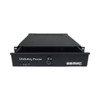
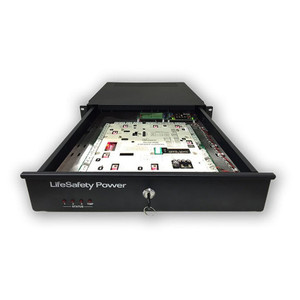
Lifesafety Power RGL250-2D8P2M8PNLCZ1-ORC02 Rackmount Dual Voltage Power System
The Lifesafety Power RGL250-2D8P2M8PNLCZ1-ORC02 is a 2U rackmount power distribution system engineered to supply conditioned DC power across surveillance cameras, access control panels, networked readers, and networked door locks in integrated security deployments. This model distributes power across 16 individually managed and monitored outputs with simultaneous dual voltage support (12VDC and 24VDC) — a critical feature in mixed legacy and modern installations where devices operate on different rails. Network management capabilities allow remote monitoring and outlet-level control without site visits, reducing operational overhead and enabling predictive troubleshooting across distributed security infrastructure.
Key Features
- 16 Managed Outputs: Individual circuit protection and real-time monitoring per outlet. Remote power cycling and status reporting eliminate unnecessary truck rolls when devices freeze or lose connection.
- Dual Voltage Support (12VDC / 24VDC): Simultaneous 12V and 24V rails eliminate the need for separate power supplies or voltage converters in heterogeneous device environments. Each output is hard-assigned to its voltage rail at configuration time.
- Networked Monitoring & Management: Ethernet connectivity enables SNMP integration with standard NOC platforms (Nagios, Zabbix, SolarWinds) and Lifesafety Power's native management console. Query outlet status, set load thresholds, and receive alerts on overload or supply loss from the control center.
- Redundant AC Input: Primary and backup mains connections support N+1 power resilience. Wire both inlets to separate circuit breakers on independent utility phases to eliminate single points of failure at the facility level.
- 2U Rackmount Form Factor: Standard 19-inch rack mounting consumes minimal vertical space. Fits alongside NVRs, switches, and access control appliances in standard IT racks or security-specific enclosures.
- Per-Outlet Circuit Protection: Individual breakers prevent cascading failures — a short on one output does not affect the remaining 15 devices. Simplifies diagnostics and keeps critical devices online during fault isolation.
In surveillance and access control deployments, power distribution reliability directly impacts uptime. A failed outlet on a legacy PDU cuts power to all downstream devices; the RGL250's managed outputs mean a single camera or reader can be power-cycled or isolated without affecting the rest of the system. This is particularly valuable in multi-building campuses or distributed access control networks where on-site troubleshooting is costly.
The dual voltage architecture addresses a common integration pain point: legacy door locks and alarm panels often run 12VDC, while modern IP cameras and networked controllers expect 24VDC. Rather than deploying two separate power supplies, the RGL250 consolidates both rails into one chassis, reducing rack clutter and simplifying cable management. The simultaneous voltage support also means you can upgrade individual device segments over time without redesigning the entire power infrastructure.
Network integration is essential for modern security operations. The RGL250's SNMP interface allows your existing NOC platform to ingest power supply status, outlet load, temperature, and mains voltage in real time. Automated alerts on overload conditions or supply anomalies flag integration issues before they cascade into downtime. For sites running Lifesafety Power's management software, the native integration includes granular outlet scheduling, load balancing across outputs, and historical reporting for capacity planning.
Installation requires a dedicated 19-inch rack with at least 2U of vertical space and AC mains connection (primary and backup inlets if redundancy is required). Verify that the total connected device load does not exceed the unit's capacity rating — oversized loads degrade power conditioning and trigger protective shutdowns. Network configuration occurs via web interface or CLI; document outlet assignments (voltage, connected device, expected load) during commissioning to simplify future troubleshooting and maintenance.
The RGL250 is compatible with all 12/24VDC security devices (IP cameras, networked door locks, card readers, alarm panels, access control mainboards) and works with standard Ethernet-based NOC platforms. SNMP v2/v3 support ensures integration without proprietary middleware. Lifesafety Power's native management console provides additional features (outlet scheduling, group controls, historical trending) for organizations standardizing on their power infrastructure. Sites already running Milestone, Genetec, or other major VMS platforms can integrate power status via third-party SNMP monitoring tools.
Marty AllisonPerspective based on aggregated IP Security Depot and affiliated engineering team experience.
We've deployed the Lifesafety Power RGL250 across campus-scale security installations where power distribution reliability directly impacts uptime and operational cost. The standout feature isn't just the 16 managed outlets — it's the dual voltage architecture combined with network monitoring. On a typical 40-camera surveillance build-out with legacy door locks and modern IP readers, you'd historically spec two separate power supplies (one 12V, one 24V), leading to redundant UPS capacity, extra rack space, and complicated failover logic. The RGL250 consolidates both into a single monitored chassis, which means one backup power strategy covers both rails, simpler cabling, and unified outlet management. We've also found that the outlet-level power cycling capability pays for itself within the first year: instead of a technician driving to a remote site to hard-reset a frozen IP reader or reboot a bridge camera, the NOC staff can remotely cycle power and resolve connectivity issues in minutes. That operational convenience is often underestimated in the spec process, but it cascades across maintenance budgets on large deployments.
Technical Highlights:
- Simultaneous 12/24VDC Rails: Each output is locked to one voltage; there is no voltage switching per outlet. This means you must pre-plan which devices use which voltage and configure outputs accordingly. We typically allocate 8 outputs to 24VDC (cameras, modern readers) and 8 to 12VDC (legacy locks, older alarm panels). Verify your device voltage requirements in the device datasheet — some cameras report 24VDC PoE but actually operate internally on 12V with a converter; confirm the input rail requirement, not the input connector type.
- Network Monitoring via SNMP: The unit integrates with NOC platforms (Nagios, SolarWinds) without proprietary middleware. We've successfully bridged it into Zabbix for power supply trending on multi-site deployments. Set up threshold alerts on load per outlet (in watts or amps, depending on your equipment) — this catches devices drawing more power than expected, often an early sign of failure. Configure alerts for mains voltage sag as well; many access control failures are actually power quality issues, not device faults.
- Per-Outlet Circuit Protection: Each output has its own breaker. In legacy PDU designs, a short circuit on one outlet would trip the main supply, blacking out the entire rack. The RGL250 isolates faults to a single output, allowing you to safely isolate a failed device (e.g., a shorted door strike) without losing power to the rest of the system. This is a genuine operational win on large access control deployments.
- Redundant AC Mains Input: The two AC inlets allow N+1 mains resilience — wire one to Circuit A, the other to Circuit B on your facility panel. In practice, most sites use just the primary inlet and rely on UPS backup. If you have redundant power feeds available, wire both and configure the unit to auto-failover. We rarely see both inlets deployed unless the site has true utility redundancy (e.g., separate feeds from different substations).
- Load Capacity: The RGL250 has finite capacity (typically 250W total across all 16 outputs, depending on configuration). Summing the draw of all connected devices must stay below this limit. IP cameras typically draw 5–15W; networked door locks 2–8W; readers 3–5W. Calculate total load before installation; undersized units lead to nuisance breaker trips during peak load periods (e.g., when multiple doors unlock simultaneously or heaters on outdoor cameras activate).
- Web Interface & CLI Configuration: Initial setup requires Ethernet connectivity to the unit and a browser or terminal session. Document all outlet assignments (voltage, device name, expected load) during commissioning in a spreadsheet or your NOC CMDB. This saves troubleshooting time later. If you're deploying 10+ units across a campus, consider scripting outlet configuration via CLI rather than clicking through the web interface for each outlet on each unit.
Deployment Considerations:
- Pre-assign outlets to voltage rails before installation. Unlike configurable managed PDUs, each output on the RGL250 is hard-wired to 12V or 24V at the factory (hence the cryptic part number: 2D = two voltage domains, 8P = eight 24V outlets, 2M = two modular slots, 8P = eight 12V outlets). You cannot change a 24V outlet to 12V in the field. Verify your device list and voltage requirements with the factory before ordering.
- Pair the RGL250 with a UPS sized to the total load, not just the RGL250 itself. A 250W power supply may draw 300+ watts from AC under full load (accounting for efficiency losses). Size your UPS accordingly; undersized UPS units will drop offline under high load, defeating the purpose of backup power.
- Use STP (shielded twisted pair) Ethernet cabling for the management port if running long distances (>50 feet) through electrically noisy environments. Power cabling radiates interference; keeping management and data cables shielded prevents sporadic connectivity loss or threshold alert false positives.
- Place the RGL250 on a dedicated circuit breaker at the facility panel if possible, especially if redundant AC inputs are being used. Sharing a breaker with other rack equipment increases the risk of nuisance power-offs that affect the entire security system.
- Set up SNMP monitoring from day one, even if you don't have a centralized NOC. A simple Zabbix instance or even a cron-based script can poll outlet status and flag anomalies. Historical trending on power draw is invaluable for capacity planning and early fault detection.
The RGL250 is the right choice for organizations running mixed legacy and modern security infrastructure at scale — particularly campuses, multi-building access control networks, and surveillance deployments where power reliability directly impacts operational cost. If you're consolidating multiple disparate power supplies into a single rack, or upgrading from unmanaged PDUs to monitored power distribution, this unit bridges the gap between simple surge protectors and enterprise-grade power management solutions. For more information on Lifesafety Power's power distribution lineup, see the Lifesafety Power catalog.