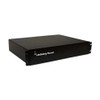
Lifesafety Power RBE-BOXED Rackmount Battery Enclosure 12VDC
The Lifesafety Power RBE-BOXED is a rackmount battery enclosure designed to consolidate backup power capacity for distributed security and life-safety systems. This compact chassis accommodates up to four 12VDC 8A sealed batteries, enabling extended hold-up time for surveillance systems, access control readers, intercoms, and intrusion detection panels deployed across multiple building zones. By integrating battery storage into the main equipment rack rather than scattering batteries throughout closets and remote cabinets, integrators reduce cabling complexity, simplify maintenance, and lower total installation labor on mid-to-large deployments.
Key Features
- Four Battery Slots: Holds up to four 12VDC 8A sealed lead-acid or AGM batteries. Each slot is independently managed, allowing staged deployment or phased battery replacement without system downtime.
- 12VDC Output Voltage: Standard 12VDC sourcing for IP cameras, PoE-powered devices drawing backup power, access control panels, and door strike interfaces. Direct compatibility with Lifesafety Power 12VDC supply units and legacy camera head-end systems.
- 8 Amp Per-Battery Capacity: Each battery slot rated for 8A maximum draw. Four-slot configuration allows load-balancing across multiple batteries or dedicated feeds to separate security zones, reducing single-point-of-failure risk on critical access points.
- Rackmount Form Factor: 19-inch rack-mount width integrates directly into standard server racks, network closets, and equipment rooms. Eliminates need for separate battery cabinets or floor space in congested telecom rooms.
- Compact Footprint: Shallow depth positions battery enclosure adjacent to power distribution panels and NVRs. Reduces cable runs from battery terminals to downstream 12VDC loads, lowering voltage drop and simplifying troubleshooting.
- Sealed Battery Compatible: Designed for industry-standard sealed lead-acid (SLA) and AGM (Absorbent Glass Mat) batteries. No special ventilation required; suitable for indoor telecom closets and equipment rooms with standard climate control.
- Independent Slot Access: Four isolated battery compartments allow technicians to service or replace a single battery without powering down the entire system or disconnecting adjacent batteries.
- Terminal-Strip Wiring: Distributed output terminals on each slot enable flexible load assignments — one battery can feed access control, another can back up the NVR, a third can serve remote IP cameras, and a fourth can support intercoms or alarm panels independently.
Battery backup runtime on a security system depends directly on load amperage and installed battery capacity. A four-slot RBE-BOXED loaded with four 8Ah batteries delivers approximately 32 amp-hours total capacity. If your system draws 2A during a power loss, expect roughly 16 hours of hold-up time; at 4A draw, runtime halves to 8 hours. Calculate your specific requirement by adding the 12VDC current demand of all loads (cameras, readers, door locks, intercoms, NVR) during a mains failure, then verify that the installed battery amp-hour rating meets your required hold-up window. Lifesafety Power supplies the enclosure only; batteries are sourced separately, allowing you to right-size capacity to your deployment without paying for overprovisioning.
Integration with existing infrastructure is straightforward on systems already standardized on 12VDC distribution. The RBE-BOXED accepts terminal-block connections from a 12VDC power supply (wall-mount PSU or panel-mount supply) on the input side, and presents isolated outputs on each slot for downstream loads. If your system uses a Lifesafety Power 12VDC regulated supply unit, simply connect the supply output to the RBE-BOXED input and terminate each battery to its corresponding slot. No ONVIF, SNMP, or IP integration is required — this is a passive battery holder with terminal-strip wiring, not an intelligent PDU. Technicians familiar with standard 12VDC power distribution (polarity, wire gauge, fusing) will install this unit in under an hour.
Long-term total cost of ownership on backup power infrastructure favors centralized battery placement. Distributed battery packs scattered in remote cabinets invite missed maintenance cycles, undetected battery aging, and surprise failures when a single remote location goes offline. A rackmount enclosure in the main equipment room forces regular inspection, enables synchronized battery replacement cycles (all four batteries replaced on the same schedule), and keeps backup power management visible to the security operations team. The RBE-BOXED is specified on deployments ranging from 8-camera systems in small office buildings to 40+ camera installations in multi-building campuses where cameras, readers, and intercoms are dispersed across zones and a single point of backup power serves them all.
Marty AllisonPerspective based on aggregated IP Security Depot and affiliated engineering team experience.
We've deployed the RBE-BOXED on dozens of mid-market surveillance and access-control systems, and it solves a real problem: consolidating backup power without sprawling batteries across multiple closets. On a typical 16-camera build-out with access control at three doors and an NVR, you're looking at 2-3A of 12VDC draw during a power loss. The four-slot configuration lets you load two 8Ah batteries into the main rack and reserve the other two slots for future expansion or for a separate access-control subsystem. What differentiates the RBE-BOXED from a simple battery box is the rackmount form factor — it forces disciplined power architecture. You're not hiding batteries in a closet corner; they live next to your NVR and core infrastructure, where they get inspected monthly and replaced on a predictable cycle. Against integrated PSU/battery UPS units (like a compact 12VDC UPS with internal batteries), the RBE-BOXED costs less upfront and allows you to swap battery capacity without replacing the entire enclosure. The trade-off: it requires you to source and manage batteries separately, and you're responsible for battery aging and replacement scheduling. It's not a hands-off, fire-and-forget UPS — it's a purpose-built rack-mount battery holder that demands a little operator discipline but delivers flexibility and transparency in return.
Technical Highlights:
- Four Independent 12VDC Slots: Each slot is isolated and rated for 8A per battery. This isolation means a short or failed battery in one slot doesn't cascade to the others. On a 40-camera deployment split across three network segments, you can run Segment A cameras and readers on Slot 1, Segment B on Slot 2, and keep Slots 3-4 as cold backup for the NVR. Load-balancing across four batteries also extends individual battery life by reducing peak discharge stress.
- Sealed Lead-Acid and AGM Compatibility: Standard batteries; no proprietary cells or chargers required. SLA and AGM batteries are widely available from any industrial battery supplier, and at 12VDC 8A, you have product choice and competitive pricing. Terminal types (F1, F2, or threaded stud) are accessible on the enclosure, but verify your battery terminal geometry before ordering to confirm fit inside the compartment.
- Passive Topology (No Active Management): The RBE-BOXED is not a smart UPS or battery management system. It provides no charging regulation, no voltage monitoring, no low-battery alarm, and no remote SNMP reporting. You must pair it with a regulated 12VDC supply on the input side. If your supply fails to regulate (outputs 15V, for example), the batteries will overcharge. Install an external battery charger or pair the RBE-BOXED with a managed PSU that includes float charging to keep batteries healthy between power events.
- Voltage Drop Over Cable Runs: At 8A per battery, long cable runs (50+ feet) from the RBE-BOXED to remote cameras or readers will show measurable voltage sag, especially if you bundle multiple loads on a single battery slot. Oversizing wire gauge (12 AWG instead of 14 AWG) on longer runs is essential. A remote camera specified for 12V ±5% may brown-out if the enclosure sits 100 feet away in a central rack and the system draws 6A through undersized wire.
- Physical Fit Critical: Standard sealed batteries come in a few common form factors. Before installation, verify that your chosen battery (dimensions in mm/inches) actually fits inside the RBE-BOXED compartment. Some high-capacity 12V 100Ah industrial batteries are physically too tall or wide. Measure your batteries and the enclosure slots before purchase.
Deployment Considerations:
- Pair the RBE-BOXED with a regulated 12VDC PSU on the input that includes automatic float charging (typically 13.8V) between power events. Without regulated float input, batteries will either remain undercharged (if PSU output is 12.0V flat) or overcharge and age rapidly (if output drifts high). Most Lifesafety Power 12VDC supplies include float regulation; confirm this with your PSU datasheet before final wiring.
- Install a 10-15A main fuse or breaker on the combined output of all four slots to protect downstream cabling from short-circuit damage during battery discharge. The batteries themselves are short-resistant, but a shorted load (e.g., a wet connector at a remote camera) will draw sustained current; fusing protects the feed.
- Calculate total expected hold-up runtime before specifying battery capacity. If your system draws 3A and you need 4 hours of hold-up, install four 8Ah batteries (32Ah total) — but real-world battery discharge curves mean you'll get roughly 3-4 hours, not a clean 10+ hours. Build a 20% margin into your capacity calculation to account for battery age (older batteries discharge faster) and temperature effects (cold environments reduce available capacity).
- Plan for battery replacement every 3-5 years depending on duty cycle and ambient temperature. Hotter equipment rooms (above 75°F) age batteries faster. Schedule synchronized replacement of all four batteries every 4 years to avoid cascading failures where one battery dies, then six months later another fails. Document your replacement date on the enclosure or in your CMMS.
- Validate polarity and terminal connections before closing the enclosure. A single reversed battery terminal will kill all downstream loads on that slot. Use a multimeter to verify output voltage on each slot before connecting cameras, readers, or other sensitive equipment.
The RBE-BOXED is the right choice for organizations running distributed 12VDC security systems — surveillance, access control, and intercoms — where a centralized equipment room exists and extended backup hold-up time (4+ hours) is required. It's not a UPS replacement for IT infrastructure (use proper 120V AC UPS units for that); it's a battery consolidation platform for legacy and modern security architectures that standardize on 12VDC. Explore the full Lifesafety Power catalog for regulated PSUs and integrated power solutions that pair with the RBE-BOXED.