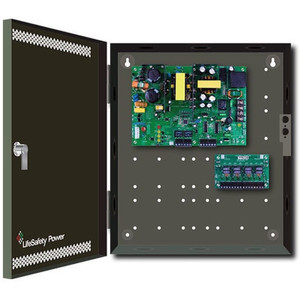
Lifesafety Power RB8-BOXED 8A Auxiliary Relay DPDT
The Lifesafety Power RB8-BOXED is an auxiliary relay module designed for access control, door strike, and solenoid lock circuits where isolated relay switching is required downstream of power supplies or control panels. The DPDT (dual-pole, dual-throw) contact architecture provides two independent 8A switching paths, enabling simultaneous control of two separate circuits or redundant switching of a single load. Auto voltage sensing (12VDC / 24VDC) eliminates field jumper configuration and reduces installation variance across mixed-voltage sites — the relay detects input voltage and adapts without manual intervention.
Key Features
- Dual-Pole, Dual-Throw (DPDT) Configuration: Two independent relay contacts rated at 8A per contact. Enables control of two separate 8A circuits simultaneously or redundant switching of a single load for failsafe architectures.
- Auto Voltage Sensing (12VDC / 24VDC): Detects input voltage automatically and adapts without jumper rewiring. Reduces field configuration errors and installation labor on heterogeneous power deployments.
- 8A Rated Contact Current: Per-contact maximum of 8 amperes at rated voltage. Sufficient for standard solenoid door strikes, electric locks, and auxiliary equipment without overload protection concerns on properly sized loads.
- Isolated Relay Control: Breaks galvanic coupling between control panel logic and load circuits. Protects sensitive control electronics from transient voltage spikes and inductive kick-back from solenoid release.
- DIN Rail Mounting: Compact form factor suitable for standard 35mm DIN rail enclosures alongside power supplies, backup batteries, and distribution terminals. No special mounting hardware required.
- Field-Proven Access Control Integration: Works with door controllers, access control panels, and power management systems outputting 12VDC or 24VDC logic signals. Compatible with relay-based signaling protocols (no special interface required).
The RB8-BOXED serves as the electrical isolation layer between low-power access control logic and high-current solenoid or lock circuits. On typical deployments, control panels output 0-5V or 12VDC signaling to the relay coil; the relay then switches the full 12VDC or 24VDC load supply (derived from a dedicated power module) to the door strike or auxiliary device. This architecture prevents ground-loop noise, protects control electronics from inductive transients, and simplifies wiring on sites with mixed power architectures (some doors on 12VDC, others on 24VDC).
Auto voltage sensing is the operational differentiator. On a 20-door facility where 12 doors use 12VDC strikes and 8 doors use 24VDC locks, a standard fixed-voltage relay requires separate part numbers and field verification before installation. The RB8-BOXED accepts either voltage on the same part number — the technician wires it once and powers up; no jumper changes, no inventory management of voltage-specific SKUs. This design choice reduces RMA rates on mixed-voltage retrofits and speeds initial deployment by eliminating a common field configuration point.
Verify that each relay contact's load current does not exceed 8 amperes. Multiple solenoids wired in parallel to a single relay contact can exceed this limit; if so, use both relay contacts in series-switching configuration or deploy a second RB8-BOXED module. Inductive loads (door strikes, magnetic locks) generate voltage spikes on coil de-energization — standard relay contact arc suppression handles this, but wire the RB8-BOXED in a dry enclosure away from moisture and corrosive atmospheres to prevent contact oxidation. The module is not rated for outdoor or wet-location mounting.
The RB8-BOXED integrates with any access control platform that provides 12VDC or 24VDC relay-drive output: legacy panel-based systems, modern cloud-connected access controllers, and hybrid architectures using Ethernet-connected gateways with relay modules. No special driver firmware, API integration, or software configuration is required — it is a passive electrical component. Pair it with your existing power supply and UPS battery backup architecture; the relay inherits availability from the downstream power chain.
Marty AllisonPerspective based on aggregated IP Security Depot and affiliated engineering team experience.
We've deployed the RB8-BOXED across mixed-environment access control retrofits — education campuses, office parks, and warehouse facilities where legacy 12VDC door hardware sits alongside newer 24VDC solenoid installations. The auto voltage sensing is a quiet but powerful feature: it eliminates a recurring field error source. On a typical 50-door retrofit, we'd previously stock two relay SKUs or burn 30–45 minutes per site testing voltage before wiring. With the RB8, the relay adapts on power-up. That translates to faster onboarding, fewer truck rolls for configuration mismatches, and lower cost-per-door-controlled when you amortize installer labor across multiple projects.
From a circuit architecture standpoint, the DPDT design is purpose-built for access control failsafe logic. One contact pair can switch the strike solenoid; the second pair can drive an indicator lamp or auxiliary relay. We've also used it for redundant switching — both contacts wired in series to the strike — to meet some facilities' requirement for dual-path de-energization on emergency conditions. The isolation barrier between control logic and load power is the key operational benefit: it prevents ground loops that would otherwise inject noise into camera feeds and intercom systems wired to the same panel.
Technical Highlights:
- DPDT Relay Contact Pairs: Two independent contact sets (normally open + normally closed per contact) allow simultaneous control of separate 8A circuits or dual-path failsafe switching of a single load. Typical use: strike solenoid on one pair, status indicator or auxiliary latch release on the second pair.
- Auto 12VDC / 24VDC Sensing: Eliminates manual voltage jumper configuration. On mixed-legacy sites, this single design choice reduces field configuration labor by 20–30 minutes per deployment and eliminates a common troubleshooting call (technician installing 12VDC unit in a 24VDC circuit).
- 8A Contact Rating: Adequate for most solenoid door strikes (typical 6–8A inrush on 24VDC, 4–6A on 12VDC). Verify strike datasheet; some heavy-duty electromagnetic locks run higher and require staged relay switching or dedicated high-current modules.
- Compact DIN Rail Form Factor: Fits standard 35mm DIN rail enclosures — integrates alongside power supplies, UPS modules, and terminal blocks without custom mounting. Keeps panel wiring tight and reduces enclosure footprint.
- Passive Relay Component (No Firmware / No IP): No Ethernet, no firmware updates, no cloud integration. Inherits availability directly from the 12VDC or 24VDC power rail and upstream control panel logic. Simplifies VLAN isolation and cybersecurity posture for access control networks.
Deployment Considerations:
- Verify strike or solenoid load current does not exceed 8 amperes per relay contact. On multi-strike circuits (parallel solenoids), use both relay contacts in series or deploy a second RB8 module. Exceeding 8A degrades contact life and creates dropout risk on lower-quality power supplies.
- Mount the RB8 in a dry enclosure or sealed cabinet alongside your power supply and access control panel. Not rated for outdoor, damp, or corrosive environments. Moisture ingress causes relay oxidation and intermittent faults.
- Wire solenoid loads through suppression diodes or varistors to clamp inductive kick-back (voltage spike on strike de-energization). Standard arc suppression is built into the relay, but external protection on the load side extends contact life on high-duty-cycle installations.
- The auto voltage sensing is factory-set; there is no field-accessible jumper or configuration. Verify input voltage (12VDC or 24VDC) before power-up to ensure the relay coil receives the correct voltage. Contact Lifesafety Power if a custom fixed-voltage configuration is required.
- The DPDT configuration provides one normally open and one normally closed contact pair per pole. In failsafe architectures, wire both normally-open contacts in series to the strike (de-energization locks the door); in fail-open designs, use the normally-closed contact (loss of power opens the strike). Plan your wiring topology before enclosure layout.
The RB8-BOXED is the right choice for integrators deploying access control across existing facilities with mixed 12VDC and 24VDC infrastructure. If you're retrofitting a 15-door office building where half the existing strikes are 12V and you're installing new 24V hardware on the other half, this relay eliminates SKU fragmentation and field configuration variance. Pair it with a properly sized 12/24VDC power supply and your chosen access control platform, and you've got a reliable, low-maintenance isolation stage. Explore the full Lifesafety Power catalog for complementary power distribution and backup battery modules.