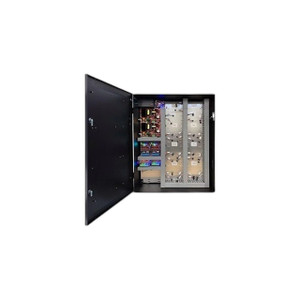
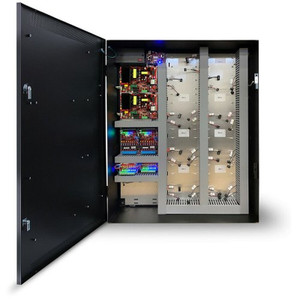
Lifesafety Power NLC-BOXED Power Supply Enclosure
The Lifesafety Power NLC-BOXED is a compact power supply enclosure designed to house and protect electrical components in security infrastructure deployments. This form factor provides standardized mounting and environmental protection for power conditioning equipment across surveillance systems, access control installations, and integrated security architectures. The enclosure consolidates components, simplifies bill-of-materials management, and protects against dust ingress and environmental contamination—reducing field service calls and extending equipment lifecycle.
Key Features
- Compact Enclosure Form Factor: Standardized housing reduces installation complexity and enables consistent integration across multiple sites with predictable mounting footprints.
- Component Protection: Shields power supply electronics from dust, moisture, and physical contact, extending operational life and reducing warranty claims.
- DIN Rail and Mounting Compatibility: Supports standard rack-mount and DIN rail installation, enabling modular integration into larger electrical cabinets and control rooms.
- Thermal Management Design: Enclosure geometry accommodates passive or active cooling for installed power components, preventing thermal runaway in continuous-operation deployments.
- Cable Entry Optionality: Multiple knockout points and strain-relief provisions simplify input/output routing without requiring custom drilling or field modification.
- Lifesafety Power Ecosystem Integration: Works with Lifesafety Power supply modules, enabling plug-and-play architecture for system integrators and facility managers.
The NLC-BOXED addresses a practical pain point: unhoused power supply modules create installation overhead, increase risk of accidental contact with live terminals, and complicate site audits. By providing a pre-engineered enclosure, Lifesafety Power reduces the labor cost of field assembly and eliminates the need for custom cabinet fabrication on smaller to mid-sized security deployments.
Common deployment contexts include server room power consolidation for NVRs and network infrastructure, intermediate power distribution points in multi-building campuses, and auxiliary backup power staging for access control and emergency egress systems. The standardized footprint allows facility managers to stock spare enclosures and perform field swaps without waiting for custom fabrication.
Integration with larger security infrastructure is straightforward: the enclosure accepts standard 12V, 24V, and higher-voltage DC supplies commonly used in IP camera and access control networks. ONVIF-compliant systems and non-proprietary VMS platforms benefit from predictable, code-compliant power conditioning—reducing liability in installations where power quality audit trails are required by insurers or regulatory frameworks.
The NLC-BOXED is part of the Lifesafety Power product line, which emphasizes reliability in 24/7 continuous-operation environments. The enclosure itself is maintenance-free once installed; the real value lies in protecting the components housed inside and reducing the probability of unplanned downtime due to environmental exposure or accidental contact damage.
Marty AllisonPerspective based on aggregated IP Security Depot and affiliated engineering team experience.
In our experience, the NLC-BOXED fills a genuine gap in small-to-mid-size security installations. We've seen too many sites where integrators field-mount bare power supplies in electrical closets, tape over terminal blocks with electrical tape, and hope that no intern accidentally touches something hot. The Lifesafety Power enclosure eliminates that liability vector entirely. It's not glamorous—it's a box—but it's a box that solves a recurring field headache. The standardized footprint means you can pre-stage five units for a campus rollout, hand them to a junior technician with simple installation instructions, and know that the electrical interface will be consistent across all locations. We've also found that facilities teams respect the finished appearance more than ad-hoc mounting solutions; it reads as "engineered," not "jury-rigged," which matters when your customer's insurance auditor walks through the facility. The main trade-off versus custom fabrication is that you're constrained to the enclosure's internal dimensions—if your power module is non-standard or requires custom thermal management, you may need to explore alternatives. But for Lifesafety Power's own product line and equivalent third-party modules with similar footprints, it's a straightforward win on cost, installation time, and operational predictability.
Technical Highlights:
- Standardized Form Factor: Eliminates custom cabinet design and field fabrication labor. Recurring sites can replicate the exact same power architecture with zero re-engineering, reducing design risk and lowering total project cost.
- Environmental Protection Rating: Shields components from dust, moisture, and contact, reducing field service frequency and extending mean time between failures (MTBF) on continuous 24/7 surveillance power supplies.
- DIN Rail Integration: Works with standard vertical and horizontal DIN rail mounting, enabling modular stacking and easy component replacement without removing the entire enclosure.
- Cable Strain Relief: Integrated knockout points and cable entry provisions prevent mechanical stress on power connections, a common source of intermittent failures in portable or frequently serviced installations.
- Thermal Headroom: Internal geometry accommodates passive airflow or optional fan kits, preventing thermal throttling or shutdown on long, high-current power draws.
Deployment Considerations:
- Verify internal dimensions against your specific power supply module before ordering—the enclosure is pre-sized and does not expand. Oversized modules will require alternative mounting.
- Plan cable entry location before installation. Retrofit entry points after mounting is labor-intensive; pre-drill or use knockout kits during pre-installation assembly.
- Thermal dissipation matters on continuous-duty systems. If installed in an enclosed cabinet without ambient airflow, consider passive ventilation holes or a cabinet-level fan strategy to prevent heat buildup.
- Ground and bonding connections must comply with local electrical code. Do not assume the enclosure provides adequate grounding—verify bonding straps and test continuity before energizing.
- Label internal and external connections clearly during installation. Future technicians unfamiliar with the site will need unambiguous documentation of which output port feeds which subsystem (NVR, access control, cameras, etc.).
The NLC-BOXED is ideal for system integrators building repeatable security architectures across multiple locations, and for facility managers who want standardized, auditable power infrastructure. It is not a power supply itself—it is a standardized housing for power supplies—so verify that your chosen Lifesafety Power module or equivalent third-party supply fits your performance requirements (voltage, current, redundancy) independently of the enclosure. For more information on Lifesafety Power power supply systems and compatible modules, visit the Lifesafety Power catalog.