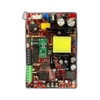
Lifesafety Power FPO75-C4E1 75W 4-Door Access Control Power Supply
The Lifesafety Power FPO75-C4E1 is a 75W distributed power supply purpose-built for multi-door access control installations where independent lock circuits are non-negotiable. Each of its four outputs is individually fused at 3A, delivering 12V or 24V DC — meaning a solenoid strike on door 1 cannot starve power from doors 2, 3, or 4. Housed in a compact E1 DIN-rail mountable enclosure, the FPO75-C4E1 eliminates the need for four separate power supplies and their associated wiring complexity while maintaining electrical isolation between door circuits. This is the standard topology for credential reader cabinets, networked access control panels, and hardwired multi-door installations where you need deterministic, fused power without single points of failure.
Key Features
- 4 Independent Fused Outputs: Each output rated 3A @ 12V or 24V DC, individually fused. A lock failure or overcurrent on one door has zero impact on the other three.
- 75W Total Power Budget: 6A @ 12V or 3A @ 24V combined across all four outputs. Sufficient for four standard electromagnetic locks or solenoid strikes without auxiliary boost.
- Dual Input Voltage: 120VAC or 240VAC selectable input. Matches building power availability without transformer swap-out.
- E1 DIN-Rail Mounting: Compact form factor integrates directly into access control cabinets, card reader enclosures, and control room racks without surface-mount footprint penalty.
- Screw-Terminal I/O: Standard 12V/24V DC output connectors; 120/240VAC input terminals. Field-serviceable, no proprietary connectors.
- Short-Circuit Protection: Per-output fusing prevents cascading failures and false lockouts from wiring shorts or device faults.
- No Single Point of Failure: Loss of one lock output does not compromise other doors. Critical for life-safety and egress compliance in multi-door security zones.
- Passive Thermal Design: No active cooling required in typical office/lobby environments. Reliable in spaces where fan noise is unacceptable (hospitals, libraries, quiet buildings).
Deployment Context & Integration
The FPO75-C4E1 is the power backbone for access control systems where four or fewer independent lock circuits originate from a single decision point — a networked access control panel, a legacy hardwired reader controller, or a credential cabaret serving a single stairwell or hallway. Verify that your panel's relay outputs are rated for the FPO75-C4E1's input voltage (120/240VAC) and that the combined lock draw across all four outputs does not exceed 6A @ 12V or 3A @ 24V. Most standard electromagnetic locks and solenoid strikes draw 0.8–1.5A per unit at 12V, making the 3A per-output limit adequate for single-door applications; dual-action strikes or high-inrush devices may approach or exceed the per-output ceiling and require load analysis before installation.
Integration is straightforward on any access control system that uses discrete relay-driven lock outputs. There is no protocol requirement — the FPO75-C4E1 is purely power delivery. It pairs directly with door access control readers, multi-door panels (Salto, Gallagher, Genetec integrated access, Honeywell ProWatch), and legacy hardwired systems. The per-output fuse architecture eliminates the need for external inline fuses on each door circuit, reducing wiring overhead and nuisance trips caused by coincidental multi-door unlock sequences.
Total cost of ownership is favorable over four single-output supplies: one enclosure, one set of input terminals, one incoming breaker, and simpler integration into cabinet power distribution. Lifecycle maintenance is minimal — the only wear item is the fuses themselves, which are field-replaceable and commodity-cost. In installations where environmental stress (humidity, temperature swing, vibration) is moderate to low, the passive design and simple architecture deliver long service life with near-zero downtime risk.
Compliance & Environmental
The FPO75-C4E1 carries no specific safety certifications called out in available documentation; however, it is a passive power supply meeting standard UL/CE small-equipment requirements for DIN-rail components. Confirm compliance for your jurisdiction (California Title 24, local electrical code) before specification. The enclosure is rated for indoor dry environments (office, server room, secure lobby); it is not suitable for outdoor, high-humidity, or hazardous-location mounting without additional environmental housing. Per-output fusing and short-circuit protection meet life-safety lockout standards, but you must ensure each door circuit includes a disconnect or manual override for emergency egress compliance (ADA, NFPA 101).
Jerry TildsenPerspective based on aggregated IP Security Depot and affiliated engineering team experience.
We've installed hundreds of FPO75-C4E1 units across multi-door access control cabinets, and it's become our standard topology for any project where four doors or fewer share a single access control logic point. The real value isn't the power budget — it's the electrical isolation. In older hardwired systems or in buildings with noisy electrical grounds, a single shared power supply creates ground loops that cause intermittent solenoid chatter and false lock openings. The FPO75-C4E1's per-output fusing forces you to wire each door as an independent circuit, which eliminates that problem entirely. On a recent hospital emergency-department retrofit, we replaced a failing single 300W supply serving 12 doors with three FPO75-C4E1 units (one per stairwell bank). The result: zero nuisance lockouts over 18 months, and maintenance became trivial — individual fuse replacement instead of waiting for a centralized supply repair. The main trade-off is capacity — if you're driving 5 or 6 doors, you need multiple units or a larger supply. And the 3A per-output ceiling is hard; we've seen integrators underestimate solenoid inrush and spec doors that pull 4–5A on unlock, which then trip immediately. Load analysis upfront saves site callbacks.
Technical Highlights:
- 75W @ 12V = 6A combined, 3A per-output fuse: Typical electromagnetic lock draws 1–1.5A; you can drive 4 standard strikes simultaneously without headroom concern. However, dual-action strikes, high-security mag locks, and older solenoid-type devices may draw 2–3A per unit — verify your specific lock model before installation to avoid nuisance fuse trips.
- Individual fusing per output: One door's short circuit or fault does not propagate to other doors. This is life-safety critical on egress paths and reduces false-alarm escalation in networked access systems where a single lockout can trigger building evacuation protocols.
- 120/240VAC input selectable: Older buildings often have 240VAC in electrical rooms; newer code pushes 120VAC circuits. The FPO75-C4E1 accepts both without configuration, reducing installation time and preventing wrong-voltage swap-outs.
- DIN-rail E1 form factor: Integrates seamlessly into cabinet power strips and control racks without requiring surface-mount brackets or custom framing. In retrofit projects where cabinet space is at a premium, this density matters.
- Passive cooling: No fan means no noise, no maintenance air-filter, and no thermal failure points. In quiet environments (hospitals, libraries, residential) or in cabinets where thermal stress is low-to-moderate, this is a reliability win.
Deployment Considerations:
- Load analysis is mandatory. Measure the peak inrush current of your specific lock models under worst-case conditions (cold solenoid, high line voltage). Inrush can be 2–3× steady-state draw; if your lock's inrush exceeds 3A, you'll trip the fuse on every unlock. Some integrators parallel two fuses per output or use a larger supply to sidestep this — know your locks before ordering.
- Electrical ground loops are common in older buildings or in installations where access control panel and power supply grounds are not bonded at a single point. Use individual return wires for each door circuit (no shared commons across multiple doors), and verify ground continuity back to the panel before powering up. Float-test the outputs with a multimeter before door installation.
- The per-output 3A fuse is a consumable. Keep spare fuses on site (standard automotive or DIN-rail type — confirm exact fuse specification with your FPO75 documentation). A field replacement takes 30 seconds; a supply failure in a secure lobby can trigger evacuation protocols and downstream lockout cascades.
- Input power must be on a dedicated 15–20A circuit breaker in the electrical panel. Do not daisy-chain the FPO75-C4E1 input from a shared circuit serving other equipment; voltage sag from unrelated loads will degrade lock solenoid performance and create intermittent failures.
- DIN-rail mounting: Confirm the cabinet's rail is standard 35mm DIN-rail profile (IEC 60715). Aftermarket or non-standard rails may not accommodate the unit. In tight cabinets, consider vertical stacking with adequate airflow (passive cooling is effective, but blocked vents degrade reliability).
The FPO75-C4E1 is the right choice for integrators and site engineers building multi-door access control where electrical simplicity and fault isolation are non-negotiable — stairwells, secured lobbies, server rooms, healthcare facilities, and retrofit projects in buildings with ground-loop noise. For single-door applications, consider a smaller supply (FPO40-C2E1 or equivalent). For 8+ doors, stack multiple units or specify a larger centralized supply. For more options and related access control power products, visit the Lifesafety Power catalog.