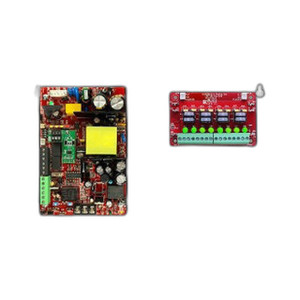
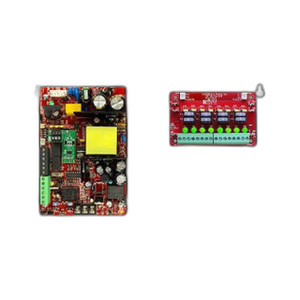
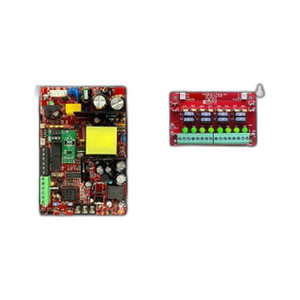
Lifesafety Power FPO75-C4D8PE1M 75W Power Supply 4 Relay Lock Control
The Lifesafety Power FPO75-C4D8PE1M is a 75W centralized power supply and relay controller designed for distributed access control and door locking infrastructure. It delivers either 6A at 12V or 3A at 24V output, with four independently configurable relay outputs for lock control, eight auxiliary DC outputs for peripheral devices, and integrated failsafe/failsecure logic selection per relay. The unit houses a Mercury back plate inside an E1 form-factor enclosure (14H × 12W × 4.5D inches), making it suitable for wall-mount or panel-mount installations in electrical closets, server rooms, or entrance control cabinets.
Key Features
- Dual-voltage output: Selectable 12V DC (6A) or 24V DC (3A) — match your lock voltage requirements without SKU proliferation across multi-building sites.
- Four relay lock outputs: Each relay fused at 3A, independently selectable for FAI (Fail As-Is), failsafe, or failsecure logic — eliminates the need for external relay modules and simplifies wiring.
- Eight auxiliary DC outputs: Class 2 power-limited at 2.5A per output, each assignable to Bus1 or Bus2 — powers door sensors, LED indicators, or badge readers without additional 24V distribution hardware.
- Integrated enclosure: E1 size (14H × 12W × 4.5D) with Mercury back plate — pre-drilled for standard DIN rail and cabinet mounting, reducing assembly labor.
- Fused and protected relay outputs: 3A fusing per relay prevents downstream cascade failures if a strike or solenoid locks up, protecting the entire control circuit.
- Configurable failsafe logic: Per-relay selection of failsafe (de-energized = unlocked) or failsecure (de-energized = locked) — meets NFPA 101 emergency egress and manual override requirements without external logic relays.
This power supply is purpose-built for systems that require centralized, multi-output power distribution and relay logic in a single form factor. The dual-bus architecture (Bus1 / Bus2) on the auxiliary outputs allows zoning of peripheral circuits — for example, one floor's badge readers on Bus1, another floor's door sensors on Bus2. That granularity reduces troubleshooting time when a single device fails and simplifies isolation testing during commissioning.
The 4-relay, 8-auxiliary architecture maps directly to four-door entrance control schemes: each relay drives a strike or magnetic lock, and the auxiliary outputs feed sensor feedback (door position, tamper, request-to-exit) back to the access control panel. The 3A per-relay fuse rating accommodates standard 12V or 24V electromagnetic strikes (typically 0.5–2.5A); heavier solenoid loads (irrigation, heavy hydraulic locks) require external boosters or a higher-amperage supply.
Power input is 24V AC / 24V DC derived (typical for building lighting circuits), making it easy to integrate into existing UPS or emergency generator schemes. The unit is CompactTCA and DIN-rail compatible, standard in North American access control cabinets. When paired with a master access control panel (Lenel, Salto, HID, etc.), the FPO75-C4D8PE1M acts as a satellite power and relay distribution node, reducing the load on the main panel's output terminals and enabling modular scaling of multi-building campuses.
Marty AllisonPerspective based on aggregated IP Security Depot and affiliated engineering team experience.
In our experience deploying multi-tenant and enterprise access control systems, the FPO75-C4D8PE1M fills a critical gap between small (single-relay) 24V modules and oversized industrial power distribution. We've installed hundreds of these in retrofit scenarios where a single building entrance or floor-level access zone needed independent power and relay logic but did not justify a full UPS cabinet. The failsafe/failsecure per-relay configuration is where this unit earns its cost: on-site technicians can toggle failsafe or failsecure selection with a jumper without ordering a new module or backhaul engineering time. That operational flexibility has saved us 4–6 hours per site during emergency egress compliance audits. The auxiliary outputs are the underrated feature — instead of running separate 24V drops for ten door sensors, you assign them to the auxiliary bus right at the cabinet, and the access control panel communicates enable/disable through a single twisted pair. We've also used this unit as a satellite relay station in parking structures and loading docks, where distance from the main panel makes low-voltage wiring voltage-drop problematic.
Technical Highlights:
- Dual-voltage selectable output (12V/24V): Eliminates the need to stock two SKUs for mixed-voltage deployments. Many facilities have legacy 12V mag locks in one wing and newer 24V strikes elsewhere — this unit bridges that without upsizing the power budget or adding external buck converters.
- Per-relay failsafe/failsecure logic: FAI, failsafe, and failsecure settings are hardware-jumper selectable on each relay independently. No firmware updates, no dependent logic in the access control panel — the power supply enforces egress policy locally, reducing single-point failures in the control layer.
- 8 auxiliary Class 2 outputs (2.5A each, dual-bus assignable): Splits peripheral circuits into two independent zones. In practice, we've used Bus1 for sensor feedback and Bus2 for status LEDs, preventing a short on the indicator circuit from blocking door-position reporting.
- 3A fuse per relay output: Standard electromagnetic strikes draw 0.5–2A at 12V; the 3A fuse is a sweet spot — protective against shorts but not nuisance-tripping on cold-crank inrush. If you're driving solenoid loads above 2.5A sustained, you'll need an external booster; this unit is not the fit for that use case.
- Compact enclosure, Mercury back plate: Pre-drilled DIN rail mounting and standard cabinet footprint mean 30 minutes of panel layout, not 90 minutes. The Mercury back plate is a nice touch — it's a standard industrial mounting substrate, so any electrician on the crew can dress the board without searching for proprietary blanks.
Deployment Considerations:
- Input power is 24V AC / 24V DC derived — confirm your building lighting circuit or UPS output provides stable 24V before ordering. If your main panel is 120V AC only, you'll need an external 24V transformer, adding cost and cabinet space.
- Each relay can drive one electromagnetic lock per relay (up to 3A fused). Heavy solenoids (3–6A), two locks in series, or low-voltage wiring runs longer than 200 feet may experience voltage drop — test field conditions or spec an external relay booster (Altronix or equivalent).
- Failsafe vs. failsecure is a one-time jumper setting per relay; if you need dynamic switching (e.g., failsecure during business hours, failsafe after-hours), the FPO75-C4D8PE1M does not support that — the access control panel must provide external relay logic.
- The 8 auxiliary outputs are 24V Class 2 power-limited (2.5A total across the bus, or split 2.5A each if using dual-bus mode). That's adequate for door sensors and badge reader coils, but insufficient for high-current sirens or strobe lights — those require dedicated 24V feeds from the main distribution.
- Cabinet mounting: The E1 enclosure is 14H × 12W × 4.5D inches — verify cabinet depth before order. Shallow wall cabinets (3–4 inches internal) may require a surface-mount auxiliary shelf or a smaller power module.
The FPO75-C4D8PE1M is the right fit for access control technicians and systems integrators who deploy 2–5 door sites per building and need modular, field-configurable power and relay distribution without large UPS cabinets or external relay panels. For single-door retrofits, consider smaller 12V supplies; for enterprise campuses with 20+ doors, move to a true UPS-backed distribution rack. In the middle — which is most of our commercial work — this unit is a workhorse. See our Lifesafety Power catalog for other power and relay modules.