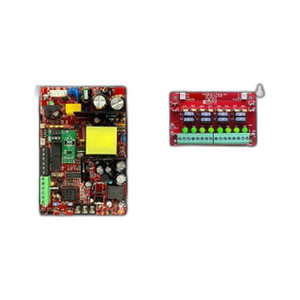
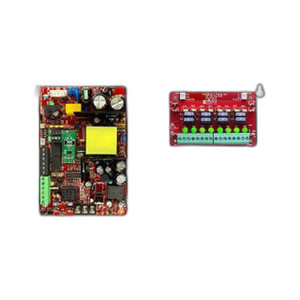
Lifesafety Power FPO75-C4D8E1PDK 75W Power Supply 4-Relay Lock Control
The Lifesafety Power FPO75-C4D8E1PDK is a 75W regulated power supply engineered for multi-door access control systems where lock control flexibility and distributed auxiliary power are operational priorities. It delivers either 6A at 12V or 3A at 24V — allowing you to match the supply to your site's door-lock current draw and voltage standard. The four dedicated relay outputs enable independent failsafe, failsecure, or FAI-type control per relay, so a single panel can manage heterogeneous lock behaviors across entrance doors, emergency exits, and auxiliary access points. Eight additional fused DC auxiliary outputs distribute low-current control and monitoring signals to second-stage devices — card readers, REX buttons, motion sensors — without a separate auxiliary supply.
Key Features
- Dual Output Voltage: Selectable 6A @ 12V or 3A @ 24V. Choose 12V for lower copper losses on short cable runs; select 24V where voltage drop is a concern or your site standard is already 24V infrastructure.
- Four Relay Outputs: Each rated 3A, independently fused. Selectable failsafe, failsecure, or FAI operation per relay — no jumper changes needed if you mix lock control types across a single installation.
- Eight Auxiliary DC Outputs: 3A fused each, assignable to Bus1 or Bus2. Eliminates the need for a separate low-current supply for second-stage devices like card readers, request-to-exit buttons, and indicator lights.
- Independent Fusing: Each output fused at 3A. A short or overload on one relay or auxiliary line does not affect the others — fault isolation protects the rest of the system.
- DIN-Rail Mount: Standard DIN-rail form factor fits industry-standard electrical enclosures. Compact footprint simplifies integration into security cabinets alongside NVRs, network switches, and access controllers.
- Regulated DC Output: Filtered, regulated output with power-loss indicator. Prevents lock chatter on weak mains voltage and provides stable control signals to access panels and auxiliary devices.
The FPO75-C4D8E1PDK is purpose-built for mid-to-large single-building or multi-floor access control where you need one centralized power and relay distribution point. A typical deployment might be a 4-door floor (main entrance, emergency exit, service door, loading dock) where each door lock requires independent failsafe/failsecure behavior, plus shared auxiliary power for card readers and request-to-exit sensors. By combining four relay outputs and eight auxiliary outputs in a single 75W supply, you eliminate the cost and complexity of daisy-chaining multiple smaller power supplies and reduce the footprint in your electrical enclosure.
Voltage selection (12V or 3A/24V) is a design-time choice — verify your access control panel's input specification and your total connected load before installation. For example, a building with four 0.5A magnetic locks (typical for access-controlled interior doors) would comfortably fit on the 12V, 6A output; if you add electric strikes rated at 1.5A each, or plan for future expansion, the 24V, 3A output may be more suitable for sites already standardized on 24V infrastructure. The eight auxiliary outputs are invaluable on larger floors: a single card reader draws 200–300mA, so you can power four readers directly from auxiliary Bus1 without touching your relay outputs or main lock supply. Bus1/Bus2 separation allows you to segregate control circuits if your access control panel requires isolation between certain devices.
Each relay and auxiliary output is independently fused at 3A, so you can confidently pull up to 3A from a single output without risk of nuisance fuse blows on other circuits. This architecture is standard in professional access control supplies but worth emphasizing: if a reader develops a short, or a lock solenoid draws excess current on startup, only that output's fuse trips. The remaining three relays and seven auxiliaries stay live. Compare this to cheaper non-fused supplies where a single short can kill the entire panel — the cost of independent fusing is negligible versus the operational cost of an unplanned access outage.
The FPO75-C4D8E1PDK integrates with any FAI-compatible access control panel (Honeywell ProWatch, HID VertX, Nortek Salto Gateway, and many others). Relay contact closure is standard across the industry — no special drivers or interfaces needed. Verify that your specific panel can source/sink the relay contact current you intend (typically under 1A per contact) and that your door locks operate at the voltage you select. Failsafe/failsecure selection is usually a dip-switch or software setting on the access controller; the FPO75-C4D8E1PDK supplies the relay contact and lets the panel dictate the logic.
Marty AllisonPerspective based on aggregated IP Security Depot and affiliated engineering team experience.
We've installed the FPO75-C4D8E1PDK in dozens of mid-scale access control retrofits — office buildings, multi-tenant facilities, and mixed-use sites where you need to consolidate lock control and auxiliary power in a single cabinet. The real differentiator is the four independent relays with selectable failsafe/failsecure behavior. Most sub-$300 power supplies force you to choose one behavior (all failsafe or all failsecure) across the board; this unit lets you mix. That flexibility eliminates design complexity on a floor plan with a fire-rated emergency exit (must be failsafe) alongside a tenant suite entrance (typically failsecure). The eight auxiliary DC outputs are also underrated — integrators often underestimate how much low-current distribution they need once a project expands beyond the initial 2–3 readers. We've seen sites add a second reader or motion sensor six months post-deployment, and suddenly there's no 12V or 24V source for it. The FPO75-C4D8E1PDK's eight auxiliaries solve that without a second supply.
Technical Highlights:
- Independent Fusing per Output: Each of the 4 relays and 8 auxiliaries is 3A fused. Operationally, this means a short on one lock solenoid doesn't cascade across your entire system. You lose a single door, not four. Redundancy and fault isolation are worth the added component cost when you're managing critical access points.
- Dual Voltage Selection (12V or 24V): Choose 12V for short cable runs under 50 feet (lower copper losses); pick 24V if your site is already 24V standardized or cable runs exceed 100 feet. The decision is made at installation, not field-changeable, so verify your panel and locks before shipping.
- Four Selectable Relay Outputs: Failsafe, failsecure, or FAI logic per relay. On a 4-door floor, you can run two failsafe (emergency exits) and two failsecure (tenant suites) from a single supply without jumper changes or external logic modules.
- Eight Bus-Selectable Auxiliaries: Assignable to Bus1 or Bus2. Allows circuit isolation if your access panel segregates control signals (e.g., readers on Bus1, sensors on Bus2). Typical current per auxiliary is 200–500mA (card readers, exit buttons, indicator LEDs), so all eight can run concurrently without overload risk.
- Regulated, Filtered Output: Brown-out protection and capacitor filtering prevent lock chatter during mains voltage sag or in electrically noisy environments. Critical in industrial or warehouse deployments where VFD motors or heavy machinery generate line noise.
- DIN-Rail Mounting: Standard 35mm DIN rail — integrates seamlessly into electrical cabinets alongside NVRs, POE switches, and UPS units. Reduces cabinet real estate versus wall-mount or panel-mount alternatives.
Deployment Considerations:
- Voltage selection is design-time only. Confirm your access control panel's input voltage spec and total connected load (all locks + readers + sensors) before ordering. If your site runs a mix of 12V and 24V devices, you may need two units or a higher-capacity multi-rail supply.
- Each relay output is rated for standard solenoid lock currents (typically 0.5–1.5A at strike). Verify your specific lock's holding current; if you spec electric strikes rated above 2A, you'll be at the edge of the 3A per-relay fuse limit. Consider a higher-capacity unit or distribute locks across multiple supplies.
- The eight auxiliary outputs are 3A fused each but share the main 75W budget with the four relay outputs. If you're pulling 5A from the main relay supply (close to 12V max), you can't simultaneously pull 3A from all eight auxiliaries. Size your auxiliary load conservatively — typically card readers and sensors draw 200–500mA each.
- FAI logic and failsafe/failsecure selection are handled by the access control panel, not the supply. The FPO75-C4D8E1PDK provides the relay contact; the panel drives the relay logic. Verify your panel's relay contact current rating (typically under 1A) to avoid contact erosion or chatter.
- Mount in a secure, weatherproof electrical enclosure. The unit itself is not outdoor-rated; condensation or direct water exposure will degrade the fused outputs and relay contacts. If the cabinet is in an unheated garage or outdoor wall, add a thermostatic heater or relocate the supply indoors.
The FPO75-C4D8E1PDK is the right choice for mid-scale access control projects where you need flexible lock control (mixed failsafe and failsecure) and don't want to buy a separate auxiliary power supply. It's not the largest unit in the Lifesafety Power lineup, so if you're managing 8+ doors or running high-current electric strikes, evaluate the FPO120 or FPO200 series. For a 4-floor office building with 2–3 doors per floor, this unit delivers operational simplicity, fault isolation, and cost-effective power distribution. Explore the Lifesafety Power catalog for higher-capacity models and other specialized supplies.