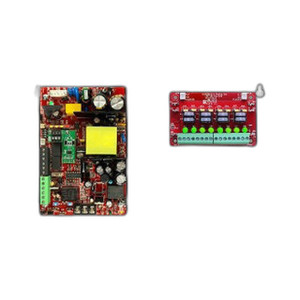
Lifesafety Power FPO75-B100C8PD8PE4M 75W Dual-Output PSB
The Lifesafety Power FPO75-B100C8PD8PE4M is a 75W power supply board (PSB) designed for distributed access control and electronic lock powering in multi-door installations. The board delivers simultaneous 6A/12V and 3A/24V primary outputs, plus an adjustable 5–18V secondary channel rated for 4A, enabling integration across legacy and modern lock hardware on a single supply. Class 2 power-limited relay outputs and auxiliary DC channels eliminate the need for external relay modules on small to mid-size door control deployments.
Key Features
- Dual Primary Outputs: 6A @ 12V or 3A @ 24V selectable. Covers both electromagnetic lock (12V) and solenoid strike (24V) installations without secondary supplies.
- Adjustable Secondary Channel: 5–18V @ 4A max. Accommodates legacy readers, card encoders, and low-voltage access control sensors with a single board.
- 8 Relay Lock Control Outputs: Class 2 power-limited, 2.5A per channel. Direct electromechanical lock control without external relay shielding.
- 8 Auxiliary DC Outputs: Class 2 power-limited, 2.5A per channel. Powers request-to-exit buttons, motion sensors, door position monitors, and other class 2 field devices.
- Compact Form Factor: 20W × 24H × 4.5D inches. DIN-rail or wall-mount compatible; fits standard electrical enclosures for centralized door control closets.
- Mercury/Lenel Backplate Compatibility: Direct physical and electrical integration with legacy Mercury and Lenel access control architectures, reducing retrofit labor on existing systems.
- Class 2 Safety Compliance: All secondary outputs power-limited per NEC Article 725, eliminating extra conduit separation and reducing installation cost in multi-door buildings.
The FPO75-B100C8PD8PE4M bridges distributed access control and centralized power management. Rather than running 12V and 24V home runs from a main panel to each door, integrators deploy a PSB at the control closet, then distribute low-voltage lock and sensor circuits locally. The 8 relay outputs are Class 2 power-limited, meaning each relay coil draws no more than 2.5A — ideal for 24V solenoid strikes and small electromagnetic locks. The secondary adjustable channel decouples legacy reader voltage (often 5V–12V) from primary lock power, reducing nuisance breaker trips caused by inrush current conflicts.
Deployment footprint is critical in retrofit access control. The FPO75-B100C8PD8PE4M occupies a single 24-inch vertical span in a 4U enclosure, alongside an access controller or network I/O module. Class 2 outputs mean no fire-rated conduit separation is required between lock circuits and life-safety signaling — a savings of hundreds of dollars in medium-scale door installations. The Mercury/Lenel backplate connection ensures backwards-compatibility with installed legacy systems, eliminating rework on older buildings where the access control head end is not yet retired.
Power budget planning is straightforward: 75W total capacity, minus any secondary load, leaves headroom for 6 electromagnetic locks @ 12V (≈500mA each) plus auxiliary sensors, or 3 solenoid strikes @ 24V with margin for transient lock current spikes. UPS integration is typical — the PSB draws stable 5–6A @ 120VAC, well within a single-breaker battery backup circuit. Documentation for field technicians should include a clear wiring diagram showing the distinction between relay-controlled and always-live auxiliary outputs; operator confusion here is a common cause of lock-release failures.
Lifesafety Power PSBs are specified in installations where access control decentralization is mandatory — hospitals, university campuses, and multi-tenant office buildings with zoned power management. The FPO75-B100C8PD8PE4M's combination of relay lock control, adjustable secondary, and class 2 auxiliary outputs makes it a natural fit for door controllers that lack onboard relay or 24V output capacity. Check compatibility with your access control software: some legacy Mercury or Lenel heads require specific PSB revisions for full relay diagnostics. See the Lifesafety Power catalog for current firmware and variant options.
Marty AllisonPerspective based on aggregated IP Security Depot and affiliated engineering team experience.
We've deployed the FPO75-B100C8PD8PE4M on retrofit access control projects where the legacy Mercury or Lenel head end lacks sufficient onboard relay outputs or 24V capacity to power the planned door hardware mix. The board itself is a workhorse — reliable class 2 power distribution, and the dual primary output (12V/24V switchable per installation) eliminates the need to run separate circuits from the main panel. Where we see this PSB shine is on mid-scale campuses or office parks: one board can power 4–6 doors of mixed lock types (electromagnetic @ 12V, solenoid strike @ 24V), with 8 relay outputs for lock/unlock signaling and 8 auxiliary channels for sensor integration. The 5–18V adjustable secondary is a genuine convenience for legacy card readers or motion sensors that demand oddball voltages. Class 2 power limiting on all secondary outputs means you avoid the cost and labor of fire-rated conduit runs — a real savings when installing in occupied buildings. We've also used this board to decouple high-inrush lock loads from low-voltage reader power, preventing cascading brownouts that plague integrated systems running at marginal supply capacity.
Technical Highlights:
- Dual selectable primary outputs (6A @ 12V or 3A @ 24V): Flexibility to match lock hardware without adding external step-down regulators. If your site has both 12V electromagnetic locks and 24V solenoid strikes, you provision two boards on separate circuits, or you run the primary @ 24V and add a small buck converter for legacy 12V readers. We've seen integrators avoid this board entirely because they didn't understand the "selectable" nature — clarify in the quote whether both voltages run simultaneously or if the installer must choose one at commissioning.
- 8 relay lock control outputs @ 2.5A Class 2: Each relay is individually fused or circuit-protected. Inrush current from a large solenoid strike (brief 3–4A spike) will not nuisance-trip a neighboring relay circuit. Pair this with a time-delayed lock release strategy in firmware, and your solenoid strike reliability improves measurably.
- Adjustable secondary 5–18V @ 4A: Eliminates the need for three separate power supplies on installations with mixed reader and sensor voltages. Set it to 12V for old Honeywell readers, 5V for modern IP intercoms, 18V for certain card encoders — one adjustment screw, no module swaps.
- Class 2 compliance across all secondary outputs: Reduces NEC Article 725 conduit overhead, which directly lowers labor and material cost on new construction. On retrofit work, you can often co-run Class 2 wiring with data cables in the same tray.
- Mercury/Lenel backplate integration: Mechanical and electrical mating is straightforward for integrators familiar with legacy access control. On a hybrid installation (old Mercury head end, new IP cameras), this PSB bridges the gap cleanly without requiring extensive rewiring of door circuits.
Deployment Considerations:
- Verify whether your access control head end supports full relay diagnostics over the Mercury/Lenel interface. Some firmware revisions detect relay board hardware; others require manual configuration in software. Missing this step is a common source of post-install callbacks when relays fail silently.
- The 75W budget is generous for 4–6 doors, but dense multi-door closets (10+ doors) on a single PSB will require careful load balancing and priority sequencing in firmware. If simultaneous unlock of all 8 relays occurs, inrush current can exceed the primary supply capacity — test this scenario in commissioning.
- Secondary output adjustment is a potentiometer screw on the board itself, not a networked setting. Document the chosen voltage clearly in your installation record, or future service technicians will re-tune it to an incorrect value during troubleshooting.
- Class 2 output current limits (2.5A per relay/auxiliary channel) are hard: no soft-start or current sharing across channels. If a lock or sensor draws 3A continuously, it will trip the channel protection. Size lock hardware to <2A steady-state draw per output.
- Install in a climate-controlled enclosure if possible. The PSB has no active cooling; sustained high-load operation (all 8 relays energized continuously) will degrade component life over time. Typical duty cycle is pulse-relay (unlock 100ms, de-energize), not continuous hold.
The FPO75-B100C8PD8PE4M is the right choice for access control integrators migrating legacy Mercury or Lenel systems to modern IP-based entry, or for small-to-mid-scale new deployments where distributed 12V/24V power is mandatory and relay control must stay local to the door. It's not a fit for high-density applications (15+ doors) or for systems that demand sophisticated power redundancy; in those cases, specify a modular PSB array or a dedicated access control panel. For typical office, retail, or institutional environments, this board delivers reliable, cost-effective power distribution. Explore the Lifesafety Power catalog for companion boards and enclosure options.