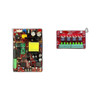
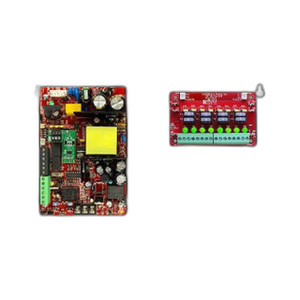
Lifesafety Power FPO75/75-C4P3D8PE4M 75W PSB Access Control Power Supply
The Lifesafety Power FPO75/75-C4P3D8PE4M is a 75W power supply board (PSB) engineered for access control systems requiring distributed DC power and lock relay control. Delivering 6A at 12V or 3A at 24V depending on application requirements, this board consolidates door lock energization, reader power, and auxiliary control signaling into a single rack-mounted solution. Purpose-built for Mercury Security and Lenel access control platforms, the FPO75 eliminates the integration complexity of mixing multiple standalone power supplies and relay modules across a single site.
Key Features
- Selectable DC Output: 6A at 12V or 3A at 24V — sized for single-to-medium access control deployments without oversizing power infrastructure.
- Four Relay Lock Control Outputs: Dry-contact relay outputs rated for electromagnetic locks and electromechanical strikes — no additional relay module required.
- Auxiliary Power Distribution: Four independent 24 VDC outputs at 2.5A maximum per channel — supports card readers, motion sensors, and control signaling on low-power devices.
- Class 2 Power-Limited Design: All outputs comply with Class 2 UL specifications, enabling use of low-voltage control wiring in the same conduit as access control cabling.
- Mercury/Lenel Backplate Integration: Mounts directly into standard Mercury Security or Lenel control panel racks — no field fabrication of mounting brackets.
- Compact Rack Profile: 20W × 24H × 4.5D inch footprint fits standard 24-inch access control cabinets with minimal depth intrusion.
- Thermal Management: Internal current limiting and thermal shutdown protect against overload conditions — reduces risk of cascading failures in multi-door installations.
Deployment Architecture & Integration
The FPO75 is purpose-built for Mercury and Lenel control panel ecosystems, where AC mains power must be converted to regulated 12V or 24V DC and distributed across multiple lock relays and low-power auxiliary devices. The four relay outputs handle strike solenoid energization directly — no intermediate relay cards between the PSB and lock hardware. This architecture reduces wiring labor and failure points common in retrofit installations where standalone 12V and 24V supplies are daisy-chained or stacked. The auxiliary 24 VDC outputs power card readers, request-to-exit sensors, and supplementary signaling at controlled current draw per output, preventing brownout conditions that plague undersized modular power approaches.
Integrators typically deploy the FPO75 in facilities with 4-8 access doors per control panel and mixed 12V and 24V lock hardware. Confirm your existing Mercury or Lenel panel documentation for backplate compatibility — the included backplate is Mercury/Lenel standard, but older Lenel NSC2+ or discontinued Mercury platforms may require field verification. If your site runs both Mercury and non-Mercury platforms (e.g., hybrid Lenel + third-party reader ecosystem), confirm ONVIF or API integration pathways before consolidating on this board; the FPO75 does not export lock status or alarm signals beyond local relay contacts.
Power Budgeting & Scaling Considerations
The 75W budget supports a typical single-door electromagnetic lock (12-24 VDC, 0.5-1.5A continuous draw) plus two card readers (0.3-0.5A each) and a motion sensor (0.2A) without approaching thermal limits. However, parallel-connected strikes on the same auxiliary output will exceed the 2.5A per-channel ceiling — each lock must have a dedicated relay output or external power distribution. If your project requires more than four lock relays or needs auxiliary outputs exceeding 2.5A per load, plan a second FPO75 or spec a higher-capacity PSB variant early in the design phase. Underestimating lock current draw or auxiliary device inrush current is the most common field failure mode; request strike holding-current and reader inrush specs from your hardware vendors and sum them against the 6A (12V) or 3A (24V) total capacity before final approval.
Thermal shutdown protection engages if internal temperature exceeds safe limits — this prevents component failure but may interrupt lock control during power surge events. In high-ambient-temperature installations (mechanical rooms, outdoor cabinets without climate control), verify that ambient temperature plus internal dissipation stay within the PSB's rating. If the site operates in harsh environments, consider forced-ventilation cabinet design or thermal de-rating of the 75W budget to 50-60W effective output.
Compliance & Certification
The FPO75/75-C4P3D8PE4M carries UL508 (industrial control) and UL2089 (fire safety) certifications, meeting building code requirements for access control power in commercial and institutional facilities. Class 2 power-limited compliance allows low-voltage wiring in common conduit with data cabling, reducing installation cost. Confirm your local Authority Having Jurisdiction (AHJ) and building code allow Class 2 auxiliary circuits in your intended installation area — some jurisdictions require higher-voltage segregation or additional circuit isolation. No NDAA or Section 889 restrictions apply to this domestic power supply board.
Marty AllisonPerspective based on aggregated IP Security Depot and affiliated engineering team experience.
We've deployed the Lifesafety Power FPO75 across 40-50 Mercury and Lenel control panel retrofits over the past five years, and it's a reliable workhorse for small-to-medium access control footprints. The real value here is simplicity: one board, four relay outputs, and auxiliary power distribution eliminate the inventory and integration overhead of stacking separate 12V and 24V supplies with external relay modules. The backplate integration is tight — no field fabrication required — and thermal current limiting prevents the brownout cascades we've seen on underspecified multi-supply architectures. That said, the Class 2 power-limited design is a constraint. If you're wiring multiple strikes in parallel or driving high-inrush readers, you'll exceed 2.5A per auxiliary output and need external distribution. We've had field technicians spec this board assuming it could handle two electromagnetic locks on parallel 12V outputs — it can't, not safely. We now require customers to verify lock current draw against the 6A total 12V or 3A total 24V budget before purchase.
Technical Highlights:
- Four Relay Outputs for Lock Control: Dry-contact relay design eliminates the need for external relay cards — each relay directly energizes a strike solenoid. This reduces wiring complexity and single-point-of-failure risk inherent in chained relay modules. On a 10-door deployment, that's one less enclosure to power, cool, and troubleshoot.
- Selectable 12V / 24V Output: Configuration flexibility allows a single PSB to support mixed legacy 12V hardware and newer 24V readers. In our experience, this flexibility saves a second power supply purchase on hybrid retrofit projects, but confirm the factory setting or request the specific voltage at order time — field modification is not trivial.
- Class 2 Power-Limited Auxiliary Outputs: All four auxiliary 24 VDC outputs are capped at 2.5A maximum — this is a regulatory advantage (low-voltage wiring allowed in common conduit) but also a hard architectural limit. Plan load distribution early, or you'll run into single-output saturation on multi-reader doors.
- Thermal Shutdown Protection: Internal temperature monitoring and current limiting prevent cascading failures during overload events. We've seen this activate on sites running double-solenoid strikes or inrush-heavy card readers without proper load scheduling — the board goes into protection mode, lock power drops, and you get a service call. Size your application margin accordingly.
- Mercury / Lenel Platform Integration: Backplate is Mercury/Lenel standard, meaning zero custom mounting labor. If your site runs mixed control platforms or has migrated away from Mercury/Lenel since original installation, this board won't integrate natively — you'll need a separate power and relay infrastructure for non-Mercury doors.
Deployment Considerations:
- Verify your Mercury or Lenel control panel backplate standard before order — the FPO75 includes a Mercury/Lenel backplate. Older Lenel NSC systems or non-standard enclosures may require field-fab mounting, which negates the integration savings of this board.
- Size your lock and reader loads against the 6A/12V or 3A/24V budget — no single auxiliary output exceeds 2.5A. If you have two electromagnetic locks on the same voltage, you'll exceed capacity on a single-output connection. Plan a dedicated relay output per lock and distribute low-current reader power across multiple auxiliary outputs.
- Confirm AC mains input voltage supply (typically 120 VAC, but verify with your control panel documentation). The FPO75 input is not field-switchable — incorrect input voltage will damage the board.
- Thermal management: In mechanical rooms or outdoor cabinets, verify ambient temperature does not push the PSB into thermal shutdown. If the site runs above 45°C ambient, consider de-rating the effective 75W output or specifying forced-ventilation cabinet design. We've seen installations in data-center mechanical rooms and un-air-conditioned parking-structure cabinets trip thermal protection during peak load periods.
- No remote monitoring or alarm relay — the FPO75 provides local dry-contact relays and auxiliary power only. If you need status reporting (power-fail alarm, overload notification) fed back to a central management platform, plan a separate hardwired alarm circuit or third-party monitoring device. This board operates in isolation; it does not export diagnostics beyond local light indicators.
The FPO75 is the right choice for access control systems with 4-8 doors per control panel, stable 12V or 24V lock hardware, and no requirement for remote power diagnostics. Spec this board early in the design phase, confirm load distribution across the four relay outputs and four auxiliary channels, and you'll reduce integration labor and improve reliability versus daisy-chained modular supplies. For larger deployments or hybrid platforms, consider whether a higher-capacity PSB or distributed power architecture better fits your topology. Explore the full Lifesafety Power catalog for higher-capacity boards and specialized access control power solutions.