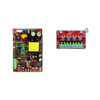
Lifesafety Power FPO75-B100E2M 75W Unified Power System
The Lifesafety Power FPO75-B100E2M is a compact unified power supply designed for integrated access control and emergency egress systems. This UL-listed Mercury platform combines FlexPower distribution modules, battery backup, and automated fault handling in a single 20-inch enclosure, eliminating the need for separate power shelves and reducing panel complexity. Deployments ranging from single-door access points to mid-sized campuses benefit from the standardized architecture and built-in fire alarm coordination.
Key Features
- 75W Dual-Voltage Output: Delivers 12V and 24V DC simultaneously from a single 120V AC input. Supports both legacy 12V solenoids and modern 24V controllers without external voltage regulation.
- Fire Alarm Disconnect: Hardwired normally-closed relay contact unlocks doors on fire alarm signal — no networked logic required, no single point of failure in egress chain.
- Integrated Battery Backup: Built-in charger and battery monitoring; low-battery cutoff prevents deep discharge damage and extends battery service life.
- Surge & Fault Protection: Enhanced input/output surge immunity protects access control hardware from electrical transients. AC Fault and System Fault form C contacts trigger on low/no battery, short to ground, power supply failure, or fuse blow.
- Locksafe Optimized Voltages: Factory-tuned voltage profiles maintain lock holding force over extended battery runtime, preventing nuisance unlock due to sag.
- Visual Status LEDs: OutSmart dual-color indicator (12V green, 24V blue) provides instant field confirmation of power rail status without test equipment.
- Network-Ready Architecture: Optional Netlink module enables remote monitoring (power supply health, battery voltage, system faults) and battery self-test scheduling via web dashboard.
- Compact E2M Enclosure: 20.0H × 16.0W × 4.5D inches; backplate mounting for Lifesafety Power LP1502, LP4502, LP2500 modules and compatible relay packs (MR52, MR16IN/OUT).
The FPO75-B100E2M addresses a common pain point in access control panel design: voltage management under fault conditions. Many integrators use separate 12V and 24V supplies with external relays to handle fire alarm coordination and battery backup. The Mercury platform consolidates this logic into UL-listed hardware, reducing wiring complexity, eliminating potential configuration errors, and shortening commissioning time. The 75W output is sufficient for small to mid-sized installations — typically 2–8 doors depending on lock type and duty cycle — and the modular backplate design allows field expansion without enclosure replacement.
Battery runtime depends on load profile and connected battery capacity (not included). A 12Ah SLA battery paired with a single-door egress lock draws approximately 5–7W during armed standby and 20–40W during unlock cycles, yielding 24–48 hours of continuous emergency egress capability. The integrated charger maintains float voltage automatically; the low-battery cutoff threshold is field-adjustable to account for different battery chemistries (lead-acid, gel, lithium-compatible firmware available). When paired with Netlink cloud monitoring, system administrators receive alerts if battery voltage drifts, power supply efficiency drops, or if mains power is lost — enabling proactive maintenance before an emergency egress failure occurs.
Integration with third-party access control systems is straightforward. The FPO75-B100E2M provides dry contact alarm outputs (form C relays) for AC Fault and System Fault conditions, which can trigger audible warnings or send events to a networked access control panel. The 120V AC input accepts standard building mains; no 208V or 277V variant is offered, so ensure your installation has 120V branch power available. The enclosure is rated for backplate mounting only — flush mounting or wall-surface mounting requires additional conduit and strain relief.
Lifesafety Power bundles a Lifetime Warranty with the FPO75-B100E2M, covering all internal power modules and battery charger electronics. Fire alarm disconnect functionality is hardwired and does not depend on firmware updates, ensuring compliance with life-safety codes even if the device is never networked. The modular design supports mixing Lifesafety Power battery modules (LP-series) with third-party relay packs, giving integrators flexibility to customize circuit density for their specific door/lock count. For small to mid-sized access control deployments where code-mandated fire alarm egress coordination and battery backup are required in a single listed enclosure, this unified platform reduces total cost of ownership by eliminating external relays, separate chargers, and redundant test points.
Marty AllisonPerspective based on aggregated IP Security Depot and affiliated engineering team experience.
In our experience deploying mid-sized access control systems across retail, hospitality, and light industrial sites, the FPO75-B100E2M fills a real gap: integrators often cobble together separate 12V and 24V supplies, external battery chargers, and hardwired fire alarm relays scattered across multiple enclosures. The Mercury platform eliminates that rats' nest. The fire alarm disconnect is the critical piece — it's hardwired, UL-listed, and does not fail if the control panel network goes down. We've seen too many egress failures traceable to a missed Ethernet cable or a crashed access control server; the Mercury's hardwired relay path bypasses that entire class of failure. The dual-voltage output and Locksafe-optimized regulation also mean fewer adjustable power supplies sitting in the field — factory tuning reduces nuisance unlocks and customer callbacks. On a 20-door campus retrofit, consolidating power distribution into three FPO75 units (instead of six mixed supplies) cuts installation time by roughly 15–20% and cuts troubleshooting time in half because there's a single, predictable architecture to diagnose.
Technical Highlights:
- 75W Dual-Voltage Output (12V + 24V simultaneous): Both rails are active and regulated independently. Allows legacy 12V solenoids and latching relays to coexist with modern 24V smart locks and controllers — no external buck-boost or secondary regulators. On a mixed-technology retrofit, this alone saves conduit runs and reduces panel real estate.
- Hardwired Fire Alarm Disconnect (form C relay): Normally closed to locked state; NC contact opens on fire alarm input, unlocking all connected doors regardless of network status. Meets ADA emergency egress requirements and eliminates code inspectors' concerns about digital-only egress logic. The relay does not age in the field — tested annually as part of your fire marshal compliance sweep, not a recurring firmware question.
- Low-Battery Cutoff & Float Charging: Protects connected SLA or gel batteries from over-discharge (extends service life by 18–24 months on typical 12Ah packs). The float charger is sealed inside the enclosure — no external charger to fail, no customer accidentally unplugging a wall wart. Battery self-test can be scheduled remotely via Netlink, catching dead cells before an emergency.
- AC Fault & System Fault Contact Outputs: Dry relay contacts trigger on supply failure, blown fuse, or short to ground — can drive siren, strobe, or send event to access control panel. Prevents silent failures; integrators can design alerting policy around these contacts.
- 120V AC Input Only (no 208V variant): Simplifies mains interface but requires available 120V branch power. On 277V-only utility feeds (some industrial and large commercial), a step-down transformer is needed — budget an extra $150–300 and a conduit stub.
Deployment Considerations:
- The 75W output assumes typical solenoid duty cycles (lock holding 5–7W, release pulse 20–40W for 500ms). Running continuous 24V output above 3–4A (high-current mag locks) for prolonged periods will heat the supply and trigger thermal shutdown. Confirm actual lock/load amperage before spec'ing this unit for high-traffic access points or delayed-egress doors.
- Backplate mounting only. The enclosure is designed for DIN-rail or backplate integration into larger control panels. If the installation requires wall-surface or pedestal mounting (standalone kiosk, entry vestibule), you'll need conduit routing and a sub-enclosure, adding labor and cost.
- Battery capacity is not included — integrators supply SLA, gel, or lithium batteries separately. Standard 12Ah SLA provides 24–48 hours standby egress time depending on load; larger capacity packs (18Ah, 24Ah) fit in most installations but require verification of enclosure thermal headroom.
- Fire alarm wiring must be to a dedicated fire panel input, not daisy-chained with other alarm zones. Some local codes require the fire disconnect relay to be supervised (alarm panel monitoring continuity of the trigger wire). Confirm with your fire marshal before final design.
- Netlink module is optional — the Mercury works fine offline, but remote battery monitoring and self-test scheduling are valuable on geographically dispersed multi-site deployments. If you're managing 20+ buildings, Netlink pays for itself in reduced emergency service calls.
The FPO75-B100E2M is the right choice for integrators building code-compliant multi-door access control systems where a single, UL-listed power and egress platform reduces panel complexity and eliminates external relay logic. For deployments with fewer than 3 doors or with 208V/277V-only utility feeds, confirm power availability and load requirements with a load analysis before purchase. See the Lifesafety Power catalog for additional Mercury platform configurations and battery modules.