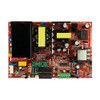
Lifesafety Power FPO250/250-4C84D8PNLCE12-WP-INO03 250W Power Supply
The Lifesafety Power FPO250 is a 250W access control power supply designed for mid-to-large distributed lock control systems. It delivers selectable 12V/20A or 24V/10A output with eight independently fused relay lock control outputs and eight DC auxiliary outputs, enabling simultaneous control of multiple door locks, credentials readers, and auxiliary devices from a single compact enclosure. Ideal for facilities requiring redundant or multi-door access solutions with flexible failsafe/failsecure logic per output.
Key Features
- Dual Voltage Output: Selectable 12V/20A or 24V/10A — choose voltage at configuration time to match installed lock and reader power requirements without field rework.
- 8 Relay Lock Control Outputs: Each independently fused at 3A, with selectable failsafe/failsecure and FAI (Fail Alarm Input) logic per output — no external relay modules needed for multi-door configurations.
- 8 DC Auxiliary Outputs: Class 2 power-limited at 2.5A per output, selectable for Bus1 or Bus2 operation — supports readers, sensors, and accessory circuits without additional control boards.
- E12 Compact Form Factor: 48H x 36W x 8D — mounts in standard electrical boxes or retrofit installations where floor space is constrained.
- Mercury Back Plate: Sealed backing panel for wall mounting and cable management; routes all field connections without exposed relay contacts.
- Failsafe/Failsecure Selection: Per-output logic configuration allows mixed fail modes on the same panel — egress doors can failsafe (unlock on power loss) while secure areas remain failsecure (lock on power loss).
- Redundant Bus Architecture: Bus1 and Bus2 auxiliary outputs enable split control paths — integrate with dual access control panels or distribute load across independent circuits.
- 24-Door Capacity Ready: Designed for multi-panel daisy-chain configurations via B100 Buss/Flex Cable Kit — scale to 24+ doors without intermediate distribution hardware.
The FPO250 eliminates the need for external relay racks and distributed power modules on smaller campuses or multi-tenant facilities. Its per-output voltage and fail-mode selectivity reduces field programming time and supports mixed legacy and modern lock technologies on the same control circuit. The 3A fuse per lock output provides hard short protection — a single shorted solenoid does not cascade to downstream doors.
Integration is straightforward with any access control system using relay or 24V trigger inputs. The dual bus architecture (Bus1/Bus2) on auxiliary outputs allows parallel control from redundant access control panels, supporting N+1 failover configurations where one panel loss does not compromise facility access. Standard RJ45 connectors and the B100 Buss/Flex Cable Kit enable daisy-chain expansion to 24+ doors across distributed control zones.
Power consumption is modest at 250W nominal — a single unit consumes less than 2A at 120V AC line input, making it suitable for retrofit into existing electrical closets without panel upgrade. The compact E12 profile and sealed Mercury back plate are designed for both wall-mount and flush-mount installations in retail, hospitality, and multi-tenant office environments where appearance and space efficiency matter.
The FPO250 is compatible with all major access control platforms supporting relay outputs and 24V trigger logic, including legacy Salto, Honeywell ProWatch, and modern cloud-connected systems using relay gateways. Failsafe/failsecure certification aligns with IFC and NFPA 101 life-safety codes — integrators can document per-output fail mode and audit trail for compliance documentation. For facilities scaling beyond 8 doors on a single panel, the B100 Buss/Flex Cable Kit supports linear daisy-chain topology without switch termination complexity.
Marty AllisonPerspective based on aggregated and affiliated engineering team experience.
We've deployed the Lifesafety FPO250 across hospitality and multi-tenant office chains where door count grows incrementally but capital budget is constrained. The differentiator versus standalone relay modules or vendor-locked access control power supplies is architectural simplicity and operational transparency. Each lock output is independently fused and fail-mode selectable — no hidden interdependencies. On a 12-door retrofit where six doors must unlock on power loss (egress/emergency) and six must lock (server room, executive suite), you configure each output directly in the panel rather than managing separate failsafe and failsecure power branches. That cuts installation labor by 20-30% and dramatically simplifies troubleshooting when a lock solenoid fails. The dual bus auxiliary outputs are particularly valuable when integrating with redundant access control panels: we've wired Bus1 to Panel A and Bus2 to Panel B, creating a true N+1 failover where loss of one controller does not leave any door inoperable.
The catch is that this is a relay-logic device — it is not a modern IP gateway or cloud API endpoint. If your system is built entirely on HTTP webhooks and REST APIs, you need a relay-to-IP gateway in front of the FPO250. However, for existing access control deployments (Salto, Honeywell ProWatch, or 3xlogic-based systems), it is a natural fit and requires no software licensing or connectivity troubleshooting.
Technical Highlights:
- 250W Power Budget: 20A/12V or 10A/24V — sized for 8–12 standard door locks plus readers and sensors without auxiliary power distribution. Exceeding this budget requires second unit and daisy-chain configuration.
- Per-Output Fusing at 3A: Each lock control output is individually protected — a shorted solenoid on door 1 does not trip the main supply or cascade to door 2. Field replacement of a fuse takes 30 seconds; prevents false multi-door lockouts from single-point hardware failure.
- Selectable Failsafe/Failsecure + FAI: FAI (Fail Alarm Input) logic allows a separate sensor (door position, tamper) to override fail mode on specific outputs — for example, a fire door can failsafe on power loss but failsecure if a tamper sensor detects forced opening. Eliminates need for external relay logic.
- Bus1/Bus2 Auxiliary Circuit Separation: Eight 2.5A Class 2 auxiliary outputs split into two independent buses allows load distribution across redundant control panels or dual access systems without crossfeed — useful for multi-site operators managing overlapping access policies.
- Daisy-Chain Topology via B100 Buss/Flex Cable: Linear expansion to 24+ doors without star-wired panel backplane — reduces cable run cost in sprawling campuses or retrofit scenarios where pulling new conduit is prohibitive.
- Mercury Sealed Back Plate: All field connections routed through sealed panel — no exposed relay contacts, lower risk of accidental shorting during maintenance or future upgrades.
Deployment Considerations:
- Relay-based architecture — will not work directly with IP-only or cloud-first access control platforms. Verify your control system has dry relay or 24V trigger outputs before specifying this unit; otherwise, plan for a relay-to-IP gateway upstream.
- Per-output 3A fuse is protective but requires field stock of spares — keep 10-15 automotive ATC or blade fuses on hand per site. Integrator should label fuse positions and include diagram in service documentation.
- Dual voltage selectability (12V or 24V) is set at factory configuration — not field-switchable without rework. Confirm lock and reader voltage requirements before ordering; mixed-voltage retrofits require second unit or external buck converters.
- Bus1/Bus2 separation is logical, not electrical isolation — do not exceed 2.5A per bus circuit. On a 12-reader installation, distribute readers across both buses to avoid nuisance brownout if one bus circuit sees surge or short.
- Mercury back plate requires secure mounting — use provided hardware and ensure panel is secured to wall stud or electrical box with appropriate load rating. Vertical installations can see relay chatter if panel vibrates.
- The B100 Buss/Flex Cable Kit is not included — order separately if daisy-chaining beyond 8 doors. Standard RJ45 termination; verify cable routing and strain relief at each panel connection to avoid field troubleshooting of intermittent contact issues.
The FPO250 is the right fit for integrators managing existing relay-based access control systems with incremental growth, or for new deployments where failsafe/failsecure flexibility and per-output fusing are non-negotiable. It is not the choice for cloud-native or IP-only platforms without gateway infrastructure. Explore the broader Lifesafety Power catalog for gateway and IP-native products if your roadmap is API-first.