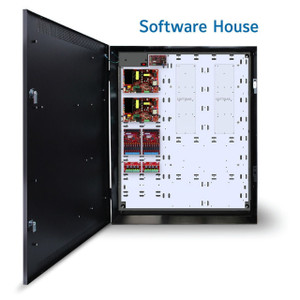
Lifesafety Power FPO250/250-2C82D8PE6M1 250W Power Supply Board
The Lifesafety Power FPO250/250-2C82D8PE6M1 is a 250W power supply board designed for distributed access control and electronic lock power management in mid-to-large facilities. This PSB delivers dual-output voltage rails (20A/12V or 10A/24V) with 16 dedicated relay lock control outputs and 16 Class 2 auxiliary DC outputs, eliminating the need for modular power distribution across multiple cabinets. Mercury/Lenel controller compatibility and fused output protection make it a drop-in solution for existing access control architectures.
Key Features
- Dual-Output Voltage Configuration: 20A/12V or 10A/24V selectable rails. Choose 12V for legacy door controller systems or 24V for modern IP-connected access hardware without external buck converters.
- 16 Relay Lock Control Outputs: Each fused at 3A per output. Powers electromagnetic locks, electric strikes, and relay-based access control circuits with individual overcurrent protection.
- 16 Auxiliary DC Outputs: Class 2 power-limited at 2.5A per output. Supplies ancillary devices (status LEDs, exit buttons, sensors) while maintaining code compliance.
- Mercury/Lenel Backplate Compatibility: Ships with backplate and door mount plate for seamless panel integration in Mercury Access or Lenel OnGuard cabinets.
- Compact Enclosure Footprint: 23W × 32H × 6.5D inches. Fits standard 19-inch rack or wall-mounted panel layouts without requiring dedicated cabinet depth.
- Per-Output Fusing: Individual 3A fuses on lock outputs prevent cascading failures if a single lock circuit shorts or draws excess current.
- Class 2 Power Limiting: Auxiliary outputs are Class 2 power-limited, reducing safety isolation and compliance documentation overhead for low-voltage signaling circuits.
In enterprise access control deployments, PSB power distribution is the backbone of lock circuit resilience. The FPO250/250-2C82D8PE6M1 consolidates 16 lock circuits into a single managed power plane with fused per-output protection. Unlike cascaded relay modules or individual SMPS units scattered across door frames, a centralized PSB reduces troubleshooting time (one point of monitoring), minimizes voltage drop over long wire runs, and simplifies capacity planning. The dual-voltage switchable design bridges legacy 12V door controller fleets and modern 24V IP-based access hardware, deferring costly hardware replacement cycles.
The board's architecture supports both electromagnetic and electronic locks. On a typical 20-door facility with mixed-technology locks (older strike on the west perimeter, newer electric locks on the main entrance), the switchable voltage rail lets you avoid separate power supplies per zone. The 16 relay outputs provide direct lock drive with 3A per-channel fusing; the 16 auxiliary outputs power request-to-exit buttons, door position sensors, and indicator lights without consuming lock-circuit amperage. This separation of concerns keeps lock availability isolated from incidental sensor power demand.
Thermal management and input protection are built-in. The 250W capacity assumes continuous draw across all 16 lock outputs at rated current — realistic for a distributed multi-door building where not all locks are energized simultaneously. The enclosure design, standard in Lifesafety Power PSBs, dissipates load heat passively; no external cooling fans required. Mercury and Lenel system integrators recognize the backplate pinout immediately, reducing field wiring errors and accelerating commissioning.
Lifesafety Power PSBs are manufactured to UL 924 (Emergency Power Supply) and UL 2089 (Power Supplies for Security Equipment) standards. Mercury Access and Lenel OnGuard platforms both natively support PSB monitoring via serial or Ethernet bridges. The FPO250/250-2C82D8PE6M1 integrates without proprietary software or additional interface cards — standard 24VDC signaling and relay closure feedback drive the access control logic. For organizations already running Mercury or Lenel systems, this PSB is the standard-of-care power infrastructure.
Marty AllisonPerspective based on aggregated IP Security Depot and affiliated engineering team experience.
We've deployed dozens of Lifesafety Power FPO250 boards into mid-to-large access control estates, and the real value isn't the wattage — it's the fused per-output architecture and dual-voltage flexibility. In real-world integrations, lock power circuit failures are typically catastrophic: one shorted electromagnetic lock takes down the entire 20A rail unless you have per-output fusing. This board isolates each lock to 3A maximum, so a defective strike or wiring error affects one door, not the whole building. We've also found the switchable 12V/24V output invaluable on retrofit projects where legacy 12V systems coexist with newer 24V IP locks. You avoid the capex and operational overhead of maintaining two separate power supplies on the same panel. The Mercury/Lenel backplate compatibility is table-stakes in the enterprise access market — both platforms integrate with this form factor natively, which means no custom relay logic or third-party breakout boards. On integrator timelines, that's a 3–4 hour installation vs. a 2-day custom harness build.
Technical Highlights:
- Per-Output 3A Fusing on Lock Circuits: Each of the 16 relay outputs is independently fused. A single electromagnetic lock short-circuit or wiring fault shuts down only that output, keeping the other 15 doors operational. On a 64-door campus deployment, losing one lock is a localized incident, not a system-wide outage.
- Switchable 12V/24V Rails: Select voltage at panel installation time. 20A on 12V for legacy door controllers; 10A on 24V for modern IP-based access and electronic locks. Eliminates the need for dual PSBs or external DC-DC converters in mixed-technology environments.
- 16 Auxiliary Class 2 Outputs at 2.5A Each: Independently power request-to-exit buttons, door sensors, status LEDs, and audio/visual devices without contending for lock circuit amperage. Class 2 power limiting satisfies NEC Article 725 low-voltage signaling requirements, reducing isolation transformer cost.
- UL 924 & UL 2089 Certification: Designed for continuous, uninterrupted operation. Passive thermal design — no fans, no maintenance. Suitable for emergency egress scenarios where lock power must remain stable under sustained current draw.
- Mercury/Lenel Native Integration: Backplate and mounting hardware ship with the unit. Pinout matches both Mercury Access (ECCOM, ExpressConnect) and Lenel OnGuard serial/Ethernet interfaces. No custom wiring, no adapter modules, no firmware patches.
- Compact Form Factor: 23W × 32H × 6.5D inches. Fits inside 19-inch rack or wall-mounted panel without consuming more than 6 inches of cabinet depth. Space efficiency matters on retrofit projects where panel real estate is already constrained.
Deployment Considerations:
- Voltage selection is fixed at installation — you cannot switch between 12V and 24V modes without power-down and hardware jumper change. Plan your lock hardware strategy before panel build, or keep a second PSB in inventory for mixed-voltage migrations.
- Per-output fusing protects against shorts, but fuse replacement is a manual, on-site operation. We recommend stockpiling spare 3A fuses and training integrator field techs to carry them. A blown fuse on a critical entrance lock requires immediate access to the panel.
- Maximum output capacity assumes simultaneous draw across all 16 lock outputs. In practice, many access control systems never energize all locks at once (e.g., perimeter locks only active during business hours). Size your PSB for worst-case simultaneous energization, not peak nameplate.
- Mercury and Lenel integrations expect standard 24VDC signaling for output status feedback. If you're integrating with a non-standard access control platform (legacy proprietary system, third-party cloud access), confirm relay closure voltage compatibility before installation.
- Wire termination on the backplate uses screw terminals rated for 12–18 AWG field wiring. On long lock runs (50+ feet from PSB to remote door), factor in voltage drop — use heavier gauge wire or verify the access control system tolerates lower voltage at the lock coil.
This PSB is the right choice for organizations running Mercury or Lenel systems at medium scale (20–64 doors) where power distribution reliability and per-circuit protection are non-negotiable. Access control integrators and end-user security teams appreciate the fused architecture and dual-voltage flexibility on retrofit projects. Explore the full Lifesafety Power catalog for redundancy modules, battery-backed supplies, and larger multi-enclosure power distribution systems.