Lifesafety Power FPO150-B100D8M8E4M 150W Power Supply Board
Overview
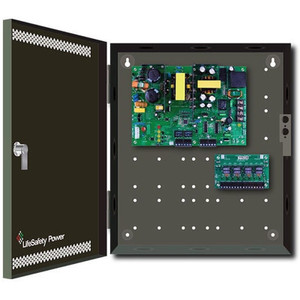
The Lifesafety Power FPO150-B100D8M8E4M is a fixed-output 150W power supply board purpose-built for distributed access control, door locks, intercoms, and auxiliary equipment in medium-scale security installations. It delivers either 12VDC at 12A or 24VDC at 6A on the primary output, with eight independently fused auxiliary channels at 3A each — each one isolated by fusing to protect downstream circuits from short-circuit damage. A secondary 5–18V adjustable output (4A max) handles specialized sensors, LED lighting, or low-voltage signaling without monopolizing the primary rail. The board fits into a compact 24-inch-wide metal enclosure (20W × 24H × 4.5D inches) with a Mercury/Lenel-compatible backplate, meaning it integrates directly into standard Lenel ACS racks and cabinet frames without adapter plates.
Key Features
- Primary Output Flexibility: Select 12VDC at 12A or 24VDC at 6A during setup — covering legacy 12V door locks and modern 24V solenoids without extra regulators. Choose based on your existing infrastructure and wire gauge availability.
- Eight Fused Auxiliary Outputs: Each 3A, individually fused — a single shorted lock or solenoid won't cascade and take down other equipment on the board. This isolation is critical in high-density door deployments where finding a single failure point is essential.
- Secondary Adjustable Rail: 5–18V adjustable at 4A maximum, with Class 2 power-limited output — ideal for badge readers, motion sensors, or indicator LEDs that require a voltage other than 12/24V. Avoids the need for separate buck converters in the cabinet.
- Mercury/Lenel Backplate Integration: Pre-drilled backplate fit means no custom mounting; slides directly into standard Lenel ACS frames. Reduces commissioning time and eliminates guesswork about rail alignment.
- Compact Footprint: 4.5 inches deep and fits into 24-inch-wide racks — relevant when floor space is limited or you're retrofitting into existing cabinets with tight depth constraints.
- Class 2 Power Limited Secondary: Auxiliary outputs meet Class 2 requirements, simplifying code compliance for low-voltage wiring in commercial buildings where Class 2 certification avoids costly conduit and spacing rules.
Integration & Compatibility
The FPO150-B100D8M8E4M assumes a 24V door control and access system environment. The Lenel backplate means it slots into Mercury or Lenel-standard racks without additional hardware. Primary outputs are terminalbar-connected; auxiliary outputs typically feed individual solenoids, mag locks, or request-to-exit buttons. Wire in 12 AWG or heavier for 12V primary (12A) to avoid voltage drop over runs longer than 50 feet; 14 AWG works for 24V at full load. Secondary adjustable output is best reserved for panel lighting or low-current sensor circuits — do not attempt to branch it into high-load equipment without calculating total draw against the 4A limit.
Deployment Considerations
The 150W budget is sufficient for approximately 4–6 electronic door locks (25–35W each) plus auxiliary circuits. If your site is heavier — 8+ locks per supply — stage multiple FPO150 boards in parallel (using diode isolation) or evaluate the next tier. Fused outputs protect circuits but do not alert you to a failure; pair with a monitoring system that polls voltage rails or door sensor status. The adjustable secondary is useful but limited to 4A; a separate 24V supply may be cleaner if you have extensive LED or low-voltage sensor loads. Always verify enclosure thermal headroom in your cabinet; 150W dissipation generates heat, especially in non-air-conditioned spaces.
Frequently Asked Questions
Q: Can I run 12V and 24V equipment simultaneously on the same board?
A: No. The primary output is either 12V or 24V — set at installation. Choose based on your dominant load type. Use the secondary adjustable output (5–18V) for minority-voltage equipment.
Q: What happens if one auxiliary output shorts?
A: The 3A fuse on that output trips, isolating the fault. Other seven outputs remain active. Replace the fuse after you find and repair the short circuit.
Q: Do I need a separate UPS or battery backup with this board?
A: The FPO150-B100D8M8E4M itself does not include battery backup. If your doors must remain powered during utility outages, add a separate battery supply or UPS system to the board's AC input.
Q: Is this board suitable for outdoor installations?
A: No. Mount the enclosure indoors or in a weatherproof cabinet. The board itself is unrated for rain or temperature extremes beyond typical climate-controlled security rooms.
Q: How do I know which primary voltage to select — 12V or 24V?
A: Check your door lock, mag lock, and solenoid nameplates. Count which voltage type dominates your site. 24V is more common in modern installations and tolerates longer cable runs with less voltage drop.
Q: Can the secondary adjustable output power a full set of door strikes?
A: No. At 4A maximum, it can support only low-current devices — badge readers, indicator lights, or sensors. Door strikes and mag locks belong on the primary 12A or 6A rails.
The FPO150-B100D8M8E4M (often searched as FPO150 B100D8M8E4M) is a workhorse for mid-sized access control builds where you need distributed fused protection without the overhead of a full modular power system. The 150W budget and eight isolated 3A outputs make it practical for buildings with 4–6 controlled doors, intercoms, or a mixed bag of door hardware on a single ACS panel.
Technical Highlights:
- 150W Capacity at Dual Voltage: 12A at 12V or 6A at 24V primary — enough for four mid-range electronic locks (25–35W each) plus auxiliary signaling. The voltage choice is hard-set at commissioning, so validate your site's lock voltage before you power it up.
- Eight Individually Fused Outputs: 3A per channel with isolated fusing — a dead-short on one solenoid does not kill downstream devices. This is worth its weight in troubleshooting time; you catch a single fault without dragging an entire floor offline.
- Secondary 5–18V Adjustable, Class 2 Limited: Handles badge readers, motion sensors, or LED indicators without a separate module. Class 2 compliance removes conduit headaches in commercial code inspections.
- Lenel/Mercury Backplate Native: No adapter plates, no spacing guesswork — board and enclosure slide into standard racks directly. Cuts commissioning labor.
Deployment Considerations:
- Voltage Selection is Permanent: Once you set the board to 12V or 24V, that choice is baked in. 24V is more forgiving for long cable runs; verify your lock spec sheet before wiring the primary output.
- 4A Secondary Ceiling is Tight: If your site has a dozen badge readers plus LED strips, the secondary rail will overload. Budget badge readers at roughly 0.5A each; map total current before commissioning.
- No Built-in Monitoring or Supervision: Fuses protect circuits, but the board does not alert you to a blown fuse or partial failure. Integrate with your ACS monitoring to poll door position and lock current draw.
- Thermal Load in Confined Spaces: 150W dissipation is real. In a hot cabinet or unventilated closet, verify airflow or derate the supply.
This board is ideal for single-floor multi-door installs, retrofit scenarios where you slot it into existing Lenel racks, and mixed 12/24V environments where the secondary adjustable rail earns its place. Skip it if you need UPS backup (add a battery module externally) or if your door count exceeds 8–10 locks — stage parallel supplies instead.