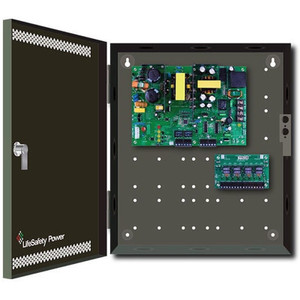
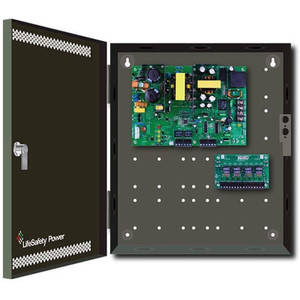
Lifesafety Power FPO150-B100C8D8E8H 150W Power Supply Board
Overview
The Lifesafety Power FPO150-B100C8D8E8H is a 150W industrial-grade power distribution board designed to serve security and access control systems in environments where you need regulated DC power to multiple endpoints from a single source. The real value here: selectable output voltage lets you run both legacy 12V devices and modern 24V equipment on the same board without dual supply infrastructure. That cuts installation complexity and panel real estate in warehouse automation and perimeter control deployments where mixed-generation systems are the norm, not the exception.
This is a board-level form factor—not a plug-and-play module. It requires DIN-rail or panel mounting and integration into your existing power distribution architecture. It's engineered for fixed installations where endpoints demand isolated, regulated DC feeds rather than PoE delivery.
Key Features
- Dual-voltage output (12V or 24V selectable): Eliminates the need for separate power supplies when supporting both older 12VDC devices and newer 24VDC systems. Saves panel space and reduces inventory complexity on large deployments.
- 150W total capacity: Delivers 12A at 12VDC or 6A at 24VDC—enough headroom for modest multi-channel distributed loads. At 12A @ 12V, you're looking at 144W continuous; at 6A @ 24V, 144W. Plan your endpoint draw accordingly; this isn't a blanket power supply for unlimited expansion.
- Integrated into Lifesafety Power ecosystem: Works with supervised multi-channel DC distribution architectures. Verify your control panel or security management system supports this board's output topology before commissioning.
- Board-level construction for fixed installation: Accepts 14–10 AWG wire terminated with ferrule crimps into standard terminal blocks. No field-replaceable connectors; this is hardwired infrastructure.
- Supervised circuits (protocol-dependent): Integrates with access control or security management systems that monitor circuit status. Requires appropriate integration—check your VMS or ACS documentation for compatible supervised output configurations.
- Thermal design for 150W envelope: Requires adequate ventilation around the board during operation. Don't mount in confined spaces; allow airflow on all sides to prevent thermal throttling or premature component failure.
Integration and Compatibility
Before installation, confirm two critical points: (1) your input voltage source (control panel, PoE switch backup, or dedicated mains connection) matches the FPO150-B100C8D8E8H's input specification, and (2) your endpoints' voltage requirement aligns with either 12V or 24V output. The board is not auto-sensing; voltage selection is fixed at commissioning.
Wire termination is bare terminal blocks—no quick-disconnects or modular connectors. Plan for permanent installation; swapping cables later means de-soldering or cutting wire. If your deployment requires frequent reconfiguration, consider a different topology.
Supervised output status reporting depends on your access control system or security management platform. Verify compatibility with your chosen VMS or ACS before ordering; not all systems expose supervised circuit feedback identically.
When to Choose a Different Model
If you need PoE-integrated power distribution, explore dedicated PoE power supplies or managed PoE switches instead—the FPO150-B100C8D8E8H is wired DC only. If your endpoint load exceeds 12A @ 12V, you'll need a higher-capacity board from the Lifesafety Power family. If you require uninterruptible power during mains failure, confirm battery backup topology; this board is DC-regulated, not a UPS.
Frequently Asked Questions
Q: Can I use the FPO150-B100C8D8E8H for both 12V and 24V endpoints simultaneously?
A: No. The output voltage is selectable at installation—either 12V or 24V. You cannot run mixed voltages from a single board. If your system has both 12V and 24V endpoints, you will need two boards or a different power distribution strategy.
Q: What input voltage does the FPO150-B100C8D8E8H require?
A: The evidence supplied does not specify the input voltage requirement. You must consult the manufacturer specifications or integration documentation for your Lifesafety Power control panel to confirm compatibility before ordering.
Q: Does the FPO150-B100C8D8E8H include battery backup?
A: Not inherently. The board is a regulated DC power supply. Battery backup or UPS functionality depends on your control panel topology or external backup system integration. Confirm with your security management platform documentation.
Q: Can I hot-swap or reconfigure the output voltage after installation?
A: No. The voltage selection is fixed at commissioning. Changing output voltage after installation requires de-energizing the board, reconfiguring the selector (if present), and re-commissioning. Plan your voltage topology upfront.
Q: What wire gauge and termination method does the FPO150-B100C8D8E8H use?
A: The board accepts 14–10 AWG conductors terminated with ferrule crimps inserted into standard terminal blocks. Use appropriate crimping tools and ferrule sizes for your wire gauge to ensure reliable contact and prevent loosening.
Q: Is the FPO150-B100C8D8E8H compliant with NDAA or other security standards?
A: The evidence supplied does not confirm NDAA compliance, certifications, or approvals. Consult the manufacturer or your integrator to verify applicable regulatory status for your deployment.
The FPO150-B100C8D8E8H solves a specific problem: mixed-voltage infrastructure sprawl. When you inherit a warehouse deployment with both legacy 12V access control readers and new 24V IP intercoms, running separate power supplies eats panel space and introduces coordination overhead. This board lets you consolidate down to one 150W source with a voltage selector—assuming your control architecture supports supervised multi-channel topology. But here's the catch: it's not plug-and-play. You're hardwiring this into your system, and voltage selection is permanent at commissioning. If your endpoint load strategy changes or you misread the spec sheet, you're looking at downtime to reconfigure.
Technical Highlights:
- 12A @ 12VDC or 6A @ 24VDC capacity: 150W total translates to roughly 144W usable in either configuration. On a 12V branch, that's enough for 12 typical 12W access control readers or 2–3 modest IP camera PoE injectors. At 24V, you lose half the current but retain the wattage—useful if your endpoints are voltage-sensitive and prefer 24V headroom.
- Selectable output voltage eliminates dual-supply logistics: One board replaces two, reducing panel footprint, wiring runs, and inventory SKUs in large multi-site deployments. Real cost savings when you're provisioning 20+ sites with mixed-generation gear.
- Supervised circuit integration (protocol-dependent): If your VMS or ACS supports supervised output monitoring, this board can report circuit status back to your management console. Failure on a single output won't go unnoticed—but only if your system is configured to listen for that status signal. Many integrators skip this step; don't.
Deployment Considerations:
- Hardwired terminal blocks require permanent installation planning: No modular connectors, no hot-swap capability. Wire once, wire right. Ferrule crimps are non-negotiable; loose bare wire in a terminal block under 12A load is a fire risk.
- Input voltage compatibility is your gating factor: The data supplied does not specify what input voltage the FPO150-B100C8D8E8H accepts. Before ordering, confirm your control panel or backup power source delivers the correct input. Misconfiguration here means the board won't activate at all.
- Thermal margin is tight on continuous 150W draw: Ensure adequate ventilation around the board. Stacking it with other heat-generating components or burying it in a panel without airflow will degrade reliability and lifespan. Plan for at least 2 inches of clearance on top and sides.
Position the FPO150-B100C8D8E8H as the backbone of a fixed warehouse automation or perimeter security installation where you have mixed 12V and 24V endpoints, predictable load budgets, and no need for frequent reconfiguration. It's not a general-purpose power supply; it's infrastructure. Install it right, and it disappears into the background for years. Install it wrong, and you'll be troubleshooting voltage drops or supervised circuit failures during a weekend outage.