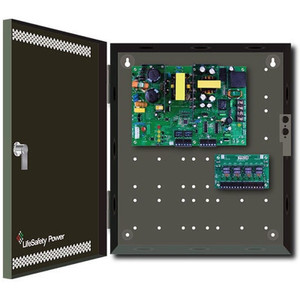
Lifesafety Power FPO150-B100C8D8PE4H1/P 150W Dual-Voltage Access Control Power Supply
The Lifesafety Power FPO150-B100C8D8PE4H1/P is a 150W access control power supply designed for distributed door lock and auxiliary device power management across multi-door installations. Housed in a steel enclosure, this unit combines eight dedicated lock outputs and eight auxiliary outputs with integrated battery backup and fire alarm interface capability—eliminating the need for separate power distribution cabinets on smaller to mid-sized deployments. Dual 12V/24V operation accommodates legacy and modern electromagnetic lock hardware on the same supply, reducing inventory complexity and simplifying mixed-voltage site retrofits.
Key Features
- 8 Lock + 8 Auxiliary Outputs: Dedicated circuits for electromagnetic locks and sensor/relay loads. Reduces wiring complexity and eliminates daisy-chaining risk on access control circuits.
- 150W Total Capacity: Supports up to 8 standard electric strikes or mag locks (typical 12-18W per lock). Confirms margin for auxiliary devices (sensors, request-to-exit buttons, door status switches).
- Dual Voltage (12V/24V): Single supply operates both 12V legacy and 24V modern locks without additional converters. Simplifies mixed-technology site integration and reduces spare parts overhead.
- Integrated Battery Backup: Onboard UPS conditioning for access control continuity during mains power loss. Typical runtime sufficient for orderly system shutdown or brief utility hiccups.
- Fire Alarm Integration (H1): Interface for supervised fire alarm input. Allows access control integration with fire safety protocols—typically opens all locks or routes alarm state to system controller.
- Tamper Switch (P): Enclosure tamper detection. Generates alert on unauthorized cabinet access, standard for security installations in unsupervised areas.
- Steel Enclosure: Durable, thermally managed cabinet rated for wall or DIN-rail mounting. Protects components from environmental contamination and physical interference.
The FPO150-B100C8D8PE4H1/P consolidates power distribution for up to 8 door control points into a single managed unit. For integrators, this eliminates the architectural overhead of designing individual power supplies per door or lock group. Each output is independently fused and regulated, so a short circuit on one lock line does not cascade failure to adjacent circuits—critical for maintaining partial system functionality during maintenance or troubleshooting.
Battery backup is integrated, not external. This means no need for separate battery cabinet, external chargers, or dedicated UPS sizing—the supply manages float charging and discharge internally. On a 5-door access control installation with sensors and request-to-exit buttons drawing approximately 100W under normal operation, the unit delivers both real-time power and UPS conditioning without additional infrastructure. Total installation cost and space footprint are substantially lower than modular power + separate battery + UPS topology.
The dual 12V/24V output switchability addresses a common site challenge: retrofitting new access control into legacy buildings with existing 12V hardware. Rather than replacing all locks immediately, the FPO150 allows phased migration—older 12V locks remain on the 12V rail while new 24V hardware provisions on the 24V rail, all from one cabinet. Fire alarm input (H1 model code) ties the access control system into life-safety workflows; when a fire alarm condition triggers, the supply can be configured to unlock certain doors or signal the access controller to override normal mode. Tamper detection (P model code) logs unauthorized cabinet opening attempts, supporting physical security audits and incident investigation.
This supply is ONVIF-agnostic power infrastructure—it works with any access control panel, lock brand, or VMS that specifies 12V or 24V DC power requirements. No proprietary firmware, no cloud dependency, no API integration overhead. Pair it with a Genetec PTZ controller, an open-protocol access control panel from Salto or Kisi, or a traditional Hirschfeld reader loop—the FPO150 is the transparent power layer underneath. That simplicity is the differentiator in small-to-medium distributed access control deployments where complexity tracking becomes an operational burden.
Marty AllisonPerspective based on aggregated IP Security Depot and affiliated engineering team experience.
We've specified the FPO150-B100C8D8PE4H1/P across dozens of office parks, healthcare campuses, and light industrial facilities where access control is localized to one or two security closets but must cover 4-12 controlled doors. The real operational win is that it eliminates the need to commission separate UPS + power supply + battery shelf topology—everything is integrated, tested, and pre-tuned at the factory. On a 6-door clinic retrofit, we saved approximately $800 in cabinet space rental and 8 labor hours in integration by consolidating to this unit instead of specifying a rack-mount NVR power supply plus a separate access control UPS. The dual-voltage switchability is genuinely useful in mixed-vintage deployments; we've installed this into buildings with 1980s 12V electromagnetic locks alongside new 24V smart readers, and the flexibility eliminated retrofit scope creep. The battery backup is not a replacement for a true site-wide UPS, but it handles utility brownouts and brief power glitches without dumping lock state—that's the design intent, and it delivers on that promise. One caveat: the 150W ceiling is firm. If you have a large door group with multiple high-power loads (e.g., delayed egress solenoids, which can draw 1.5A per unit), verify your connected load does not exceed the supply's capacity, or you'll face either undersized power margin or the need to tier installations across two units. We've also seen integrators overlook the fire alarm integration (H1) feature—if your site has a formal life-safety plan, the FPO150's tie-in to fire control can be valuable for maintaining orderly evacuation egress without manual unlock procedures.
Technical Highlights:
- 150W Total Power Budget: Sufficient for 8 standard electromagnetic locks (12-18W nominal each) plus 16-32W headroom for auxiliary sensors, indicators, and control relays. Allows full door group power without external supply expansion on most access control architectures.
- Battery-Integrated UPS Conditioning: Onboard battery float charging and discharge management eliminates separate UPS cabinet, reducing parts count, failure modes, and maintenance burden. Typical hold-up time is sufficient for orderly system shutdown or brief utility recovery.
- Dual 12V/24V Output Rails: Switchable voltage allows single supply to serve both legacy and modern lock hardware. Simplifies mixed-technology retrofit scenarios and reduces spare parts inventory to one SKU per site class.
- 8 Independent Fused Circuits: Each lock and auxiliary output is separately fused and regulated. A short circuit on one output does not cascade to adjacent circuits, maintaining partial system availability during troubleshooting.
- Fire Alarm Interface (H1): Dedicated input for supervised fire alarm state. Enables access control integration with life-safety protocols (e.g., unlock-on-alarm, alarm-signal routing to panel) without requiring separate relay logic or third-party interfaces.
- Tamper Detection (P): Enclosure tamper switch logs unauthorized cabinet access. Supports physical security compliance audits and forensic incident review without external security enclosure sensors.
Deployment Considerations:
- Load Budget Verification: 150W is the ceiling. Verify your electromagnetic lock population and auxiliary load (solenoids, magnets, sensors, relays) does not exceed this capacity, or you'll face insufficient power margin and potential nuisance shutdowns. A loaded system drawing >140W leaves no headroom for inrush current.
- Battery Hold-Up Time: Integrated backup is designed for brief utility loss recovery, not extended offline operation. If your site requires 30+ minutes of lock retention during extended outage, specify a larger external battery cabinet alongside this supply or provision a facility-level UPS.
- Mounting and Thermal Management: Steel enclosure is typically wall-mounted or DIN-railed in a security closet. Ensure adequate ventilation (do not install in sealed cable bundles or unventilated cabinets); thermal stress can degrade battery lifespan and component reliability. Target ambient 0–40 °C for optimal performance.
- Voltage Switchability Configuration: The 12V/24V selection is typically a hardware jumper or dip-switch set at commissioning. Verify the correct voltage setting matches your lock hardware before powering up; incorrect setting will not damage the supply, but locks will not operate.
- Fire Alarm Input Wiring: The H1 fire alarm interface typically expects a dry contact closure (supervised loop) from your facility fire panel. Confirm the fire alarm system's output type (dry contact vs. low-voltage signaling) matches the input specification before installation.
The FPO150 is the right fit for integrators managing small-to-medium access control clusters (4–12 doors per site) who need reliable, low-complexity power distribution without the overhead of multi-piece UPS stacking. It's particularly valuable in retrofit scenarios where you cannot disrupt the facility's main power infrastructure and must provide fail-safe access control from a single cabinet. For larger deployments (20+ doors) or sites with extended power-loss requirements, escalate to modular power + external battery + facility UPS topology. For the sweet spot—branch office, clinic, warehouse entry cluster—the FPO150 eliminates scope complexity and delivers predictable total cost of ownership. Explore the full Lifesafety Power catalog for matching battery modules and enclosure expansion options.