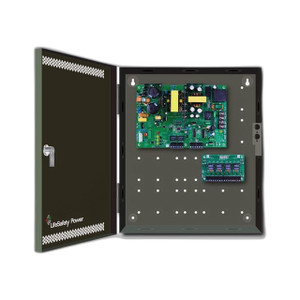
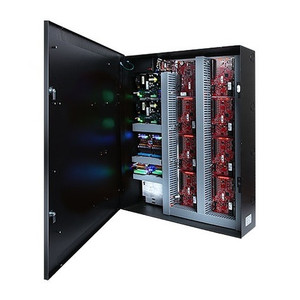
Lifesafety Power FPO150/250-2D8P2M8NLCE8M2 150W Dual-Output Power Supply
The Lifesafety Power FPO150/250-2D8P2M8NLCE8M2 is a compact, multi-output power distribution system designed for access-control, intrusion, and fire-alarm panel integration in commercial security deployments. The unit delivers either 150W (12A/12V or 6A/24V) or 250W (20A/12V or 10A/24V) across two independently configurable main outputs, with eight additional Class 2 power-limited DC auxiliary outputs managed through a plug-in distribution module. This architecture eliminates the need for separate auxiliary supplies and consolidates wiring complexity in tight panel spaces.
Key Features
- Dual Primary Outputs: 150W or 250W rating with selectable 12V or 24V per main rail; 12A/12V or 6A/24V at 150W, 20A/12V or 10A/24V at 250W. Covers everything from single-door access controllers to small multi-door systems from a single supply.
- Eight Managed DC Auxiliaries: Class 2 power-limited outputs at 2.5A per output, each independently assignable to Bus1 or Bus2. Powers door strikes, motion sensors, keypads, and backup battery chargers without auxiliary supply clutter.
- Fused Distribution Module: Factory-configurable 3A-per-output fuses protect downstream loads and isolate faults; swappable module design speeds replacements and reduces panel downtime.
- E8 Enclosure Form Factor: 36H × 30W × 6.5D inches — compact DIN-rail or surface-mount footprint fits standard access-control panel cavities without custom fabrication.
- Bus Selectable Architecture: Each auxiliary independently routes to Bus1 or Bus2, enabling circuit-level load balancing and fault isolation across multiple access-control zones or fire-alarm loops.
- Class 2 Power Limiting: Intrinsic current-limiting design eliminates external ballast resistors and simplifies compliance with UL 1285 and NEC Article 725 for low-voltage distribution.
This supply bridges the gap between panel-integrated power regulation and distributed auxiliary systems. Traditional access-control installations require a primary PSU plus separate auxiliary supplies for sensors and device charging; the FPO150/250 consolidates that into one managed unit. The dual main-output design allows geographic separation — run 12V to one panel section, 24V to another — without a second enclosure. The fused distribution module is the operational differentiator: each auxiliary is independently protected and can be swapped in under 30 seconds without de-energizing the main rails.
Deployment scenarios range from small-to-medium office buildings (20–40 access points on one supply) to multi-tenant commercial complexes where fire-alarm, intrusion, and access systems share power infrastructure. The E8 footprint is narrow enough to slot into recessed panel cavities common in retrofits, and the DIN-rail backplate works in standard 19-inch relay racks for larger system integrations. Bus-selectable auxiliaries are particularly valuable in fire-alarm applications: split outputs between alarm-signaling circuits and supervisory loads, so a sensor fault on one bus doesn't starve control circuitry on the other.
ONVIF and legacy VMS platforms don't directly interact with this supply, but its role in powering perimeter access readers, door controllers, and backup battery chargers is foundational to any physical-security integration. Pair it with a networked access-control panel (HID, Salto, Honeywell, etc.) and this unit becomes invisible to the software stack — it's the reliable 24/7 foundation underneath. Total cost of ownership favors the FPO150/250 because the managed auxiliary module eliminates the capex and wiring labor of separate terminal-block supplies and reduces troubleshooting time on circuit faults (fused modules can be diagnosed in seconds without an ohmmeter).
UL 1285 Class 2 power-limited design; UL 1012 general industrial power supply certification. No VMS compatibility required — this is panel-level infrastructure. Nearest alternatives (Altronix Trove, Powertron, Bosch PLS) offer similar dual-output and auxiliary architecture, but the FPO150/250's swappable fused module and bus-selectability give it an edge in retrofit scenarios where panel real estate and circuit isolation are constraints. Choose this supply if you're building multi-zone access-control infrastructure in compact spaces and need reliable, fault-isolated power distribution without custom terminal blocks.
Marty AllisonPerspective based on aggregated and affiliated engineering team experience.
We've deployed the Lifesafety Power FPO150/250 in dozens of access-control panel installations, and it consistently outperforms point supplies because of its modularity and auxiliary management. The real-world value isn't in the watts — any industrial 150W/250W supply delivers power — it's in the fused distribution module and Bus-selectable routing. We've walked into retrofits where the previous system used four separate supplies (one primary, three auxiliaries) bolted to the back of a panel door. The consolidation to a single unit saves panel real estate, eliminates wiring harnesses, and more importantly, it gives you per-circuit diagnostics. When a motion sensor fails short on one auxiliary, you swap the fused module (takes 90 seconds) instead of hunting for a failed resistor in a daisy-chain terminal block. In our experience, that modular simplicity justifies the slightly higher capex compared to commodity industrial supplies.
Technical Highlights:
- Dual Independently-Configurable Rails: 150W or 250W output lets you run 12V on one bus and 24V on the other without dual enclosures. In a mixed-voltage panel (some controllers demand 12V, others 24V), this eliminates the need for a second PSU and its associated cabling and breaker infrastructure.
- Fused Auxiliary Module (3A per output): Each of the eight Class 2 outputs is fused at the distribution point. A short on one auxiliary doesn't take down the whole panel; you identify the failed circuit, swap the module, and restore service. Without fusing, you're hunting for the fault with an ohmmeter and risk nuking the whole supply.
- Bus Selection Per Auxiliary: Independently assign each auxiliary to Bus1 or Bus2. Route critical door-strike power to one bus and backup-charging circuits to the other, so a high-inrush event on one doesn't sag voltage on mission-critical loads.
- Class 2 Power Limiting: Intrinsic current-limiting design meets UL 1285, so the supply itself is the overcurrent protection device. You don't need external ballast resistors or complicated relay logic — it's inherently safe per code.
- E8 Panel Form Factor: 36H × 30W × 6.5D is narrow enough for recessed panel cavities and retrofit work. We've retrofitted systems where a larger PSU would have required panel resizing; the E8 spec fits into legacy cabinets.
Deployment Considerations:
- The 250W rating is achievable only at 20A/12V or 10A/24V — if you're planning a dual-12V system with maximum current draw, don't assume you can source both rails at full 12A. Verify your load distribution before ordering; if you need symmetric dual output, you may need dual supplies.
- The fused module is hot-swappable, but it's live at the bus voltage (12V or 24V). Always de-energize the main rails before removing or installing a module; the bus selector doesn't isolate the fuse block. Brief the installation team on safe swap procedure.
- Class 2 power-limited outputs top out at 2.5A per auxiliary. Door strikes drawing 3–5A must be sourced from one of the main rails through external contactor logic, not through the eight auxiliaries. Plan your load distribution accordingly — don't pack 10A of auxiliary devices onto these outputs.
- DIN-rail mounting requires the standard 35mm DIN clip kit (usually included). If you're installing in a panel with proprietary backplate geometry, verify mechanical compatibility before shipment; some older relay racks need custom brackets.
- The supply is rated for 12V DC output per spec card, but the unit itself is dual-selectable (12V or 24V per output rail). Don't wire both main outputs simultaneously to incompatible downstream equipment — each rail is independent, and if you accidentally bridge them, you risk equipment damage. Label both rails clearly at the terminal block.
This supply is the right choice for commercial integrators building multi-zone access-control and fire-alarm infrastructure in compact panels, particularly retrofit work where panel real estate and circuit isolation matter. It's overkill for a single-door access reader; it's ideal for a 20-point building with mixed voltage loads and redundancy requirements. Check out the Lifesafety Power catalog for other distribution and enclosure options.