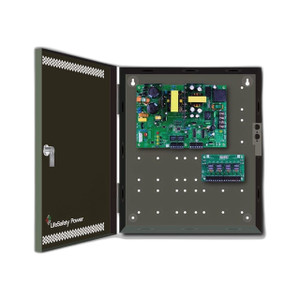
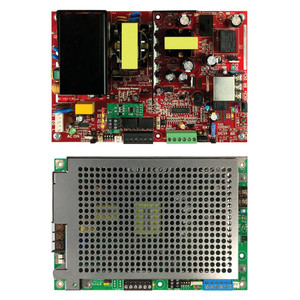
Lifesafety Power FPO150/250-2D8P2M8NLCE8M Selectable Dual-Output Power Supply with Managed Distribution
Overview
The Lifesafety Power FPO150/250-2D8P2M8NLCE8M is a configurable power supply designed for medium-scale security and access control deployments where redundancy and distributed power management matter. The unit operates in either 150W or 250W mode, with dual-output voltage options (12V or 24V) selectable at installation. Eight class 2 auxiliary outputs add flexibility for auxiliary devices — each independently fused at 3A and assignable to either Bus 1 or Bus 2, letting you distribute load across two independent circuit branches. This managed distribution approach reduces single-point-of-failure risk in multi-device installations.
Key Features
- Dual Power Configurations: Choose 150W at 12A/12V or 6A/24V, or 250W at 20A/12V or 10A/24V. Higher-wattage mode suits larger camera arrays or access control panels; 150W handles smaller remote sites. Select the voltage and capacity that match your existing infrastructure at commissioning — no field modifications needed.
- 8 Managed DC Auxiliary Outputs: Each output is class 2 power-limited to 2.5A maximum. This prevents a single auxiliary device short from cascading into a complete power loss. Fused independently at 3A per output, each can be assigned to Bus 1 or Bus 2, enabling load balancing across two separate distribution circuits.
- Bus 1 / Bus 2 Switching: Partition auxiliary devices logically between two independent power branches. Deploy cameras on Bus 1 and door strikes on Bus 2, for example, so a power surge on one system doesn't trip the other. Simplifies isolation and troubleshooting in multi-subsystem installations.
- E8 Enclosure Design: 36H × 30W × 6.5D form factor fits standard DIN rail or cabinet mounting. Compact footprint reduces wiring runs and keeps the power supply close to distributed load points in larger facilities.
- Integrated Fusing and Protection: Each auxiliary output is fused at 3A. Built-in overcurrent protection means you don't rely solely on downstream device fuses — the supply itself self-protects, reducing nuisance downtime from transients or misconfigured loads.
- Class 2 Auxiliary Outputs: Low-voltage (<100V, <4A per output) aux circuits are inherently safe for hardwiring to camera power, LED indicators, solenoid locks, and other low-power accessories without additional isolation relays in most jurisdictions.
Integration and Deployment
The FPO150/250-2D8P2M8NLCE8M fits into power supply architectures where load distribution and redundancy improve reliability. Use the 150W mode for small multi-camera sites (4–6 cameras) or single access control panels. Step to 250W for larger warehouse automation facilities, multi-door access control clusters, or surveillance systems spanning multiple zones. The Bus 1 / Bus 2 architecture is especially useful in hybrid deployments mixing cameras, intercoms, and access readers — each subsystem gets its own protected output branch, reducing cross-system interference.
The model number FPO150/250-2D8P2M8NLCE8M (often searched as FPO150/250 2D8P2M8NLCE8M) integrates cleanly with access control power supplies and security cabling infrastructure standards. Verify your voltage and total current draw during the design phase — 250W at 20A/12V gives you roughly 240W of usable power after efficiency losses, so budget accordingly if mixing high-draw devices.
Frequently Asked Questions
Q: Can I switch between 150W and 250W mode after installation?
A: The unit is configured at commissioning for either 150W or 250W operation. Switching modes requires internal reconfiguration and should be treated as a re-commissioning step — contact a senior integrator if you need to change capacity mid-deployment.
Q: What's the difference between Bus 1 and Bus 2?
A: Each of the eight auxiliary outputs can be assigned to one of two independent power branches. This lets you segregate loads — for example, keep camera power on Bus 1 and access control on Bus 2. If one bus trips, the other remains live, improving system resilience.
Q: Is each output independently fused?
A: Yes. Each of the eight auxiliary outputs is fused at 3A. If a single output exceeds 2.5A, its fuse opens without affecting the other seven outputs or the main supply.
Q: What size enclosure do I need for the FPO150/250-2D8P2M8NLCE8M?
A: The unit fits into a standard cabinet or DIN rail. Dimensions are 36H × 30W × 6.5D inches. Plan cable routing around the E8 enclosure — depth is shallow, so side-mounted terminals are accessible without rework.
Q: Does the FPO150/250-2D8P2M8NLCE8M include battery backup capability?
A: The unit itself does not include integrated battery backup. Battery-backup models are available in the Lifesafety Power catalog — check with your distributor if uninterruptible power is required for your deployment.
Q: Can I use 12V and 24V outputs simultaneously?
A: No. The FPO150/250-2D8P2M8NLCE8M is configured for one output voltage (12V or 24V) at installation. All main and auxiliary outputs operate at the selected voltage.
The FPO150/250-2D8P2M8NLCE8M is a solid middle-tier supply if you need managed distribution without the cost and complexity of a full battery backup system. The Bus 1 / Bus 2 segregation is the real differentiator here — it lets you isolate subsystems without adding external relays, which cuts wiring and reduces failure points. The eight independently fused outputs mean you can deploy eight separate low-power accessories (cameras, door sensors, intercoms) without worrying that a short on one will black out the whole array.
Technical Highlights:
- Dual Configurable Power Stages: 150W (12A @ 12V, 6A @ 24V) or 250W (20A @ 12V, 10A @ 24V). Real-world: the 250W mode is essential if you're running six or more cameras plus access control on a single supply. Don't undersize — budget 30–50W per megapixel-class camera plus overhead for aux circuits.
- Eight Managed Outputs at 2.5A per Channel: Class 2 power-limited design is inherently safe, but the 3A fuse per output is the real protection. A shorted camera power line won't ripple across your entire door strike array. In warehouse automation deployments with mixed I/O, this isolation is worth the extra cost.
- Bus 1 / Bus 2 Partitioning: You can hard-assign outputs to two independent branches. Example: Bus 1 for fixed cameras, Bus 2 for access readers and intercoms. A power surge on the camera line doesn't trip your access system. This is the kind of redundancy you build into larger facilities without needing two separate supplies.
Deployment Considerations:
- No Battery Backup Native: This is a straight AC-to-DC supply. If your facility requires UPS or battery buffer (e.g., access control must stay live during a power failure), you'll need to spec a battery backup model in the Lifesafety Power line or add external battery hardware.
- Voltage is Fixed at Commissioning: You choose 12V or 24V when you install the unit, not in the field. Verify your entire load (cameras, readers, intercoms) can run at your selected voltage before you mount the enclosure. Changing it later means a full re-provisioning step.
- Cabinet Space and Thermal Load: The E8 form factor is compact, but twenty amps at 12V dissipates real heat. Mount it with ventilation clearance in your cabinet — don't jam it in a corner. If you're running 250W continuously in a hot warehouse, plan for some active cooling or thermal margin.
The FPO150/250-2D8P2M8NLCE8M is a smart choice for mid-scale warehouse automation, multi-door access control facilities, and remote surveillance clusters where you want fused load distribution and subsystem isolation without the lead time or cost of a battery-backed system. If you need battery backup, move to a dedicated UPS-style supply. If you're running a single camera and a single door strike, you're over-specced — drop down to a smaller unit.