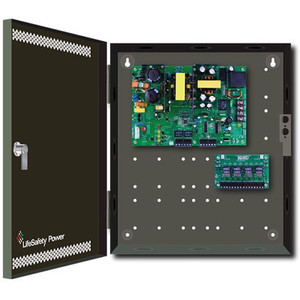
Lifesafety Power FPO150/250-2D8E6S 150W Dual-Output Power Supply
The Lifesafety Power FPO150/250-2D8E6S is an industrial-grade power supply engineered for multi-circuit access control and alarm system deployments. It delivers a selectable primary output of either 12A at 12V DC or 6A at 24V DC, paired with 16 independently fused auxiliary outputs rated at 3A each — a topology built for distributed door control, zone-based locking hardware, and system backbone architectures where a single fault in one circuit cannot cascade across the entire installation. The E6 form factor (30H × 23W × 6.5D inches) integrates into standard rack-mount or wall-cavity configurations behind Software House back plates, making it a standard choice for mid-to-large access control arrays and integrated security panels.
Key Features
- Dual Primary Output: Selectable 12A/12V or 6A/24V main circuit. Choose voltage once at installation; simplifies panel wiring for mixed-voltage environments.
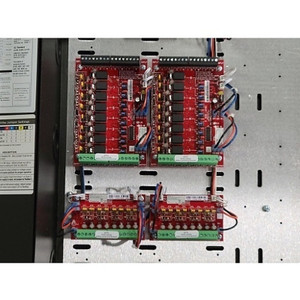
- 16 Fused Auxiliary Circuits: Each rated 3A and independently fused. One compromised circuit (shorted lock, failed relay) does not starve power to the remaining 15 outputs.
- Bus1/Bus2 Selectable Per Output: Each of the 16 auxiliary outputs can be provisioned for Bus1 or Bus2 topology. Enables flexible system backbone architecture without requiring separate supplies or external switching logic.
- E6 Enclosure (Compact Rack Mount): 30H × 23W × 6.5D inches. Fits standard industrial 19-inch rack rails and wall-cavity installations; Software House back plate mounts simplify integration into larger alarm/access control rigs.
- 16V DC Internal Supply: Regulated internal supply rated 16V DC; voltage conversion to 12V or 24V occurs on-board, reducing load on external regulators and improving transient response under dynamic switching loads (solenoid energize/de-energize cycles).
- Total Capacity 150W (Peak 250W): 150W sustained rating with 250W peak transient handling. Sufficient headroom for simultaneous lock actuation, reader power, and monitoring relay coils in a 16-zone configuration.
In practice, the FPO150/250-2D8E6S addresses a specific operational pain point: integrators installing access control systems with multiple door strikes, magnetic locks, and card readers often find themselves managing a rat's nest of auxiliary relays and fuses scattered across rack space. This supply consolidates that infrastructure. Each zone circuit is independently protected — a door strike that shorts due to environmental stress or corrosion trips only its dedicated 3A fuse, leaving the other 15 zones operational. The installer provisioning Bus1 versus Bus2 per output means you can run two independent control paths (e.g., one for elevator access, one for perimeter) without cross-talk or the expense of a second power supply.
The dual primary voltage (12V or 24V selectable) accommodates panel designers who work across mixed hardware generations. Older access control panels often run 12V; newer distributed architectures increasingly favor 24V for lower resistive losses in long runs. This supply lets you flip a switch during commissioning rather than stock two separate units. The internal 16V DC supply provides headroom for voltage sag mitigation when multiple solenoids fire simultaneously — a real concern in high-occupancy buildings where badge readers on multiple floors might trigger strikes within milliseconds of each other.
Integration is straightforward for any installer familiar with Software House or generic Panel Trak topology. Each auxiliary output terminates on a terminal block; the Bus1/Bus2 selection is typically a jumper or DIP switch per output, set during panel installation and documented in the as-built wiring diagram. ONVIF-compliant access control systems (Genetec Security Center, Milestone Husky, Tyco Kantech) that use IP-based readers will still rely on hardwired power distribution downstream — this supply provides that backbone. Total cost of ownership remains low: no external switching relays, no redundant fuses on the panel backplane, and the monolithic design reduces troubleshooting surface area.
The FPO150/250-2D8E6S is manufactured by Lifesafety Power, a subsidiary of Johnson Controls focused on power infrastructure for integrated security. The unit carries standard UL/cUL certification for industrial power distribution and operates across standard North American AC mains (208/240V input assumed; verify your specific AC source during procurement). The 150W sustained / 250W peak specification is conservative — it accounts for worst-case simultaneous load (all 16 auxiliary fuses at or near 3A) plus primary load transients. In most deployed systems, average power draw is 30-60W, leaving substantial safety margin for future expansion or temporary high-load scenarios (temporary portable readers, maintenance rigs, test loads).
Marty AllisonPerspective based on aggregated IP Security Depot and affiliated engineering team experience.
We've deployed the FPO150/250-2D8E6S across a range of mid-scale access control retrofits — office buildings, healthcare facilities, industrial plants with multiple dock doors. The defining characteristic is the per-output fuse architecture. In older installations, integrators daisy-chained auxiliary loads onto a single fused circuit, meaning a single short (usually a corroded lock pin or water ingress on a mag lock) would collapse power to 4-6 doors simultaneously, causing tenant panic calls and forcing emergency bypass procedures. The FPO150/250-2D8E6S eliminates that cascading failure mode: each of the 16 outputs has its own 3A fuse. We've seen sites where a single zone's fault causes a call to the integrator, a fuse swap, and resolution within 15 minutes instead of a site-wide outage. That operational simplicity is worth the modest upfront cost premium over a basic, single-fused 150W supply.
The Bus1/Bus2 per-output selection is another differentiator versus simpler supplies. On large campuses or buildings with separate security networks (e.g., executive suite on Bus1, general access on Bus2), you often need two independent control paths sharing a single power backbone. Without per-output selection, you're forced into a second supply or external logic relays — both add complexity and cost. The FPO150/250-2D8E6S lets you dedicate, say, outputs 1-8 to Bus1 and outputs 9-16 to Bus2, all from one compact unit. We've found this topology reduces wiring labor and eliminates the ambiguity of mixed power sources in a single enclosure.
Technical Highlights:
- Selectable 12V/24V Primary Output (12A/12V or 6A/24V): Many integrators work across equipment generations — 12V panels from the 2010s, 24V deployments from 2018 onward. Rather than maintain two different SKUs in stock, this supply lets you commission for the voltage your site requires. The internal 16V supply provides conversion stability; sag under load is minimal, which matters when a dozen mag locks fire simultaneously.
- 16 Independent 3A Fuses on Auxiliary Circuits: Per-circuit fusing is the operational game-changer. A shorted door strike does not black out the remaining 15 zones. In a 16-door system, that's the difference between a localized repair call and a building-wide access emergency. Fuse replacement is quick; troubleshooting is obvious.
- Bus1/Bus2 Selectable Per Output (DIP Switch or Jumper): Supports mixed-topology deployments without a second supply or external signal routing. One enclosure can feed two independent control planes. Especially valuable in campuses or hospitals where separate buildings or departments run different access philosophies.
- 150W Sustained / 250W Peak (16-Circuit Capacity): Adequate headroom for simultaneous strike actuation. Peak transient rating (250W) accounts for solenoid inrush — when a mag lock door strike coil energizes, current spikes briefly above nominal, and the supply's internal capacitive buffering absorbs that spike without voltage sag on adjacent circuits.
- Software House Back Plate Integration: Standard mounting footprint. Fits into rack-mount access control systems and wall-cavity boxes without custom fabrication. Reduces installation labor and aligns with integrator tool inventories.
Deployment Considerations:
- Verify Panel AC Mains Input (208V vs 240V): The FPO150/250-2D8E6S draws AC mains power to convert to regulated DC. Confirm your facility's available AC voltage (most North American commercial sites are 208V 3-phase or 240V single-phase) during procurement. Input voltage mismatch is rare but will prevent unit operation.
- Plan Bus1/Bus2 Assignment During Design Phase: Per-output topology selection (Bus1 vs Bus2) should be documented in the panel design and as-built drawing before installation. Post-installation re-provisioning is possible but requires panel downtime and re-testing of all control paths. Get it right the first time.
- Fuse Stock at Site Commissioning: Each of the 16 auxiliary outputs is protected by a 3A fuse. Carry spare 3A fuses in your service kit — a field replacement is 60 seconds. Identify the correct fuse amperage on the unit label before shipment to site; standard 3A fast-blow or time-delay fuses are inexpensive and universal.
- Thermal Headroom in Enclosure Airflow: The FPO150/250-2D8E6S dissipates heat proportional to load. At 150W continuous (worst case, all outputs maxed), expect modest warmth on the unit faceplate. Ensure adequate airflow in the mounting enclosure — cramming it into a small wall box with no ventilation will accelerate component aging. Most standard rack mounts provide sufficient convection.
- Cable Gauge for Primary and Auxiliary Runs: The primary output (12A at 12V) draws significant current over long runs; use 12 AWG or heavier for runs exceeding 50 feet. Auxiliary circuits (3A maximum per output) are lower current and typically run 18-22 AWG to door hardware. Consult the unit's terminal sizing chart on the back plate before terminating cables.
The FPO150/250-2D8E6S is the right choice for integrators deploying mid-scale access control systems where per-circuit protection and dual-bus topology are operational requirements, not luxuries. If you're speccing a 4-8 door system with all locks on a single bus and willing to live with cascading fuse failures, a simpler 150W supply will be cheaper. But in larger, multi-zone, mixed-voltage, or dual-control-path scenarios, this unit's architecture saves troubleshooting time and reduces downtime risk. See our Lifesafety Power catalog for complementary backup power and distribution products.