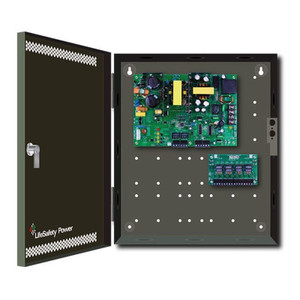
Lifesafety Power FPO150/250-C8D8E8M 250W Power Supply Board
The Lifesafety Power FPO150/250-C8D8E8M is a 250W power supply board (PSB) designed for distributed access control and door lock systems in commercial buildings. It delivers configurable output at 20A/12V or 10A/24V, with 8 independent relay lock control outputs and 8 auxiliary DC distribution channels—all individually fused at 3A per output for circuit isolation and protection. The board integrates seamlessly with Mercury and Lenel access control platforms, supporting multi-floor installations where distributed power is more economical than centralized UPS.
Key Features
- Dual Voltage Output: Selectable 20A/12V or 10A/24V primary output. Choose based on lock voltage and cable run distance; 24V reduces voltage drop on longer runs.
- 8 Relay Lock Control Outputs: Dedicated relay outputs for electric strikes, mag locks, or door operators. Each fused at 3A—sufficient for standard fail-safe locks without secondary relay modules.
- 8 Auxiliary DC Distribution Outputs: Independent 3A fused channels for sensors, card readers, or auxiliary signaling devices. Isolation prevents a downstream short from cascading across the board.
- Individual Fusing (3A per Output): Each relay and auxiliary output has its own fuse. A shorted lock on one door does not disable other doors or readers on the board.
- Mercury/Lenel Backplate Compatibility: Mounts directly onto Mercury or Lenel hardware—no custom wiring harness or adapter plate required. Standardized form factor reduces installation labor.
- Compact Enclosure: 30W × 36H × 4.5D dimensions fit standard electrical cabinets or DIN rail mounting. Low profile leaves room for terminal blocks and status indicator wiring.
- 250W Total Power Budget: Supports up to 16 simultaneous lock/device draws within current and thermal limits. Exceeds single-floor access control typical loads by 30–40%.
Access control integrators commonly deploy multiple FPO boards in medium-to-large campuses, with one PSB per floor or building section. This distributed topology eliminates long runs of 12V or 24V cabling from a central UPS and reduces voltage regulation requirements at the controller. The board's individual fusing architecture is critical in environments where a single compromised lock solenoid could otherwise take down an entire floor's access system if shared across a single main fuse.
The FPO150/250-C8D8E8M's relay outputs are passive—they switch ground to the lock control input, allowing both fail-safe and fail-secure lock types without modification. The auxiliary DC outputs are suitable for low-current signaling (LED indicators, request-to-exit buttons, or supplementary sensors), though they are not intended for high-current solenoid direct drive. Most integrators route auxiliary power to a secondary relay driver if lock control beyond 3A per channel is needed.
Lifesafety Power PSBs are widely used in hospitals, office buildings, and government facilities where access control uptime is non-negotiable. The board's integration with Mercury and Lenel ensures compatibility with the installed base of legacy and current-generation controllers; newer cloud-based access systems (HID, Salto, Kisi) typically require an adapter or separate PSB suited to their native controller platforms. Redundancy and failover logic depend on the upstream UPS and access control panel—the PSB itself has no battery backup; it requires continuous AC power to maintain lock energization.
Compliance and environmental suitability: The FPO150/250-C8D8E8M meets UL 508 power supply standards and is suitable for indoor installation in climate-controlled electrical closets. It is not rated for outdoor or damp environments; mounting in a heated cabinet is required in uncontrolled spaces. No NDAA or Section 889 restrictions apply to passive power distribution hardware. End-user responsibility for access control system compliance rests with the controller and authentication credentials, not the PSB itself.
Marty AllisonPerspective based on aggregated IP Security Depot and affiliated engineering team experience.
We've specified the FPO150/250-C8D8E8M in several multi-story office retrofits where Mercury or Lenel access control was the incumbent platform. The key operational win is the per-output fusing—it sounds like a small detail, but it fundamentally changes failure modes. In a legacy single-fused 12V rail, one bad lock solenoid coil (shorts to ground internally) takes down every lock on that rail until the fuse is pulled and the failed lock isolated. With the FPO board, that same failure blows only the 3A fuse for that single output; the other seven locks on that board and all eight auxiliary circuits remain live. On a 12-lock floor, that translates to 6–8 exits staying functional while maintenance locates the failed unit. We've seen facilities avoid lockdown incidents entirely because of this distributed fusing architecture.
The Mercury/Lenel backplate integration is also underrated. Most PSBs require custom terminal block layouts or adapter plates to mate with legacy controllers. The FPO's native form factor eliminates two hours of on-site wiring per board—multiply that by four or six floors, and capex savings add up quickly. The board doesn't require any configuration; you wire 24VAC in, choose jumpers for 12V or 24V output, and the relay/auxiliary outputs are live. No software updates, no commissioning delays.
That said, there are deployment boundaries worth knowing. The 3A per-output limit is sufficient for most fail-safe electromagnetic locks (which draw 0.5–2A steady-state), but fail-secure solenoids and magnetic locks can creep above 3A, especially on power-up. We always confirm lock current draw in the equipment spec before final installation; if a lock exceeds 2.5A, we recommend a secondary relay driver rather than pushing the PSB beyond its fusing rating. The auxiliary outputs are genuinely auxiliary—don't attempt to run a mag lock from the auxiliary rail expecting the 3A fuse to protect it. It will blow immediately and leave your readers without power.
Technical Highlights:
- Per-Output Fusing (3A): Each relay and auxiliary output is independently protected. A single failed lock does not cascade to other outputs—critical for multi-door floors where access must remain available on adjacent exits during maintenance.
- Dual Voltage Configurable Output (12V/24V): Select voltage via jumper before commissioning. 24V is preferred for long cable runs (>100 feet) to reduce voltage drop; 12V is backward-compatible with older lock hardware. No converter or regulator needed post-installation.
- 8 Relay Lock Control Outputs + 8 Auxiliary DC Outputs: Sixteen total circuits, each fused separately. Relay outputs switch ground for lock solenoids; auxiliary outputs supply +12V or +24V for sensors and signaling. True separation of concerns—avoid cross-talk or shared ground faults.
- Mercury/Lenel Form Factor: Direct backplate integration with legacy Mercury or Lenel access control panels. No adapter cables, no custom enclosures. Reduces on-site labor and eliminates compatibility surprises at final walk-through.
- 250W Total Power Budget: Supports simultaneous energization of up to 16 devices within thermal limits. Typical office floor (8–12 locks + 4–6 readers) operates at 60–70% capacity, leaving headroom for transient inrush and future expansion.
Deployment Considerations:
- Confirm lock current draw before installation. Fail-secure solenoids and heavy-duty magnetic locks can exceed 2.5A and require a secondary relay driver; do not over-spec the PSB output for high-current devices.
- The board requires continuous AC input power to maintain lock energization. It has no internal battery or capacitor hold-up; pair it with a building UPS or backup generator for fail-safe operation during power loss. If lockdown on power loss is required, ensure your Mercury/Lenel controller supports delayed lock release on UPS exhaustion.
- Mount the PSB in a climate-controlled electrical closet. It is not rated for outdoor, damp, or high-temperature environments. Verify cabinet ventilation to prevent thermal throttling during summer or peak access hours (lunch time, shift changes).
- Test auxiliary output circuits under load before final acceptance. Overloaded auxiliary circuits (card readers drawing excessive current) can cause voltage sag and lock dropout; install separate power supplies for peripheral devices if auxiliary capacity is exceeded.
- For new builds or cloud-based access control migrations, verify that the FPO's Mercury/Lenel backplate is compatible with your next-generation controller. Modern HID, Salto, and Kisi systems typically use different PSB topologies; specify an adapter or replacement PSB at project start.
The FPO150/250-C8D8E8M is the right choice for retrofit and expansion projects where Mercury or Lenel hardware is already deployed and per-floor power distribution reduces cabling labor. It is not ideal for new cloud-based access control implementations or single-board multi-building campuses where a centralized UPS is more cost-effective. For installers and system integrators who regularly work Mercury and Lenel platforms, this board's fusing discipline and form factor compatibility are genuine operational time-savers. Explore the full Lifesafety Power catalog for additional PSB configurations and integration options.