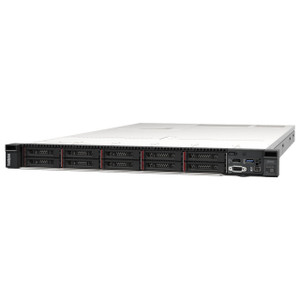
Lenovo 4XG7A63593 AMD EPYC 7313P 16-Core Processor for SR645
Overview
The Lenovo 4XG7A63593 is an AMD EPYC 7313P processor option for the Lenovo ThinkSystem SR645 server platform — a 16-core, 32-thread compute module built on AMD's 7nm Zen 3 architecture. Running at a 3 GHz base clock with a 3.7 GHz boost, this processor targets workloads that need a strong per-core performance profile and substantial memory bandwidth without jumping to the highest-tier socket configurations. For integrators deploying compute-intensive server infrastructure — whether supporting video analytics back-ends, enterprise NVR workloads, or general-purpose virtualized environments — the SR645 paired with this processor delivers an efficient, well-provisioned platform.
Key Features
- 16 Cores / 32 Threads at 3 GHz Base, 3.7 GHz Boost: The 7313P's 16-core configuration handles concurrent virtualized workloads without the overhead of higher core-count SKUs. The 3.7 GHz boost frequency means single-threaded responsiveness doesn't suffer — relevant when running VMS software that relies on fast single-threaded processing for alarm handling and analytics pipelines.
- 128 MB L3 Cache (Zen 3 Architecture): 128 MB of L3 cache is substantial for a 16-core part. Large working-set applications — database engines, analytics stacks, in-memory caching layers — benefit from keeping hot data close to the cores, reducing main memory latency and improving throughput under sustained load.
- 204.8 GB/s Maximum Memory Bandwidth: Octa-channel DDR4 at 3200 MHz delivers 204.8 GB/s of peak memory bandwidth. For frame-buffer-intensive applications or high-channel-count video recording infrastructure, that bandwidth headroom prevents memory from becoming the bottleneck even when multiple workloads compete simultaneously.
- Octa-Channel DDR4-3200 Memory Support: Eight memory channels allow the SR645 to deploy a dense DIMM configuration at full-speed operation. This is meaningful for deployments that need large addressable memory pools — think 512 GB+ configurations for virtualized security appliances or multi-tenant edge computing nodes.
- Socket SP3 Platform Compatibility: The SP3 socket is AMD's enterprise platform for EPYC processors, offering the SR645 a long-lived, well-supported ecosystem. Deploying on SP3 means access to a broad range of EPYC processor tiers — if workload demands grow, stepping up to a higher-core-count EPYC variant in the same socket is a straightforward path without replacing the entire platform.
- 155W TDP: At 155W, the 7313P sits in a moderate power envelope for the EPYC family. Data center operators balancing rack density against cooling infrastructure will find this easier to manage than higher-TDP parts, while still getting 16 full cores. Note that a cooler is not included with the 4XG7A63593 — plan for a compatible SR645 heatsink assembly separately.
- 7nm Lithography: The 7nm process node translates to better performance-per-watt compared to previous-generation 14nm EPYC silicon. For always-on infrastructure — NVR back-ends, continuous analytics processing, 24/7 security workloads — that efficiency improvement compounds meaningfully over a multi-year deployment lifecycle.
- 64-Bit Operating Mode: Full 64-bit support is expected at this tier but worth confirming for legacy workload migrations. All modern enterprise OS distributions and hypervisors (VMware ESXi, Windows Server, RHEL, Ubuntu Server) are fully supported on this architecture.
Integration and Compatibility
The 4XG7A63593 is a processor upgrade or configuration option specifically for the Lenovo ThinkSystem SR645 server. It is not a standalone server — it installs into an SR645 chassis and requires compatible DDR4-3200 RDIMMs or LRDIMMs across the platform's eight memory channels to realize full bandwidth potential. The SP3 socket ecosystem supports a wide range of EPYC 7003-series processors, giving the SR645 platform flexibility across deployment tiers. For integrators building out server and storage infrastructure, the SR645 with this EPYC 7313P configuration is well-positioned for mid-tier compute density requirements. Organizations deploying network video recorders or video analytics platforms at scale should evaluate total channel count, concurrent stream decoding requirements, and analytics pipeline CPU demand against the 16-core / 32-thread profile before specifying. The AMD EPYC platform also has strong compatibility with major hypervisors used in enterprise IP camera and physical security back-end deployments. Review Lenovo's ServerProven compatibility matrix to confirm specific DIMM configurations and OS certifications for the SR645 before procurement. A server selection guide can help match core count and memory bandwidth to your specific recording and analytics workload profile.
Frequently Asked Questions
Q: What server platform is the Lenovo 4XG7A63593 compatible with?
A: The 4XG7A63593 is a processor option for the Lenovo ThinkSystem SR645 server. It uses the AMD Socket SP3 interface and is not compatible with other server platforms or socket types.
Q: Does the 4XG7A63593 include a heatsink or cooler?
A: No. The 4XG7A63593 does not include a cooler. A compatible SR645 heatsink assembly must be ordered separately before deployment.
Q: What is the base and boost clock speed of the EPYC 7313P processor in this kit?
A: The AMD EPYC 7313P operates at a 3 GHz base frequency with a maximum boost frequency of 3.7 GHz across its 16 cores.
Q: How many memory channels does the EPYC 7313P support, and what memory speed is required?
A: The processor supports octa-channel (8-channel) DDR4-3200 memory, delivering up to 204.8 GB/s of peak memory bandwidth when all channels are populated with compatible DIMMs.
Q: What is the TDP of the 4XG7A63593, and does it require special cooling infrastructure?
A: The EPYC 7313P has a 155W TDP. Standard SR645 server cooling is designed for this power envelope, but ensure your rack cooling and power delivery are provisioned accordingly for high-density multi-server configurations.
Q: Is the 4XG7A63593 suitable for virtualized security and video analytics workloads?
A: The 16-core / 32-thread configuration with 128 MB L3 cache and 204.8 GB/s memory bandwidth makes this processor well-suited for virtualized environments running concurrent workloads such as VMS platforms, analytics engines, and security back-end services on the SR645 platform.
When I look at the 4XG7A63593 for a server deployment, the spec that stands out immediately is the octa-channel DDR4-3200 interface delivering 204.8 GB/s of memory bandwidth — that's the number that determines whether your analytics or recording back-end stays responsive under full load, not just the clock speed printed on the box.
Technical Highlights:
- 128 MB L3 Cache: For a 16-core part, 128 MB of L3 is unusually generous — most competing 16-core offerings top out at 32–64 MB. In practice, this keeps more of your hot working set on-chip and reduces round trips to main memory, which matters significantly for database-backed VMS platforms handling large event indexes.
- 3.7 GHz Boost Frequency: The gap between 3.0 GHz base and 3.7 GHz boost gives the 7313P meaningful headroom for bursty single-threaded workloads — alarm processing, report generation, or UI responsiveness in security management software that doesn't parallelize cleanly across all 16 cores.
- 155W TDP on 7nm Silicon: 155W for 16 Zen 3 cores is reasonable power density. In a multi-node SR645 rack deployment, that's a predictable per-slot power draw that lets you plan PDU and UPS sizing accurately without surprises from turbo-state thermal spikes.
Deployment Considerations:
- No cooler ships with the 4XG7A63593 — spec and order the correct SR645 heatsink assembly at the same time to avoid a hold-up at installation. This is a common procurement oversight on processor-only SKUs.
- To realize the full 204.8 GB/s memory bandwidth, all eight channels must be populated with DDR4-3200 DIMMs. Partial population (e.g., four DIMMs in four channels) cuts bandwidth roughly in half — significant if you're sizing the system for memory-intensive analytics workloads.
This processor configuration is a strong fit for a mid-tier SR645 deployment running a virtualized physical security stack — VMS server, analytics engine, and access control server co-hosted on a single node — where you need strong per-core throughput and large cache without moving to a 32-core part that would add cost and power overhead you don't need.