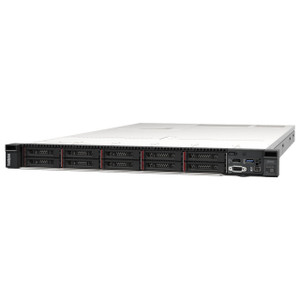
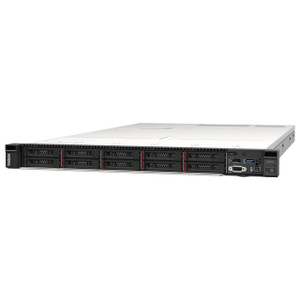
Lenovo 4XG7A63582 AMD EPYC 7713P 64-Core Processor Upgrade for ThinkSystem SR645
Overview
The Lenovo 4XG7A63582 is a factory-new AMD EPYC 7713P processor option for the ThinkSystem SR645 platform — a single-socket, 64-core part that brings serious parallel throughput to workloads that demand it: large-scale video analytics, AI inference, virtualized VMS hosts, and high-density compute clusters. With 64 physical cores (128 threads), a 2 GHz base clock that turbos to 3.675 GHz, and 256 MB of L3 cache on a single die, this is a processor you spec when the workload is thread-heavy and you cannot split it across two sockets. It seats in the Socket SP3 on the SR645 motherboard — verify your server's supported processor compatibility matrix before ordering, as not all SR645 configurations support every EPYC variant.
Key Features
- 64 Cores / 128 Threads (AMD EPYC 7713P): Running 128 concurrent threads on a single socket means a virtualized VMS host can allocate dedicated vCPUs to dozens of simultaneous analytics streams or recording channels without contention. For AI-based video analytics at the edge or in a datacenter rack, thread count directly limits how many inference pipelines you can run in parallel.
- 2 GHz Base / 3.675 GHz Boost: The base clock handles sustained parallel throughput; the boost frequency kicks in on lightly threaded bursts — transcoding, query spikes, alarm-triggered recording escalations. The gap between base and boost (1.675 GHz) is meaningful for workloads that mix batch processing with latency-sensitive tasks.
- 256 MB L3 Cache (Single Die): This is one of the largest L3 caches in the EPYC Milan generation. For database-backed VMS platforms or video analytics frameworks that keep working datasets hot, a larger L3 reduces trips to main memory — which matters at high channel counts when every millisecond of metadata latency compounds.
- Octa-Channel DDR4-3200 Memory Support: Eight memory channels running at 3200 MHz gives the SR645 substantial memory bandwidth — critical when streaming video data from many cameras simultaneously into DRAM before processing or writing to storage. Configure your DIMMs symmetrically across all eight channels to fully exploit this bandwidth.
- Socket SP3 Platform: SP3 is the AMD server socket for the EPYC 7002/7003 generation. It is a mature, well-supported platform with broad OS, hypervisor, and driver compatibility. Lenovo's firmware and BIOS for the SR645 are tuned for this socket family, so you are not running a generic board with an aftermarket CPU — the integration is platform-specific.
- 225 W TDP / 240 W Configurable TDP-Up: At 225 W base TDP, this processor draws significant power. Plan your rack PDU allocation and cooling accordingly — the SR645 chassis must be configured with a cooling solution rated for this TDP class. The configurable 240 W TDP-up mode exists for environments that need to extract every cycle, but only enable it if your thermal headroom and power budget support it. A cooler is NOT included with this part number; verify the SR645's installed cooling module is rated for this TDP before deploying.
- 64-Bit Operating Mode: Full 64-bit instruction set with support for modern virtualization extensions. This enables large memory address spaces (important when running multiple VMs or containers), hardware-assisted virtualization for hypervisor deployments, and compatibility with all current server operating systems and security features.
- Single-Socket Design (7713P Suffix): The 'P' suffix in EPYC 7713P designates a single-socket optimized part. If you are building a dual-socket SR645 configuration, this is not the right processor — dual-socket builds require the non-P variant. Confirm your chassis and motherboard configuration before ordering.
Integration and Compatibility
The 4XG7A63582 is designed for the Lenovo ThinkSystem SR645 server platform. Before integrating, confirm the following: the SR645's BIOS/UEFI firmware is at the minimum version required to support the EPYC 7713P (Lenovo publishes a supported processor matrix per firmware revision); the installed memory DIMMs are DDR4-3200 compatible and populated in a configuration that enables octa-channel operation; and the chassis cooling solution is rated for at least 225 W processor TDP. This processor is a component-level part — it ships as a CPU only and requires professional installation. If you are deploying the SR645 in a network video recorder or server and storage role within a physical security infrastructure, pair the platform with appropriate IP cameras and a VMS that can utilize the high core count for analytics offload. For environments running large-scale video analytics or AI inference, the EPYC 7713P's thread density is a meaningful architectural advantage over lower-core-count alternatives in the Lenovo server lineup. Buyers evaluating processor upgrades for compute-intensive surveillance workloads should also review server selection guidance to confirm platform fit before committing to a specific CPU option.
Frequently Asked Questions
Q: Is the Lenovo 4XG7A63582 compatible with all ThinkSystem SR645 configurations?
A: The 4XG7A63582 (EPYC 7713P) is designed for the ThinkSystem SR645 platform, but compatibility depends on the installed BIOS/UEFI firmware revision. Lenovo publishes a processor compatibility matrix per SR645 firmware version. Verify your firmware level supports the EPYC 7713P before ordering.
Q: Does the 4XG7A63582 include a heatsink or cooler?
A: No. This part does not include a cooler. The EPYC 7713P has a 225 W TDP (240 W configurable TDP-up). You must verify that the ThinkSystem SR645 chassis is equipped with a cooling module rated for this thermal envelope before installation.
Q: Is this a single-socket or dual-socket processor?
A: The EPYC 7713P is a single-socket optimized part — the 'P' suffix designates single-socket use. If you are configuring a dual-socket SR645, you need the non-P EPYC 7713 variant instead.
Q: What memory does the EPYC 7713P support?
A: The processor supports DDR4-SDRAM at up to 3200 MHz across eight memory channels (octa-channel). To maximize memory bandwidth, populate DIMMs symmetrically across all eight channels in configurations supported by the SR645's memory topology.
Q: What is the core and thread count of the 4XG7A63582?
A: The EPYC 7713P delivers 64 physical cores and 128 threads, with a 2 GHz base frequency boosting to 3.675 GHz, and 256 MB of L3 cache.
When I evaluate the 4XG7A63582 for a surveillance infrastructure build, the number that stands out immediately is 256 MB of L3 cache on a single 64-core die — that is a significant working-set advantage for analytics-heavy VMS deployments where you are keeping frame buffers, model weights, and metadata indexes hot. This is not a processor I would spec for a simple recording-only NVR; it is what you reach for when the SR645 is doing real work: running AI video analytics pipelines, hosting multiple VMS server instances under a hypervisor, or acting as a high-density compute node in a converged physical security and IT infrastructure.
Technical Highlights:
- 64 Cores / 128 Threads at 2–3.675 GHz: Enough parallel execution capacity to handle dozens of simultaneous deep-learning inference streams without CPU contention — the base-to-boost spread also handles the bursty nature of alarm-triggered processing without throttling sustained workloads.
- 256 MB L3 Cache: At this cache size, a well-tuned analytics framework can keep its most frequently accessed model data resident, reducing latency on inference decisions and improving throughput per watt compared to lower-cache EPYC variants.
- Octa-Channel DDR4-3200: Eight memory channels at 3200 MHz gives the platform the bandwidth headroom to stream high-bitrate video from a large camera count into processing pipelines without memory becoming the bottleneck before the CPU is.
Deployment Considerations:
- The 225 W / 240 W TDP-up envelope is real — budget your rack cooling and PDU capacity before deploying. An SR645 slot running this processor at TDP-up under sustained analytics load will draw meaningfully more power than a lower-core-count configuration; thermal planning is not optional.
- No cooler is included. This is a CPU-only part. Confirm the SR645's installed heatsink/fan module is rated for the 7713P's TDP class before attempting installation — using an undersized cooler will trigger thermal throttling and can damage the platform.
For a converged video analytics and recording server — one SR645 node handling AI-based object detection, VMS recording, and metadata indexing simultaneously — the EPYC 7713P's core density and cache size make it the right processor tier to spec rather than stepping down to a 32- or 48-core option that will hit CPU limits before the platform's storage or network does.