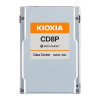
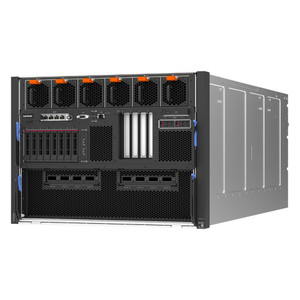
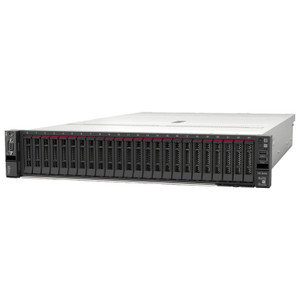
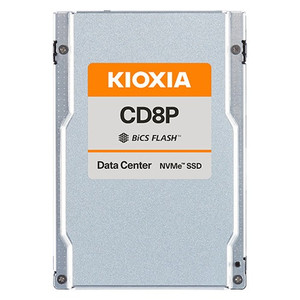
Lenovo 4XB7A93483 ThinkSystem 2.5-Inch NVMe PCIe 5.0 Read-Intensive SSD
Overview
The Lenovo 4XB7A93483 is a 15.36TB 2.5-inch U.2 NVMe SSD engineered for ThinkSystem servers running read-dominated workloads — database query offload, analytics platforms, AI inference serving, and large-scale video surveillance storage tiers where retrieval speed matters more than write throughput. Built on PCIe 5.0 x4 with TLC NAND, the CD8P series delivers sequential read bandwidth that saturates the host interface: 12,000 MB/s reads against 5,500 MB/s writes, with random read IOPS reaching 2,000,000 — roughly 10x what you'd see from a mid-range PCIe 4.0 drive. If your storage architect has been waiting for a single 2.5-inch form factor to replace multiple smaller drives in a hot-swap bay, this is the density tier that makes that consolidation viable.
Key Features
- 15.36TB in a 2.5-inch Hot-Swap Bay: At this capacity in a U.2 2.5-inch package, you can populate a 24-bay ThinkSystem chassis with over 360TB of raw flash storage — no additional enclosures, no SAS expanders, no extra cabling runs. Hot-swap support means a failed drive is swapped without a maintenance window, keeping uptime intact in production environments.
- PCIe 5.0 x4 Interface — 12,000 MB/s Sequential Read: PCIe 5.0 doubles the per-lane bandwidth versus Gen 4, which means sequential read peaks at 12 GB/s. For workloads like large dataset scans, model checkpoint loading, or reading high-bitrate surveillance footage at scale, that bandwidth ceiling matters — you're no longer waiting on storage when CPU and memory are ready.
- 2,000,000 Random Read IOPS at 4KB: Two million IOPS on random 4KB reads directly translates to lower query latency on OLTP databases and faster object retrieval in unstructured storage. Read latency is specified at up to 69 µs — low enough that storage stops being the bottleneck in most read-heavy application stacks.
- 200,000 Random Write IOPS / 5,500 MB/s Sequential Write: Write performance is intentionally asymmetric on a read-intensive drive — the TLC NAND and firmware are tuned for read endurance and throughput. For write-heavy workloads like log ingestion or transactional databases with balanced read/write ratios, evaluate a mixed-use variant instead. For RI-designated workloads, these write specs are more than sufficient: 5,500 MB/s sequential handles bulk ingest, and 200,000 write IOPS handles concurrent small writes without queuing.
- TCG Opal 2.0 Hardware Encryption: Data-at-rest encryption is handled in the drive controller, not the CPU — there's no performance penalty for enabling it. Opal 2.0 compliance means the drive works with enterprise key management systems and satisfies data security requirements for regulated environments (healthcare, finance, government) without any application-layer changes. Hardware encryption also means a cryptographic erase (drive decommission) is instantaneous rather than requiring a full overwrite cycle.
- TLC NAND with RI Endurance Profile: TLC NAND at read-intensive workload ratings delivers the right balance of cost-per-TB and endurance for archives, analytics cold paths, and surveillance retention pools. Lenovo's firmware on the CD8P series optimizes read amplification and garbage collection for this pattern — sustained throughput under RI workloads holds closer to the rated spec than a general-purpose drive running the same pattern.
- S.M.A.R.T. Monitoring Support: Full S.M.A.R.T. attribute reporting integrates with ThinkSystem's XClarity Administrator and most third-party storage management platforms. Wear-leveling indicators, reallocated sector counts, and media error rates surface in the management console before a failure occurs — giving your operations team actionable warning rather than a surprise replacement event.
- 10 µs Write Latency: The asymmetric latency profile — 69 µs read, 10 µs write — reflects the CD8P's optimization for write-commit speed in read-intensive workloads. When applications write metadata, index updates, or small transactional records alongside large read operations, the sub-10 µs write path keeps those operations from introducing tail latency.
Integration and Compatibility
The 4XB7A93483 is a ThinkSystem-series component sourced for Lenovo server platforms. U.2 (SFF-8639) connector form factor is standard across ThinkSystem 2.5-inch hot-swap bays that support NVMe. PCIe 5.0 x4 requires a host that provides Gen 5 lanes to the U.2 backplane — verify your ThinkSystem model's NVMe bay specification before ordering; some chassis support both PCIe 4.0 and 5.0 bays but not interchangeably on all slot positions. NVMe protocol support is native; no additional drivers are required on current Linux kernels (5.15+) or Windows Server 2019/2022. For VMware ESXi deployments, confirm the Lenovo hardware compatibility matrix for your specific ESXi version and ThinkSystem platform to ensure the CD8P drive is on the supported device list for your configuration.
TCG Opal 2.0 encryption pairs with ISV key management tools including those integrated into XClarity Administrator. If your security policy mandates self-encrypting drive (SED) management, the drive ships ready — activation requires only policy configuration in your key management platform, not firmware changes.
Frequently Asked Questions
Q: What interface does the Lenovo 4XB7A93483 use?
A: The 4XB7A93483 uses a PCIe 5.0 x4 NVMe interface via a U.2 (SFF-8639) 2.5-inch connector. It requires a ThinkSystem server chassis with PCIe Gen 5 NVMe U.2 hot-swap bays.
Q: Is the 4XB7A93483 compatible with PCIe 4.0 servers?
A: PCIe is backward-compatible at the electrical level, but PCIe 5.0 drives in Gen 4 slots will operate at Gen 4 speeds — you will not achieve the rated 12,000 MB/s sequential read or 2,000,000 IOPS. Verify your ThinkSystem platform's NVMe bay generation before ordering if full Gen 5 performance is required.
Q: Does the 4XB7A93483 support hardware encryption?
A: Yes. The drive implements TCG Opal 2.0 self-encrypting drive (SED) functionality. Encryption is handled in the drive controller with no CPU overhead. It supports cryptographic erase for fast, secure decommissioning.
Q: What NAND type does the 4XB7A93483 use, and is it appropriate for 24/7 surveillance storage?
A: The drive uses TLC NAND with a read-intensive (RI) endurance profile. It is well-suited for surveillance video retention — a predominantly read workload after initial write — but verify the drive's TBW rating against your specific write volume per the Lenovo product specification sheet for your deployment's endurance planning.
Q: Does the 4XB7A93483 support hot-swap replacement?
A: Yes. The drive is designed for hot-swap in compatible ThinkSystem chassis, allowing replacement of a failed unit without powering down the server or interrupting other drives in the array.
Q: What is the random read IOPS of the 4XB7A93483?
A: The drive is rated for 2,000,000 random read IOPS at 4KB block size, with a read latency of up to 69 µs. Random write IOPS is rated at 200,000 at 4KB.
The spec that stands out on the 4XB7A93483 is the sequential read ceiling: 12,000 MB/s over PCIe 5.0 x4. At that bandwidth, a single drive can saturate what most Gen 4 NVMe arrays needed two or three drives to achieve — and at 15.36TB in a standard 2.5-inch hot-swap U.2 package, you are consolidating serious storage density into a form factor that fits existing ThinkSystem infrastructure without a chassis refresh.
Technical Highlights:
- 2,000,000 Random Read IOPS: At 4KB block size and 69 µs read latency, this drive removes storage as the bottleneck in analytics and AI inference workloads. OLTP read paths, object retrieval, and large-scale index scans all benefit directly from this IOPS headroom.
- TCG Opal 2.0 Hardware Encryption: Zero CPU overhead for AES encryption means you can enforce data-at-rest security on every drive in the array without touching application performance budgets. Cryptographic erase also simplifies drive decommissioning in environments with data disposal compliance requirements.
- 10 µs Write Latency: The asymmetric profile — 10 µs writes versus 69 µs reads — is intentional on a read-intensive drive. Small write operations (index updates, metadata commits) complete fast enough that they do not introduce tail latency into read-dominated application stacks.
Deployment Considerations:
- PCIe 5.0 x4 requires host-side Gen 5 lane support at the U.2 backplane. Confirm your ThinkSystem model's NVMe bay specification — not all 2.5-inch hot-swap bays in current ThinkSystem platforms are Gen 5 capable, and a Gen 4 slot will cap sequential throughput well below the rated 12,000 MB/s.
- TLC NAND at read-intensive endurance ratings is optimized for workloads where writes are a minority of total I/O. If your workload shifts toward mixed or write-heavy patterns — log aggregation, write-through caching — evaluate the TBW spec carefully against your projected daily write volume to avoid premature endurance exhaustion.
This drive is the right fit for ThinkSystem-based AI inference servers and large-scale surveillance retention nodes where read bandwidth and capacity density are the primary sizing constraints and the workload is predominantly read after initial ingest.