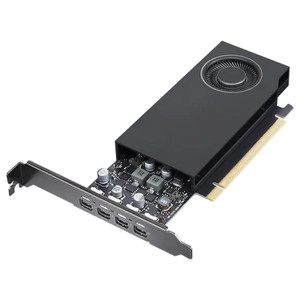
Lenovo 4X61Q50293 RTX 4000 Ada SFF Professional GPU
Overview
The Lenovo 4X61Q50293 is a small-form-factor professional graphics card built around the NVIDIA RTX 4000 Ada Generation GPU, carrying 20 GB of GDDR6 memory across a 160-bit bus. Designed to slide into SFF workstation chassis where space is a hard constraint, it delivers workstation-class compute headroom — 6,144 CUDA cores, 280 GB/s peak memory bandwidth, and a maximum display resolution of 7680 × 4320 — while drawing no more than 70 W from the system. If you're provisioning compact workstations for CAD operators, video analysts, or multi-display security review stations, this card gets professional-grade GPU compute into a chassis profile that standard full-height cards can't reach.
Key Features
- 20 GB GDDR6 over a 160-bit bus: 20 gigabytes of frame buffer is the practical differentiator here. Large scene files, simultaneous multi-stream video decoding, and GPU-accelerated analytics workloads that routinely exhaust 8–16 GB cards will run without the out-of-memory interruptions that force workflow restarts. At 280 GB/s sustained bandwidth, the memory subsystem keeps the 6,144 CUDA cores fed — you won't be memory-starved mid-task.
- 6,144 CUDA cores (RTX 4000 Ada architecture): The Ada Lovelace generation's CUDA core count translates directly into parallel throughput for rendering, AI inferencing, and compute shaders. For multi-camera analytics workloads or visualization pipelines running GPU-accelerated decoders, a larger core count means more simultaneous operations before the GPU becomes the bottleneck.
- Four Mini DisplayPort outputs (8K support): Four Mini DisplayPort connections in a single-slot SFF form factor is a meaningful layout advantage for operators who need a wide display array. The card supports resolutions up to 7680 × 4320, meaning you can drive a single 8K monitor for forensic-level image review, or spread four independent feeds across a control-room array — all from one card, one slot.
- 70 W maximum TDP with PCIe x16 4.0 interface: At 70 W max draw (minimum system PSU 160 W), this card fits cleanly into SFF system power budgets that full-height pro cards blow past. PCIe 4.0 x16 doubles the interface bandwidth versus Gen 3 — useful when streaming high-bitrate data between system RAM and GPU memory under sustained workloads.
- Active cooling, single fan: Active cooling maintains sustained performance under continuous workloads without relying on chassis airflow alone. For rack-adjacent SFF workstations with limited internal airflow, the onboard fan means you're not dependent on case cooling to prevent thermal throttling during extended GPU sessions.
- SFF form factor: The small-form-factor physical envelope fits Lenovo SFF workstation chassis directly — no bracket swaps, no riser card complications. For deployments in tight operator consoles, under-desk mounts, or space-constrained control rooms, this is the practical path to getting RTX 4000 Ada compute without replatforming to a tower.
- Broad regulatory certifications: The 4X61Q50293 carries UL, FCC, CE, CB, BSMI, KC, VCCI, UKCA, RCM, Ukraine DOC, and Morocco DOC certifications — covering the major markets across North America, Europe, and Asia-Pacific. For enterprise IT procurement teams managing multi-region deployments, pre-cleared regulatory status removes a sourcing variable.
Integration and Compatibility
The card interfaces via PCI Express x16 Gen 4.0, compatible with any workstation motherboard or SFF system offering a Gen 4 (or Gen 3, backward-compatible) x16 slot. The four Mini DisplayPort outputs support direct connection to DisplayPort monitors or via passive adapters to other display standards. As an NVIDIA RTX platform, the card is compatible with CUDA-based software stacks, NVIDIA's professional driver branch, and GPU-compute frameworks used in video analytics, simulation, and visualization software. The 160 W minimum system PSU requirement should be confirmed against the SFF chassis spec before deployment — most current Lenovo SFF systems at this tier ship with adequate PSUs, but it's worth a spec-check on older chassis. TV tuner functionality is not integrated; this is a pure compute and display card.
Frequently Asked Questions
Q: What is the maximum display resolution supported by the Lenovo 4X61Q50293?
A: The RTX 4000 Ada supports a maximum resolution of 7680 × 4320 (8K). All four Mini DisplayPort outputs are active simultaneously, so you can drive up to four independent displays from a single card.
Q: How much power does the 4X61Q50293 draw, and what PSU does the system need?
A: The card draws a maximum of 70 W. Lenovo specifies a minimum system power supply of 160 W. Confirm the host SFF chassis PSU rating before installation.
Q: Does the 4X61Q50293 support parallel processing or multi-GPU configurations?
A: According to the product specifications, parallel processing technology (NVLink/SLI) is not supported on this card. It operates as a standalone GPU.
Q: What PCIe slot does the 4X61Q50293 require?
A: The card uses a PCI Express x16 Gen 4.0 interface. It is backward-compatible with Gen 3 x16 slots, though at reduced interface bandwidth.
Q: What certifications does the 4X61Q50293 carry?
A: The card is certified for UL, FCC, CE, CB, BSMI, KC, VCCI, UKCA, RCM, Ukraine DOC, and Morocco DOC — covering North American, European, and major Asia-Pacific markets.
Q: Is the 4X61Q50293 a full-height or low-profile card?
A: This is a small-form-factor (SFF) GPU designed for compact SFF workstation chassis. Verify mechanical compatibility with your specific chassis before ordering.
The spec that defines the 4X61Q50293's deployment fit is the combination of 20 GB GDDR6 at 280 GB/s inside a small-form-factor envelope drawing 70 W max. That's a workstation-class memory configuration in a chassis footprint that most 20 GB pro cards won't physically enter — and the low TDP means it's viable in SFF systems without requiring a PSU upgrade in most current Lenovo chassis.
Technical Highlights:
- 20 GB GDDR6 / 160-bit bus: 280 GB/s peak bandwidth keeps 6,144 Ada CUDA cores fed under sustained parallel workloads — large texture sets, multi-stream video decode, or GPU-accelerated compute that exhausts smaller frame buffers won't force a workflow pause here.
- Four Mini DisplayPort outputs: Drive up to four independent displays at up to 7680 × 4320 from a single SFF slot — operationally significant for control room layouts or forensic review stations where screen count matters as much as GPU compute.
- 70 W TDP, PCIe 4.0 x16: 70 W max draw against a 160 W minimum PSU requirement is manageable in current SFF workstation builds. PCIe Gen 4 doubles the interface ceiling versus Gen 3, which matters when streaming high-bitrate frame data between host RAM and the GPU continuously.
Deployment Considerations:
- Confirm mechanical SFF compatibility against your specific chassis model before ordering — SFF GPU clearance specs vary even within the Lenovo ThinkStation SFF line, and a physical fit assumption is the most common install failure point.
- Parallel processing (NVLink/SLI) is not supported; if the workload requires multi-GPU scaling, this card is not the right platform — plan for a single-GPU architecture or evaluate a different product line entirely.
This card is the right call for compact operator workstations in security operations centers or video analytics nodes where you need RTX 4000 Ada compute and a four-display layout but the chassis rules out full-height GPU options — the SFF form factor and 70 W ceiling are the deciding factors, not the GPU tier.