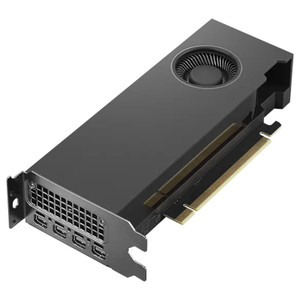
Lenovo 4X61Q73041 NVIDIA RTX A1000 8GB Workstation GPU
Overview
The Lenovo 4X61Q73041 is a professional-grade discrete graphics card built around the NVIDIA RTX A1000 GPU, fitted with 8GB of GDDR6 memory and designed for dense workstation and edge-compute deployments where reliable multi-display output, hardware-accelerated rendering, and AI inference throughput matter more than gaming headroom. At 0.62 lb and 9.50 x 5.70 x 2.20 inches, this card fits single-slot form factors and is sourced as a genuine Lenovo OEM component — factory-new, no grey-market, no parallel imports.
With 2304 CUDA cores and a 128-bit GDDR6 memory bus delivering up to 192 GB/s of memory bandwidth, the 4X61Q73041 handles compute-heavy workloads — video transcoding, AI-assisted analytics, CAD visualization, and multi-stream surveillance decoding — without the power and thermal overhead of consumer-tier alternatives. If your deployment sits at the intersection of professional graphics and edge AI, this card is worth a close look.
Key Features
- 8GB GDDR6 with 192 GB/s Memory Bandwidth: Moving 192 gigabytes per second between the GPU and frame buffer means large model weights and high-resolution texture assets don't stall the pipeline. For multi-stream video analytics or 4K workstation rendering, this bandwidth prevents the throughput cliff you hit when VRAM saturates on lower-tier cards.
- 2304 CUDA Cores — RTX A1000 Architecture: The NVIDIA RTX A1000 brings Tensor and RT cores alongside general CUDA compute. Tensor cores accelerate AI inference workloads (object detection, classification pipelines) without requiring a separate co-processor. This matters in edge deployments where you want GPU-accelerated analytics without racking a separate AI appliance.
- 128-bit Memory Bus: A 128-bit bus paired with GDDR6 is the practical sweet spot for professional single-GPU cards — wide enough to sustain throughput under concurrent workloads, narrow enough to keep thermal design compact. If your workload requires pushing multi-GPU NVLink bandwidth, this is not that card — but for single-slot professional compute it holds up.
- PCIe x8 4.0 Interface: PCIe 4.0 doubles the per-lane bandwidth of PCIe 3.0. At x8 lanes, you get 16 GB/s of host-to-GPU transfer — enough to avoid CPU-GPU data transfer bottlenecks in real-time analytics and streaming pipelines. Verify your host system exposes PCIe 4.0 x8 slots; PCIe 3.0 hosts will work at reduced bandwidth.
- 4x Mini DisplayPort 1.4a — Up to 7680x4320 Resolution: Four independent Mini-DP 1.4a outputs let you drive four monitors simultaneously, each capable of 8K (7680x4320) resolution. For video wall control rooms, multi-display operations centers, or workstations running parallel analytic dashboards, four outputs from a single low-profile card eliminates the need for additional display hardware.
- DirectX 12.0 / OpenGL 4.6 / Shader Model 6.6: Full DirectX 12 Ultimate feature support and OpenGL 4.6 mean compatibility with both modern real-time rendering pipelines and legacy professional visualization software. Shader Model 6.6 specifically enables mesh shaders and sampler feedback — relevant for simulation and CAD workflows running on modern engines.
- CUDA Support with NVIDIA Graphics Processor Family: CUDA support unlocks GPU-accelerated libraries across the NVIDIA ecosystem — cuDNN, TensorRT, RAPIDS, and vendor SDKs from major VMS and AI analytics platforms. This is the foundational requirement for deploying GPU-accelerated inference at the edge without rewriting inference pipelines.
- No TV Tuner, No Dual-Link DVI: This is a clean professional card without legacy analog outputs. If any display in your deployment requires DVI-DL, plan for an active Mini-DP-to-DVI adapter — passive adapters will not work at high resolutions.
Integration and Compatibility
The 4X61Q73041 connects via PCI Express x8 4.0, making it compatible with any PCIe 4.0 or 3.0 x8 or x16 slot (operating at the slot's native generation if below 4.0). The four Mini DisplayPort 1.4a outputs support DisplayPort Multi-Stream Transport (MST) for daisy-chaining compatible monitors. CUDA support means this card integrates with NVIDIA-accelerated software stacks used in AI-driven network video recorders and edge analytics servers. For enterprise deployments building out AI-compute or visualization infrastructure, pairing this with compatible enterprise networking and server hardware ensures the GPU isn't bottlenecked at the host bus or storage layer.
This Lenovo OEM variant is intended for integration into Lenovo workstation and server platforms. Verify slot clearance and PCIe power connector requirements against your specific chassis before ordering — at 9.50 inches in length and 2.20 inches in height, physical fit should be confirmed in rackmount or compact workstation enclosures. Explore the broader Lenovo compute catalog for compatible host platforms and workstation accessories. If your use case requires higher VRAM headroom for large model inference or 3D visualization datasets, consider a higher-memory variant in the same RTX A-series professional family.
When to Choose a Different Model
If your deployment runs large generative AI models or complex simulation datasets that exceed 8GB VRAM, you will hit memory limits under sustained load — a higher-memory variant in the RTX A-series line will serve better. For deployments requiring ECC memory for mission-critical compute (scientific workloads, financial modeling), confirm whether ECC is available and enabled on this SKU before committing. If your host only has PCIe 3.0 slots, the card will operate but at reduced host-to-GPU bandwidth — evaluate whether your pipeline is bandwidth-sensitive before assuming 3.0 is sufficient. For pure multi-display signage with no compute requirement, a lower-cost display card frees budget for other infrastructure.
Frequently Asked Questions
Q: What PCIe slot does the Lenovo 4X61Q73041 require?
A: The 4X61Q73041 uses a PCI Express x8 4.0 interface. It will seat in any PCIe x8 or x16 slot and operate at the slot's native generation — PCIe 4.0 for full bandwidth, PCIe 3.0 at reduced bandwidth. Confirm your chassis provides a physical x8 or wider slot.
Q: How many monitors can the 4X61Q73041 drive simultaneously?
A: Four monitors, each via a Mini DisplayPort 1.4a output. Maximum resolution per output is 7680x4320 (8K). All four outputs can operate simultaneously.
Q: What is the memory configuration on the 4X61Q73041?
A: 8GB of GDDR6 on a 128-bit memory bus, delivering up to 192 GB/s of memory bandwidth. This is a discrete graphics card — the VRAM is dedicated and not shared with system RAM.
Q: Does the 4X61Q73041 support CUDA for AI and compute workloads?
A: Yes. The RTX A1000 GPU includes CUDA cores (2304 total) and supports NVIDIA's CUDA platform, enabling GPU-accelerated AI inference, video transcoding, and compute pipelines using NVIDIA software stacks such as TensorRT and cuDNN.
Q: What display connector type does the 4X61Q73041 use?
A: Four Mini DisplayPort 1.4a connectors. There is no DVI or HDMI output on this card. Mini-DP to DisplayPort, HDMI, or DVI adapters can be used — confirm adapter type requirements for your specific monitors.
Q: What are the physical dimensions and weight of the 4X61Q73041?
A: 9.50 x 5.70 x 2.20 inches (L x W x H), weighing 0.62 lb. Verify clearance in your target chassis before ordering, particularly in compact or rackmount workstation enclosures.
The Lenovo 4X61Q73041 is a card I recommend specifically for edge AI and multi-display analytics deployments where you need CUDA acceleration and four independent outputs from a single low-profile slot. The 192 GB/s memory bandwidth on 8GB GDDR6 is the spec that actually moves the needle for multi-stream video decode pipelines — it's the difference between smooth concurrent stream processing and frame-drop under load.
Technical Highlights:
- 192 GB/s Memory Bandwidth: At 128-bit bus width with GDDR6, sustained throughput holds up under concurrent inference and display workloads — critical when this card is handling both AI analytics decode and live multi-monitor output simultaneously.
- 2304 CUDA Cores (RTX A1000): Enough parallel compute for real-time TensorRT inference on medium-complexity detection models without needing a dedicated AI accelerator — reduces rack footprint and power draw in edge server builds.
- 4x Mini DisplayPort 1.4a at up to 8K: Four simultaneous outputs from one card simplifies cabling in video wall and operations-center builds. DisplayPort 1.4a's DSC (Display Stream Compression) support also matters for driving high-resolution panels over longer cable runs.
Deployment Considerations:
- Confirm PCIe 4.0 x8 slot availability in your target platform — PCIe 3.0 systems will run this card at half the host-to-GPU bandwidth, which can become a bottleneck in high-throughput inference pipelines feeding large frame buffers.
- At 9.50 inches long, measure physical clearance in any compact or rackmount chassis before committing — this is not a half-height card and will not fit short-depth workstation enclosures without verification.
This card is the right fit for a workstation or edge server that anchors a multi-camera AI analytics node — think four-display SOC workstation with GPU-accelerated VMS decoding and on-card inference, where you want a single professional GPU handling both compute and display without splitting the workload across two cards.