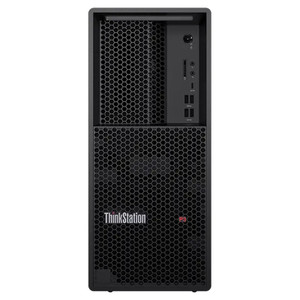
Lenovo 30HT004MUS ThinkStation P3 Tower Gen 2 Workstation
Overview
The Lenovo ThinkStation P3 Tower Gen 2 (30HT004MUS) is a professional workstation built around Intel's Core Ultra 9 285 vPro processor — a 24-core design with E-cores clocking up to 4.60GHz — paired with 64GB of DDR5-5600 RAM, a 1TB PCIe Gen 5 NVMe SSD, and an NVIDIA RTX 2000 Ada Generation GPU with 16GB of GDDR6 onboard. This is the configuration you reach for when your deployment involves GPU-accelerated analytics, real-time video processing, or high-channel-count VMS server workloads that have outgrown shared rack servers. The tower form factor keeps the system accessible for field expansion without pulling a server from a rack.
For security integrators running network video recorders or VMS software on-premises, the P3 Tower Gen 2 sits at the intersection of enough CPU headroom to decode dozens of high-resolution streams and enough GPU VRAM to run AI inferencing tasks in parallel — without the operational complexity of a full server deployment. If you're evaluating Lenovo workstations for surveillance or command-center roles, this configuration is near the top of what the P3 Tower family offers in a single-socket package.
Key Features
- Intel Core Ultra 9 285 vPro, 24 cores / 24 threads, E-cores to 4.60GHz: The 24-core layout — all efficiency cores in this architecture — gives you dense parallel throughput for multi-stream video decoding and analytics pipelines. vPro support means Intel AMT remote management is available, which matters if this unit is deployed in a back-office or network closet where physical access is inconvenient. The 36MB cache reduces memory round-trips during high-concurrency workloads.
- 64GB DDR5-5600 in 2×32GB config, 4 slots total (up to 256GB): DDR5-5600 delivers roughly 70–80% more bandwidth than DDR4-3200 — meaningful when a VMS is pulling frame buffers from many cameras simultaneously. The 2×32GB population leaves two slots open, so you can scale to 128GB or 256GB without replacing existing modules. That upgrade path matters if your channel count grows after initial deployment.
- 1TB PCIe Gen 5 NVMe SSD (M.2 2280, TLC Opal): Gen 5 NVMe roughly doubles sequential throughput vs. Gen 4 — real-world reads in the 10–12 GB/s range. For a VMS server writing continuous streams from high-resolution cameras, fast storage directly affects how many cameras you can sustain without dropped frames. The Opal self-encrypting drive (SED) capability means you can enforce hardware-level encryption on recorded footage without CPU overhead.
- NVIDIA RTX 2000 Ada Generation, 16GB GDDR6: The Ada Lovelace architecture adds dedicated tensor cores and updated NVENC/NVDEC blocks — the hardware video encode/decode engines. That means the GPU can handle H.265/H.264 transcoding tasks off the CPU entirely, keeping processor headroom available for analytics or additional stream processing. 16GB of GDDR6 is enough to run multiple AI inferencing models concurrently without swapping to system RAM.
- Intel BE200 Wi-Fi 7 + Bluetooth (vPro): Wi-Fi 7 (802.11be) is included for environments where a wired LAN drop isn't practical during staging or temporary deployments. In a fixed security operations center, you'd typically wire this to a managed switch; the wireless card is useful during configuration and commissioning phases.
- Slim DVD±RW (RAMBO): Optical media is rarely a primary workflow, but in regulated environments — government facilities, healthcare, some financial deployments — DVD-based audit exports and software installs from physical media remain an operational requirement. Having it built in avoids an external USB drive on a rack shelf.
- Tower form factor, 9 lb, PCIe / USB / Ethernet interfaces: At 9 lb the P3 Tower is desk- or floor-deployable without rack hardware. PCIe expansion slots allow adding a dedicated capture card, additional GPU, or fiber NIC as the installation scales. USB and Ethernet cover peripheral and network connectivity for cameras on a local segment or PoE switch integration — see PoE switches compatible with your camera infrastructure.
- Windows 11 Pro 64-bit, pre-installed: Ships ready for enterprise domain join, BitLocker, and Group Policy enforcement out of the box. No additional OS licensing needed for a standard Windows-based VMS deployment.
Integration and Compatibility
The 30HT004MUS connects to the network via Ethernet (interface confirmed in structured data) and supports PCIe expansion for capture cards or additional storage controllers. The RTX 2000 Ada's NVENC/NVDEC engines are compatible with GPU-accelerated decoding in major video management software platforms that support NVIDIA hardware acceleration — verify your specific VMS vendor's GPU support matrix before purchasing if GPU decode offload is a firm requirement. The DDR5 SO-DIMM slots (4x DIMM, two populated) follow standard ECC-capable DDR5 specs; consult Lenovo's memory configurator for validated ECC module part numbers if error-correcting memory is required for your environment. The Opal-compliant SSD pairs with Windows BitLocker eDrive for transparent hardware encryption without a performance penalty on storage throughput.
For integrators sizing storage for continuous recording, the 1TB SSD is a boot and application drive in most VMS deployments; add a secondary NVMe or SATA drive for video retention — the PCIe interface on this platform supports additional M.2 or SATA expansion depending on available slots. Pair this with a managed network switch for camera segment isolation.
Frequently Asked Questions
Q: What is the maximum RAM the 30HT004MUS supports?
A: The ThinkStation P3 Tower Gen 2 (30HT004MUS) supports up to 256GB of DDR5-5600 RAM across its four DIMM slots. It ships with 2×32GB (64GB total), leaving two slots available for expansion without removing existing modules.
Q: Does the 30HT004MUS include a dedicated GPU?
A: Yes. It includes an NVIDIA RTX 2000 Ada Generation GPU with 16GB of GDDR6 memory. This GPU includes dedicated NVENC/NVDEC hardware video encode and decode engines, which VMS platforms can use to offload H.265/H.264 transcoding from the CPU.
Q: What storage interface does the SSD use, and is it encrypted?
A: The included 1TB SSD uses a PCIe Gen 5 (NVMe) interface in an M.2 2280 form factor. It is a TLC Opal (self-encrypting) drive, compatible with Windows BitLocker eDrive for hardware-level encryption without CPU overhead.
Q: Is the processor in the 30HT004MUS suitable for multi-camera video analytics?
A: The Intel Core Ultra 9 285 is a 24-core vPro processor with E-cores reaching 4.60GHz and 36MB of cache. Combined with the RTX 2000 Ada GPU for hardware-accelerated decode, this platform handles demanding multi-stream analytics workloads. Actual channel capacity depends on your VMS software, analytics algorithms, and camera resolution.
Q: Does the 30HT004MUS come with Windows pre-installed?
A: Yes. It ships with Windows 11 Pro 64-bit pre-installed, ready for enterprise domain join, BitLocker, and Group Policy configuration.
Q: Can I add more storage to the 30HT004MUS after purchase?
A: The tower form factor provides PCIe expansion and standard SATA bays (verify available slots against Lenovo's P3 Tower Gen 2 chassis documentation). The platform supports additional M.2 NVMe and SATA drives for video retention storage beyond the included 1TB system SSD.
When I spec workstations for on-premises VMS deployments, the 30HT004MUS lands in my shortlist specifically because of the RTX 2000 Ada's 16GB GDDR6 — that's enough VRAM to run parallel AI inferencing models across multiple camera feeds without memory pressure forcing GPU context switches. Pair that with the Intel Core Ultra 9 285's 24 cores at up to 4.60GHz and 36MB cache, and you have a platform that can sustain real decode and analytics workloads that would saturate a typical business-class desktop in minutes.
Technical Highlights:
- PCIe Gen 5 NVMe SSD: Gen 5 sequential read throughput (~10–12 GB/s) means the OS and VMS application load nearly instantly, and continuous write performance won't bottleneck camera stream ingestion at the speeds this GPU can decode them. The Opal SED capability lets you enable hardware encryption in BitLocker eDrive mode — zero throughput penalty, which matters on a recording server.
- DDR5-5600, 4-slot, up to 256GB: The two open DIMM slots are genuinely useful. If you deploy this as a 32-camera server and need to expand analytics memory headroom six months later, you add two modules rather than replacing the system. DDR5-5600 bandwidth supports simultaneous GPU data transfers and CPU processing without the stall patterns you see under DDR4 on older workstation-class platforms.
- Intel vPro + BE200 Wi-Fi 7: vPro's AMT gives you out-of-band remote management — reboot, BIOS access, power control — without depending on the OS being alive. For a machine deployed in a back-office or server room, that's an operational necessity, not a nice-to-have. Wi-Fi 7 is useful during staging and commissioning even if the final install is wired.
Deployment Considerations:
- The 1TB SSD is appropriately sized as an OS/application drive, but you'll need to plan secondary storage for video retention — add a NVMe or SATA drive via available expansion slots. Don't treat the system SSD as your recording volume on a multi-channel deployment.
- The Core Ultra 9 285 is an efficiency-core-only design under Intel's architecture; it delivers strong throughput per watt but lacks the P-core single-thread peaks of hybrid designs. If your VMS or analytics software has components that are heavily single-threaded, benchmark your specific workload before committing this config to a high-channel deployment.
This configuration is the right call for a 16–32 camera on-premises VMS server in a physical security operations center or command room where the machine will double as both the recording engine and the AI analytics host — the RTX 2000 Ada handles the GPU workload, the 24-core CPU handles the OS and software overhead, and the DDR5-5600 keeps both fed without contention.